Former Kosovo President Hashim Thaçi was sentenced to 25 years in prison by the Kosovo Specialist Chambers in The Hague on Wednesday for war crimes, in a long-awaited judgment that is expected to have significant political and public repercussions in Kosovo.
According to French newspaper Le Monde, judges found Thaçi guilty of crimes including arbitrary detention, torture, murder and cruel treatment committed by KLA fighters. Three other former KLA leaders tried alongside him — Kadri Veseli, Jakup Krasniqi and Rexhep Selimi — were also convicted.
Krasniqi was sentenced to 25 years, Veseli to 18 years and Selimi to 13 years. The court found the four defendants criminally responsible for the arbitrary detention and mistreatment of hundreds of people and for 96 murders, while acquitting them of charges of crimes against humanity.
The defendants have remained in detention in The Hague since their indictments in 2020, with time already spent in detention credited toward their sentences.
Large crowds gather in Kosovo
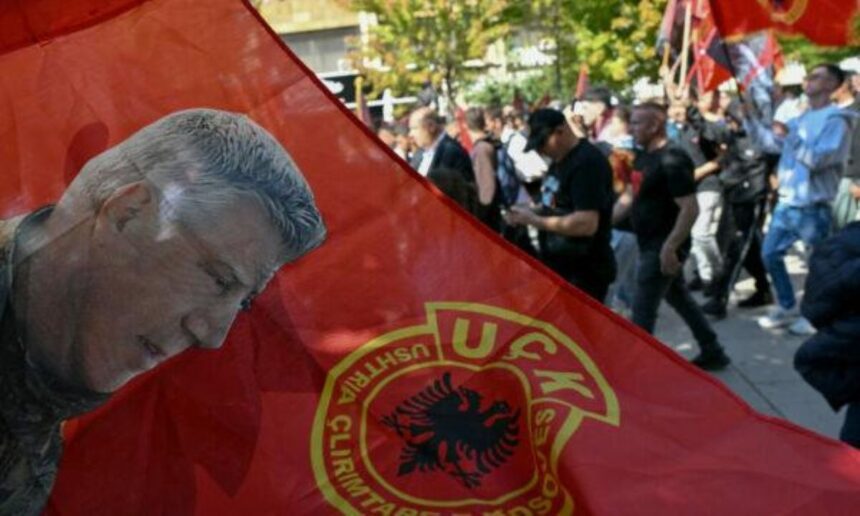
In Prishtina, large crowds gathered to watch the verdict on giant screens in the capital.
Thaçi remains a highly significant political figure in Kosovo, where he and the KLA are widely associated with the country’s struggle for independence. He served as prime minister and later president and played a prominent role in Kosovo’s declaration of independence in 2008.
Following the announcement of the sentence, the crowds in Prishtina reacted with shock, with the central square emptying within minutes after it became clear that Thaçi would remain in detention.
Kosovo Foreign Minister Glauk Konjufca described the judgment as a deeply troubling decision.
“A terrible judgment for Kosovo, for our liberation war,” Konjufca told reporters outside the court, calling it a “sad, unjust and undeserved” decision.
Prime Minister Albin Kurti similarly criticized the sentences, describing the punishment imposed on the four former KLA leaders as an unacceptable injustice.
A controversial court
Le Monde described the Specialist Chambers as a controversial institution that was established under Kosovo law but operates in The Hague with international judges and prosecutors.
The court was created specifically to prosecute alleged crimes committed by members of the KLA during and immediately after the Kosovo war. Previous war-crimes proceedings in Kosovo had faced serious difficulties, including allegations of witness intimidation and political interference.
The Specialist Chambers have remained deeply unpopular among many Kosovars since their creation, and their use of evidence obtained from Serbian institutions has become another source of controversy.
Serbia does not recognize Kosovo’s independence, and the use of evidence originating from Belgrade has fueled criticism from opponents of the court who question whether the proceedings can be fully separated from the political disputes surrounding the Kosovo war.
Prosecutors distinguish KLA’s goals from alleged crimes
Throughout the trial, prosecutors sought to distinguish Kosovo’s struggle for independence from the individual criminal responsibility of the defendants.
They argued that Thaçi, Veseli, Krasniqi and Selimi were responsible for crimes committed against detainees held at KLA detention facilities in Kosovo and neighboring Albania, as well as politically motivated killings of Serb, Albanian and Roma civilians.
The alleged crimes took place during and shortly after the Kosovo war, which resulted in approximately 13,000 deaths.
The defense teams, meanwhile, argued that the KLA did not operate under a rigid command structure and that senior political and military figures could not exercise sufficient control over individual fighters who committed crimes.
The first-instance judgment is subject to appeal, meaning the legal proceedings are not yet final.