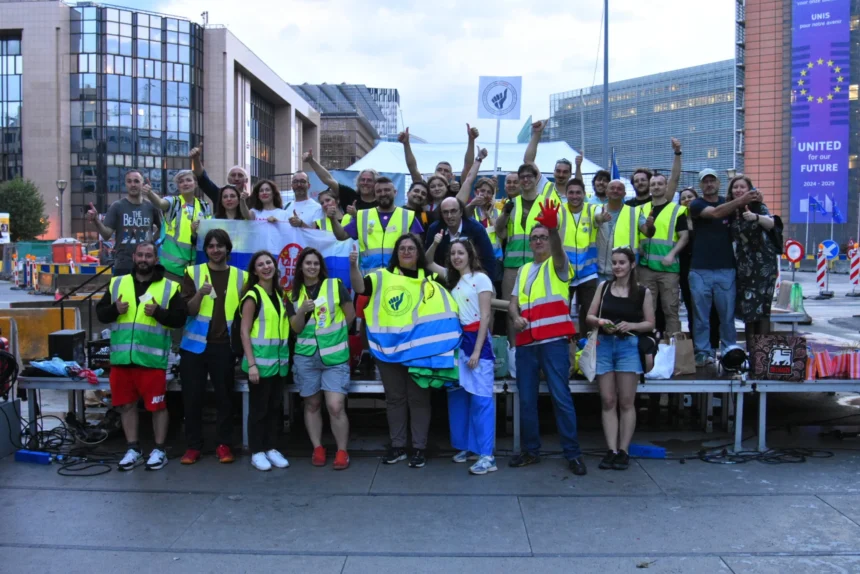
Serbia’s recent election victory by the student-backed Studentska Lista movement has attracted significant international attention, with European leaders, global media outlets and public figures highlighting the potential implications of the political shift. Analysts say the result could give Serbia an opportunity to improve its international image and renew its path towards European Union membership.
In an analysis published by Radar, journalist Vera Didanović examines how the electoral victory has changed international perceptions of Serbia and whether the incoming political leadership can turn that attention into concrete diplomatic and economic gains.
Before the elections, representatives of President Aleksandar Vučić reportedly sought to convince European officials that Studentska Lista was pro-Russian and made up of supporters of Vladimir Putin. According to Euractiv editor Georgi Gotev, this message was conveyed by Serbia’s ambassador to the EU, Danijel Apostolović.
However, the movement’s electoral victory did not trigger the international concerns that Vučić’s representatives had allegedly sought to raise.
On election night, European Commission President Ursula von der Leyen and European Council President António Costa congratulated the winners. The following day, EU Enlargement Commissioner Marta Kos held talks with Studentska Lista representative Ilija Srdanović before receiving a delegation of four representatives of the winning movement.
European officials also expressed readiness to support efforts aimed at improving Serbia’s prospects for EU membership. Andreas von Beckerath, shortly before leaving his position as head of the EU Delegation in Belgrade, said Serbia had everything necessary to become a leading EU candidate country again.
Russia reacted more cautiously, with Kremlin spokesperson Dmitry Peskov expressing expectations that constructive relations between Moscow and Belgrade would continue. Russian media, meanwhile, highlighted potential challenges arising from the ideological diversity within the student movement.
The US Embassy in Belgrade issued its congratulations five days after the election, while several American senators and members of Congress also welcomed the political developments.
Fitch signals potential improvement in Serbia’s credit rating
The political transition has also attracted attention from international financial institutions.
Just three days after the election, credit rating agency Fitch issued an assessment indicating that Serbia’s credit rating could improve if the political transition does not undermine economic growth, macroeconomic stability or external finances.
Fitch noted that progress in strengthening governance and institutions could also support an upgrade of the country’s credit profile.
This assessment contrasts with warnings from Vučić about the potential economic consequences of a change in government.
A new international image for Serbia
Vedran Džihić, a senior adviser at the Austrian Institute for International Affairs, believes the Studentska Lista victory has significantly changed Serbia’s international image.
He noted that Serbia had increasingly been associated with negative political developments in recent years, including Vučić’s governing style, police violence against students and controversies surrounding the legacy of former Bosnian Serb military commander Ratko Mladić.
According to Džihić, Vučić had gradually lost control over the international narrative surrounding Serbia, while attempts to promote a positive image of his government had failed.
During months of protests, Serbia increasingly came to be viewed by international observers as a country experiencing innovative democratic mobilisation, with young people emerging as a source of political change.
Džihić argues that the election result could produce tangible benefits in Serbia’s relations with the EU and among potential investors, particularly if the new authorities successfully address corruption and political patronage networks.
He also believes Serbia could potentially join the European Union by 2030, describing the current political moment as an opportunity to accelerate European integration.
EU accession process could regain momentum
Former Serbian ambassador Branka Latinović says the political transition presents an opportunity that must be used carefully.
She notes that the European Union had remained relatively restrained in its response to developments in Serbia over the previous two years, although some political groups within the European Parliament had expressed support for the student movement.
According to Latinović, Brussels now appears to see an opportunity for a fresh start, particularly given that Serbia has not opened a new negotiating cluster in its EU accession process for five years.
She argues that removing the obstacles that have stalled negotiations will depend largely on the priorities of the incoming government and the work of the new parliament, particularly its parliamentary committees.
Latinović stressed that the current political momentum should not be wasted and that domestic reforms and progress towards EU membership should advance simultaneously.
One possible early benefit of the transition could be the release of EU funds previously frozen under the Western Balkans Growth Plan, Džihić said.
However, he noted that Brussels would closely examine the new government’s domestic reform programme, particularly in the judiciary, as well as its foreign policy orientation and commitment to European integration.
New government’s foreign policy will be closely watched
The composition of the incoming government will be an important indication of Serbia’s future political direction, Latinović said.
She pointed to the appointment of the prime minister and the ministers responsible for foreign affairs and European integration as particularly important signals.
The first foreign visits by the new prime minister and foreign minister will also carry diplomatic significance.
Latinović suggested that the new leadership should consider visiting Zagreb or Sarajevo early in its mandate, given the strained relations Serbia has experienced with neighbouring countries. A subsequent visit to Budapest could also help establish a different foundation for bilateral relations.
Hungarian Prime Minister Péter Magyar has publicly supported the Serbian student movement and welcomed its electoral victory. This has fuelled speculation about closer cooperation between the two countries’ incoming political leaderships, including the possibility of Hungary providing guidance to Serbia during its EU accession process.
Foreign policy differences remain a challenge
Despite the movement’s electoral success, questions remain about its future foreign policy direction, particularly given the ideological diversity of its members.
Džihić argues that the movement’s stated priorities, including an independent judiciary, institutional accountability, transparency, media freedom and the fight against corruption, are closely aligned with fundamental European values.
At the same time, he criticised the EU’s previous approach towards Vučić’s government, arguing that Brussels had often been too accommodating and had contributed to a decline in public confidence in the European project.
He believes the EU should respond to the political transition by providing stronger support for democratic reforms and accelerating Serbia’s integration process.
Among the possible steps he identified are unblocking financial assistance, opening additional funding opportunities, allowing Serbia to participate as an observer in EU institutions and accelerating its integration into the European economic area.
However, he emphasised that rebuilding public trust will require cooperation between Brussels and the incoming Serbian leadership rather than a process based exclusively on conditions imposed by the EU.
Resistance from the former governing structures
The transition will not necessarily be straightforward.
Latinović raised concerns about the lack of clearly identifiable personnel within Studentska Lista with extensive experience in foreign policy, European integration and public administration. She identified former National Bank of Serbia governor Dejan Šoškić as one of the movement’s representatives with relevant experience in state administration.
The new parliamentary representatives will also need expertise in these areas, particularly those serving on committees dealing with foreign affairs and European integration.
Džihić warned that elements of the former governing system could resist political changes and attempt to obstruct the new authorities.
He specifically highlighted the need for reforms within Serbia’s intelligence and police services, arguing that these institutions could present particular challenges during the transition.
Relations with neighbouring countries could also become a source of difficulty, particularly if disagreements with Croatia influence Serbia’s European integration process.
Džihić therefore called on Brussels to avoid imposing additional political ultimatums and instead provide strong support for Serbia’s democratic transition.
Meanwhile, media outlets supportive of Vučić have focused on claims that Brussels will demand sanctions against Russia, presenting Chapter 31 of the EU accession negotiations, which concerns foreign, security and defence policy, as a potential source of conflict within the new political leadership.
The foreign policy question could therefore become one of the most significant tests for Studentska Lista as it prepares to take on governing responsibilities.