Italian media researcher and journalist Massimo Moratti is due to leave Serbia by Saturday, September 19, after Serbian authorities ordered his expulsion from the country, a decision that has prompted criticism from international media organizations.
Moratti, who has lived in Belgrade since 2022, received the expulsion order in early September after applying for a temporary residence permit in January. According to his colleagues, the authorities gave him 15 days to leave the country.
The only stated reason cited in the proceedings was that Moratti allegedly represents a “dangerous risk to Serbia.” Serbian authorities have not publicly provided further details explaining the decision.
Radio Free Europe/Radio Liberty said Serbia’s Ministry of Interior did not respond to questions about the reasons for Moratti’s expulsion.
Luka Zanoni, editor-in-chief of the Osservatorio Balcani Caucaso Transeuropa (OBCT), said he believed Moratti’s professional activities could be linked to the decision.
“He is not a secret agent working with official secrets. He is simply a professional who does his work,” Zanoni told RFE/RL.
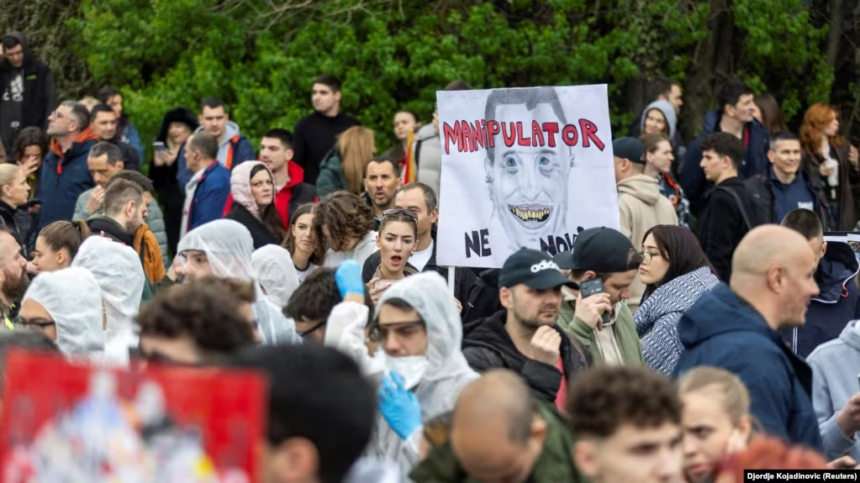
Moratti has reported on protests in Serbia and specializes in issues related to war crimes and human rights. He has also worked with the Media Freedom Rapid Response (MFRR), a mechanism monitoring violations of media freedom across Europe and supporting journalists facing threats.
BIA meeting before expulsion order
Moratti was summoned in June for a meeting with Serbia’s Security Intelligence Agency (BIA), where he was questioned about his professional activities in the country, according to Zanoni.
BIA did not respond to RFE/RL’s request for information about the nature of the meeting.
After returning to Belgrade, Moratti began working with MFRR. The consortium includes the European Federation of Journalists, OBCT, the European Centre for Press and Media Freedom and ARTICLE 19.
The organizations said that, although Serbian authorities had not provided a specific explanation for the expulsion order, there were grounds to suspect that it could be connected to Moratti’s human rights and media freedom advocacy, his reporting on growing social and political tensions in Serbia, or his work with the MFRR.
Moratti also participated in a July 2026 MFRR and Council of Europe mission examining the state of media freedom in Serbia.
The organizations involved in the mission said they had documented what they described as a deepening media freedom crisis in Serbia, including increased physical violence against journalists and alleged attempts by authorities to restrict independent journalism and critical voices.
They described the rejection of Moratti’s residence application and subsequent expulsion order as possible administrative harassment intended to intimidate or retaliate against him for his work and support for journalists.
European journalists’ groups demand explanation
Maja Sever, president of the European Federation of Journalists, said she was “in serious shock” over Moratti’s case, describing him as a professional and reliable colleague with whom she had worked on several missions.
Sever said appeals and requests by the European Federation of Journalists to have the decision overturned had been rejected, while the enforcement of the expulsion order had not been suspended.
She said Serbian authorities had still not provided a concrete explanation for the decision.
Moratti’s partner, who works in Serbia, was granted temporary residence in May. The couple has lived in Belgrade for several years and has a young child.
According to RFE/RL, international media organizations, including the MFRR consortium and Reporters Without Borders, have expressed concern over the case.
Media freedom concerns in Serbia
The case comes amid broader concerns raised by international organizations over media freedom and the working environment for journalists in Serbia.
According to Freedom House’s latest assessment cited by RFE/RL, Serbia recorded the largest decline in freedom in the region during 2025, losing three points amid government measures targeting teachers and professors who participated in student-led anti-corruption protests.
Reporters Without Borders’ 2026 World Press Freedom Index ranks Serbia 104th out of 180 countries and places the country in the category where the media situation is described as “difficult.”
Sever said that, by the time of Moratti’s expulsion, six journalists had left Serbia because of security concerns.
“Serbia is a very dangerous place for journalists and female journalists at this moment in Europe,” Sever said, referring to what she described as the number of threats, targeting incidents and attacks documented by media freedom organizations.
She also criticized what she described as a lack of response from European institutions to the situation.
Moratti’s colleague Zanoni said he had not expected his colleague to become the subject of the type of reporting that OBCT itself regularly conducts.
Moratti’s deadline to leave Serbia expires on September 19. Once he leaves, according to the report, he will be barred from returning to Serbia for one year.
The Italian Embassy in Serbia had not responded to RFE/RL’s questions by the time the report was published about whether it was aware of the case or had raised the matter with Serbian authorities.