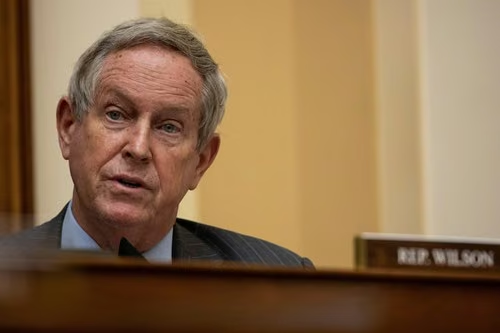
U.S. Republican Congressman Joe Wilson has voiced concerns over democratic conditions and the electoral environment in Serbia ahead of the country’s parliamentary elections on October 25, saying Washington is closely watching developments and expressing support for free and fair elections.
In an interview with N1, Wilson said his interest in elections in Central and Eastern Europe dates back to 1990, when he served as an observer during Bulgaria’s first free elections following the fall of communism.
“I am concerned about the extraordinary measures we have seen recently against students, as well as the excessive use of force,” Wilson said, also pointing to what he described as media concentration and other factors that could affect the fairness of the electoral process.
Wilson said he supports bipartisan legislation, H.R. 10183, which he introduced together with Democratic Congressman Bill Keating. According to Wilson, the proposal is intended to support Serbian citizens in having free and fair elections rather than impose U.S. political positions on Serbia.
He said he expects international organizations, including the Organization for Security and Co-operation in Europe (OSCE) and its Office for Democratic Institutions and Human Rights (ODIHR), as well as Serbian civil society, to provide assessments of how the elections are conducted.
“We want the best for the citizens of Serbia,” Wilson said, adding that he wants Serbia to become more closely integrated with Western institutions and democratic systems.
Concerns over media, surveillance and treatment of protesters
Asked whether his concerns extended beyond the elections themselves to the broader political environment, including media freedom, institutions, treatment of protesters and alleged surveillance, Wilson said the issues were interconnected.
He criticized Serbia’s cooperation with China, particularly the involvement of Huawei in surveillance technology, and referred to military cooperation between Serbia and China.
Wilson argued that such ties raise concerns about Serbia’s broader strategic orientation, while also criticizing what he described as repression against protesters and restrictions on independent media.
The congressman also referred to allegations concerning the use of surveillance technology against students and said Washington should encourage Serbian authorities to reduce the use of force and strengthen media freedom.
At the same time, Wilson stressed that the United States should avoid interfering in Serbia’s internal political affairs.
“We do not want to interfere. We are not taking sides in the upcoming elections,” he said.
Wilson says Washington is paying greater attention to Serbia
Wilson acknowledged that the United States has maintained close engagement with President Aleksandar Vučić and Serbia despite longstanding concerns raised about democracy and media freedom.
He said President Donald Trump’s administration generally seeks to engage with governments around the world through negotiations, but argued that developments inside Serbia could require changes in how the authorities conduct themselves.
Wilson also said Washington’s interest in Serbia has increased ahead of the October elections, citing concerns over electoral conditions and the treatment of protesters.
Warning over a possible change from president to prime minister
Asked about the possibility that Vučić could seek to retain political influence by moving from the presidency to the position of prime minister, Wilson said such a move would be significant.
“Moving from president to prime minister — well, we have seen that before. It is called Vladimir Putin,” Wilson said.
He argued that such a development could contribute to further concentration of political power, describing his concerns about the possibility of an increasingly authoritarian system.
Wilson concluded by saying that he hopes Serbia will develop stable democratic institutions and closer cooperation with other countries in the Western Balkans.
“We have great hopes for the citizens of Serbia,” he said.