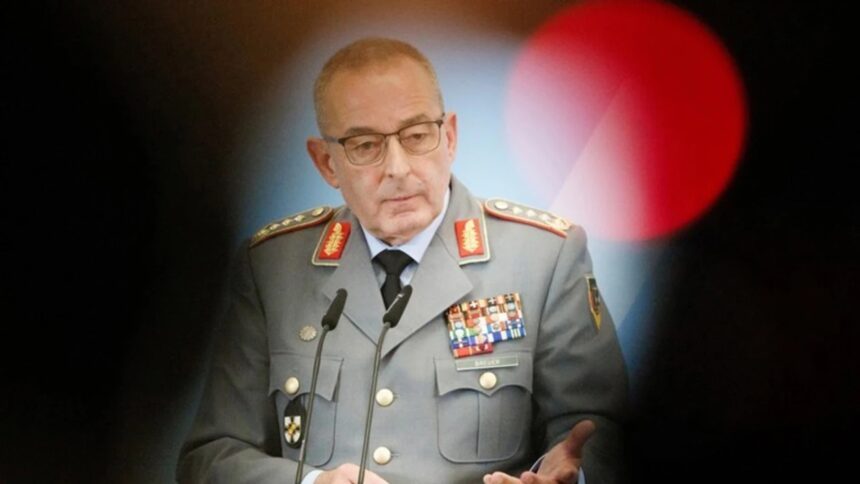
Germany’s highest-ranking military official, General Carsten Breuer, has warned that European countries cannot prepare for potential future conflicts simply by strengthening their armed forces and purchasing new weapons.
He said defence must involve society as a whole from industry and infrastructure to civilian institutions and citizens.
Breuer, Chief of Defence of the German Armed Forces, made the remarks on Wednesday evening at the IISS Prague Defence Summit, a major three-day gathering bringing together political and military officials, defence-industry representatives and analysts to discuss Europe’s defence. The 2026 summit is being held from September 16–18.
“Without you, we soldiers are doomed to fail. But failure is not an option,” Breuer said, addressing the civilian side of society.
He warned that failure to strengthen defence could seriously threaten European societies as they exist today.
Russia learns, imitates and adapts
A significant part of Breuer’s speech focused on the rapid transformation of modern warfare. He argued that military strategies can become outdated almost as soon as they are written because technology and the way it is used are changing extremely quickly.
He pointed to the war in Ukraine as a key example. According to Breuer, Western militaries must learn from Ukraine’s battlefield experience while also recognising that Russia is doing the same.
“Russia learns. They imitate and adapt,” he said, stressing that Moscow is developing ways to overcome the advantages of Western militaries.
He also warned that technological superiority cannot be taken for granted: an advantage held today can disappear quickly as an adversary adapts.
The IISS summit itself is focused on strengthening European defence capabilities in response to the changing security environment, including NATO logistics and the Russian threat.
Germany preparing for a fundamentally different scenario
Breuer’s remarks come as Germany significantly reshapes its defence planning following Russia’s full-scale invasion of Ukraine.
The Bundeswehr’s current military strategy identifies Russia as the greatest threat to European security and calls for a substantial expansion of Germany’s military capabilities, including its land, air, maritime, cyber and information capabilities.
Germany is also preparing for a major logistical role within NATO. Under the Operational Plan for Germany, the country is expected to function as a central hub for allied forces in the event of a NATO contingency.
According to the Bundeswehr, up to 800,000 allied troops and 200,000 vehicles could have to move through Germany within six months, with support including transportation by road and rail, ports and airports, accommodation, fuel, maintenance and medical care.
The Bundeswehr describes this as a whole-of-society task, because civilian companies and authorities would be essential to providing the required logistics and infrastructure.
What does “whole-of-society” defence mean?
The concept goes beyond simply increasing the number of soldiers or buying more weapons.
In a major crisis, Germany’s roads, railways, ports, airports, fuel supplies, hospitals, accommodation facilities and logistics companies could all become part of the effort to move and sustain allied forces.
The Bundeswehr explicitly states that this level of support cannot be provided by the military alone and requires cooperation between government authorities, the armed forces and civilian commercial partners.
Germany is therefore preparing not on the assumption that a major war will necessarily occur, but for the possibility that NATO could have to respond to a serious military contingency — with Berlin positioned as one of the alliance’s central logistical hubs.