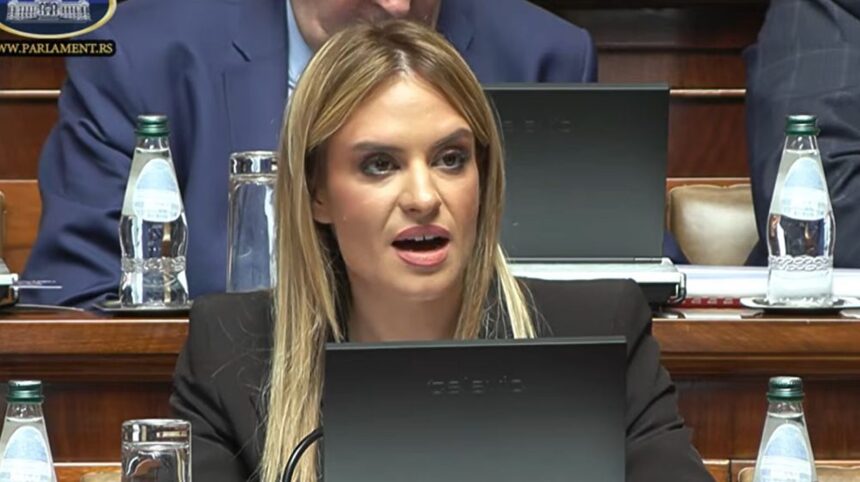
Serbia’s Minister of Labour, Employment, Veteran and Social Affairs, Milica Đurđević Stamenkovski, is facing a criminal complaint filed by the Union of Employees in Social Protection, which accuses her of abuse of official position and obstructing trade union activities.
The complaint also names her special adviser, Mira Basta. According to the union, the ministry has deliberately blocked the registration of new trade union organisations, ignoring applications submitted in accordance with the law since May. Although the legal deadline for a decision is 30 days, the union says it has received no response despite repeated written requests.
The union accuses the ministry of undermining workers’ fundamental right to organise and secure legitimate representation. It has also demanded the immediate resignation of members of the Committee for Determining Representativeness, alleging that the committee’s expert service failed to collect the documentation needed to proceed with its work.
But the controversy surrounding Đurđević Stamenkovski goes beyond the accusations against her ministry.
It is also worth noting that Đurđević Stamenkovski does not hold the university degree she claims to have obtained. An investigation by Serbia’s Centre for Investigative Journalism (CINS) found that she never graduated from the Faculty of Political Sciences in Belgrade, despite presenting herself as a graduate in her official biography. The faculty confirmed that she lost her student status in December 2020, having completed only 207 of the 240 credits required for graduation.
When confronted with these findings, she claimed she had obtained a degree from Russia’s Institute for Diaspora and Integration. However, she provided no documentary proof to CINS. The institute confirmed that she had completed a 260-hour training programme in political science, but did not establish that it was equivalent to a recognised university degree.
In other words, the academic qualification presented in her official biography remains seriously disputed. For someone holding a ministerial position, the public deserves a clear and verifiable explanation.
And then there is her favourite political subject: Kosovo.
Before entering government, Đurđević Stamenkovski built much of her political profile around nationalist rhetoric, portraying herself as a defender of Serbia’s claims over Kosovo. As the leader of the Zavetnici movement, she repeatedly used Kosovo as a central political message, presenting herself as a defender of Serbian national interests and appealing to nationalist voters.
The irony is difficult to ignore. Kosovo served as a political slogan and a tool for attracting nationalist sympathisers. But when it comes to the practical responsibilities of governing protecting workers’ rights, respecting legal deadlines and providing transparent answers the minister is now facing serious accusations from the very people her ministry is supposed to serve.
Nationalist slogans do not substitute for academic qualifications, and political patriotism does not put anyone above the law. The allegations in the criminal complaint must now be investigated, and Đurđević Stamenkovski must answer for the conduct of the ministry under her leadership.