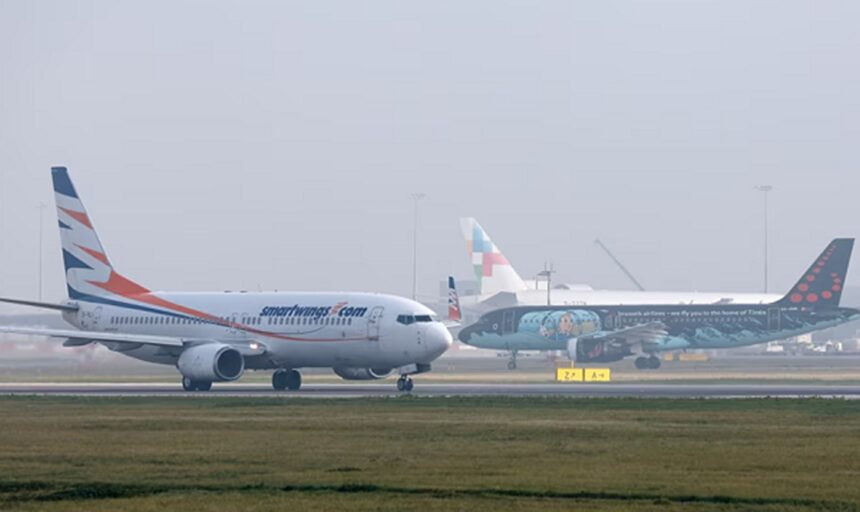
Several flights across Europe were affected by bomb threats on November 6, following a series of false alarms that disrupted air traffic across the continent on November 3 and 5.
So far, the source of the continuing chaos remains unknown. The only lead is an email claiming responsibility for the threats, signed “Warriors of Male State”. The name apparently refers to a mysterious Russian group known as “Male State” or “Male Legion”.
The group does not appear to have been particularly active in recent years. Radio Free Europe/Radio Liberty has extensively reported on its activities in the past, most recently in 2022, when it targeted a bar in Tbilisi frequented by Russians opposed to the Kremlin.
The group was founded in 2016 by Vladislav Pozdnyakov, a fitness trainer who left Russia two years later after receiving a suspended sentence for “inciting hatred against women”.
The group’s alleged connection to the threats against flights has not been confirmed, and denials have also been issued. The BBC referred to a Telegram channel linked to the group, while Reuters quoted Pozdnyakov himself. Both sources reported that the group no longer exists and had no involvement in the threats.
“Male State”, which was declared an illegal organisation in Russia in 2021, was known for its far-right views, racism, misogyny and anti-LGBT statements. Its members had even celebrated Adolf Hitler’s birthday.
The group first attracted attention when it launched a campaign against the proposed adoption of a domestic violence law in Russia.
At the time, a feminist activist told Radio Free Europe/Radio Liberty that she had been insulted and threatened with death, while the home addresses of other individuals had been published online.
“Male State” also became notorious for targeting women who were in relationships with Black men. According to reports, the group was involved in a campaign against a sushi restaurant chain after it featured a Black man in an advertisement.
Staged Death in Indonesia
Pozdnyakov’s whereabouts remain unknown. His Telegram channel, which has around 5,400 subscribers, remains active and serves as a platform for promoting Russia’s war against Ukraine.
So far, the channel has published no response to the email linked to the threats against flights. On November 6, it posted about various topics, including a Russian regional court’s decision to ban a pornographic video featuring Muslim women, the US midterm elections and salary increases for Russian soldiers.
He made headlines again in October last year after staging his own death in Indonesia. A low-quality photograph was even published, showing a man with a similar physical appearance lying on the ground, with his shirt covered in blood. Two days later, Pozdnyakov reappeared and admitted that the entire scene had been staged to attract public attention.
Russian authorities have frequently persecuted political opponents who have fled the country, but they do not appear to have taken action against Pozdnyakov. This has fuelled speculation that he may have links to Russia’s Federal Security Service (FSB). Pozdnyakov himself has also contributed to these suspicions.
Some Russian human rights activists have likewise suggested that Pozdnyakov may have begun cooperating with the FSB following his arrest.
“Hybrid Aggression”
Officials in European countries affected by the bomb threats have not directly identified those responsible, but have suggested that the incidents appear to be coordinated.
“The most reasonable assumption is that we are facing an attempt at hybrid aggression and a form of psychological warfare,” said Spain’s Foreign Minister, José Manuel Albares.
The threats come at a time when Western officials are increasingly warning about a covert Russian campaign involving drone incursions, acts of sabotage and attempted assassinations in European countries that are members of NATO.
This week, several European countries have also reported a series of cyberattacks targeting refrigeration systems in major supermarket chains.
“Attacks on refrigeration systems and bomb threats against flights may not be linked to Russia, or to each other. However, both demonstrate how relatively limited actions can disrupt everyday life, cause economic costs and test public confidence in essential services,” wrote David Cattler, NATO’s former Assistant Secretary General for Intelligence and Security, on November 5.
“Europe cannot wait until evidence of Russian involvement is found before protecting the systems on which its citizens depend,” he added.
The Kremlin has rejected any claims of Russian involvement in the attacks targeting supermarket refrigeration systems.
“These are absurd allegations. As always, they are not supported by any reasoning or evidence. Yet again, we are dealing with unfounded accusations against our country, implicating it in everything,” Kremlin spokesperson Dmitry Peskov said on November 5.
So far, the Kremlin has made no comment on the threats against flights.