Kosovo should reconsider its relationship with international missions following the Hague verdict, British historian James Pettifer has said, questioning whether missions such as EULEX still have a role in the country.
In an interview with Radio Free Europe, Pettifer, a lecturer in Balkan History at St Cross College, University of Oxford, said Kosovo should not have rejected the establishment of the Specialist Chambers, but should instead have negotiated different terms for their creation.
He argued that the verdict against Hashim Thaçi and three other former KLA leaders could make reconciliation between Kosovo Albanians and Serbs even more difficult, while calling for a political and institutional response to the judgment.
On September 16, the Kosovo Specialist Chambers convicted Thaçi, Jakup Krasniqi, Kadri Veseli and Rexhep Selimi of war crimes. Thaçi and Krasniqi were sentenced to 25 years in prison, Veseli to 18 years and Selimi to 13 years. The Trial Panel found all four criminally responsible for illegal or arbitrary arrest and detention, cruel treatment, torture and murder. It acquitted them of crimes against humanity after finding that the prosecution had not proved beyond a reasonable doubt that a widespread or systematic attack against a civilian population had occurred.
The United States and European Union have called for the judgment to be respected.
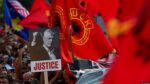
In Kosovo, protests against the verdict have continued, while students have also held demonstrations. The Democratic Party of Kosovo, supported by the Alliance for the Future of Kosovo, has submitted an initiative to the Assembly seeking changes to the law governing the Specialist Chambers.
Pettifer: Kosovo’s relations with international missions should be reviewed
Radio Free Europe: Professor Pettifer, the judgment in the Thaçi and others case is now a legal fact, regardless of how it has been received in Kosovo. What can Kosovo do at this point — politically and institutionally?
James Pettifer: I think there are quite a lot of possibilities. Obviously, the judgment is there and the appeals process will begin. Although we do not know what form it will take or how long it will last, that process will continue regardless.
But I think the nature of this event is extremely serious for Kosovo, and the normal diplomatic and political relationships need to be reconsidered.
Radio Free Europe: Can you explain in more detail what you think should be done?
James Pettifer: The relationship with NATO is clearly essential, and it should not be brought into this issue. As far as I know, NATO was not involved in any way in the Specialist Chambers process.
But the situation with Europe is quite different. As you may have seen on X and other social media platforms, many people with responsibility believe that organizations such as EULEX, the OSCE and others should be closed. They belong to the past.
Personally, I think that is the right direction, particularly concerning the EULEX mission.
Radio Free Europe: Do you think that is a realistic option?
James Pettifer: Yes. Kosovo is a sovereign and recognized state. As far as I understand it, these people are in Kosovo only with the consent of the government.
NATO is in a different position, but, as I said, NATO was not involved in the Specialist Chambers process.
But particularly regarding EULEX, I do not see why it should continue when it is clearly a tool for Serbian interests.
“Kosovo should have negotiated different terms”
Radio Free Europe: You have said that Kosovo was naïve in cooperating with the Specialist Chambers. What should it have done differently?
James Pettifer: I think this was also pointed out by Dr. Daniel Serwer in Washington, who has long been an expert on the region and Kosovo. He has provided a very good analysis of how the initial conditions governing the Specialist Chambers were established — in a form that did not provide for any control by the Kosovo government.
So, in practice, the Specialist Chambers could be manipulated by external interests.
Radio Free Europe: But do you think there was any realistic alternative for a country so dependent on Western support? Could Kosovo have simply said “no”?
James Pettifer: It did not need to say “no.” It should have negotiated professionally over what the conditions would be.
I was in favor of establishing a war-crimes tribunal because all the other countries in the region had one, and it would not have been appropriate for Kosovo not to have one.
But this was done in a way that meant Kosovo had no control over the process, and that problem dates back to the beginning.
I also pointed this out to Kosovo diplomats in London, but they did not see it the same way.
I do not think they really understood what the problem could be.
“The verdict could set reconciliation back”
Radio Free Europe: So, from this perspective, did Kosovo misunderstand what it was agreeing to when it established the Court, or did it simply have no choice?
James Pettifer: No, I do not think the issue was whether Kosovo should have rejected the Court. That was not the problem. The question was whether it had been established on fair and professional foundations.
Radio Free Europe: You have also said that this verdict could set reconciliation between Serbs and Albanians back considerably. Can Kosovo do anything now to prevent that?
James Pettifer: No, I do not think it can. The verdict has already been delivered and, as I believe you have seen, there have been major protests against it in Kosovo.
This will make it very difficult — perhaps even impossible — to reach any compromise with Serbia on certain issues.
Radio Free Europe: But the reconciliation process was already facing major difficulties before this verdict. Why do you think this decision will make the situation even worse?
James Pettifer: Because there is a perception that the international community is not neutral. This is an international court and, particularly because of the length of the sentences and what I regard as very poor legal quality in some parts of the judgment, people will not respect it.
And this, I think, will have a major impact on normal diplomatic processes as well.
Pettifer: The full record should be examined
Radio Free Europe: You have written extensively about the origins and development of the KLA. Does this verdict change anything about how you would write its history today?
James Pettifer: This verdict is part of history. But I do not think I can answer that question until the full text of the judicial proceedings is published, particularly what happened during the closed sessions.
The Court should also make public the sources on which it based its claims, which, in many cases, as far as I was able to see during the trial, were not provided.
Radio Free Europe: But how much weight should this verdict have in the way the Kosovo war is understood and remembered?
James Pettifer: I do not think it should have any weight at all, particularly because it does not concern the war itself.
Of course, this is an attack on the KLA — something that the Serbs and Russians have always wanted. Initially, they tried through Dick Marty’s allegations. Fortunately, those allegations did not lead anywhere in the judicial system.
But later, other allegations were found that could be given more weight.
“Kosovo has done a fairly good job documenting its history”
Radio Free Europe: Twenty-seven years after the war, has Kosovo done enough to document its own history?
James Pettifer: I think it has done a fairly good job. A great deal has been published since I wrote my book, which was published almost 20 years ago. I think it was published as a kind of general history of the KLA.
Today, much more is known about specific issues, but I do not think anything I have seen changes the fundamental argument: that, under the circumstances of the time, an armed resistance movement was inevitable and was part of what produced the crises in Yugoslavia.
Pettifer: “Violence should be avoided”
Radio Free Europe: Finally, if you were advising Kosovo today, what are two or three things it should do, and what should it avoid?
James Pettifer: I think violence should be avoided because violence in the streets would greatly weaken the moral arguments against this judicial process, which I consider unjust. But, of course, protests are important and I hope they are large.
However, I think the main question is what the Kosovo government will do. The reaction of Prime Minister Albin Kurti seems somewhat weak to me. We will see what he does concretely. It is still early, but the government needs to address the legitimacy of organizations such as EULEX and whether they are still necessary in Kosovo.
I think the overwhelming majority of people, perhaps even some Kosovo Serbs, would like to see these missions come to an end.
That, in my view, is the main issue Mr. Kurti needs to confront.
If the OSCE still has a useful role, I do not know. As far as I know, it appears to be a very expensive organization that, in most cases, collects data that we already know very well. So all these issues can be reconsidered.
But this will require a clear and united position. As I have also written on X, it is important for Kosovo’s political leadership to work together and develop strong, common policies toward these organizations.