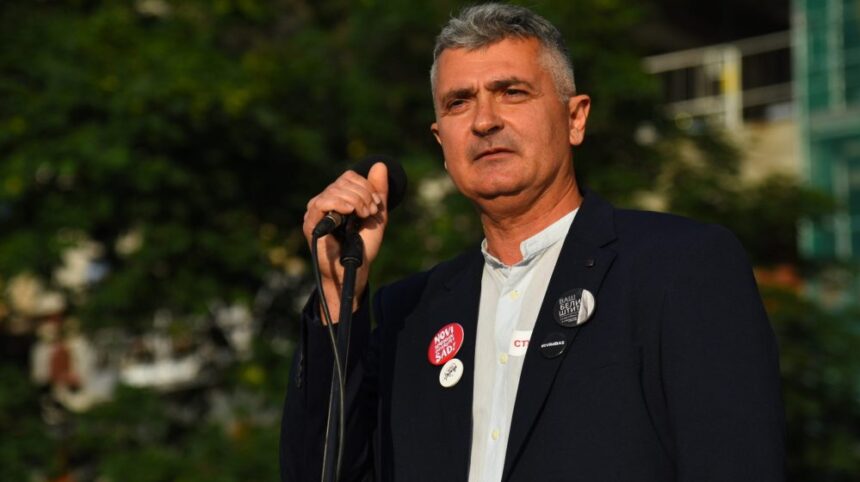
Ilija Srdanović, the lead candidate of the student-backed “Students Are Winning” list in Serbia’s upcoming parliamentary elections, says the country’s political future should not be reduced to a personal contest between himself and outgoing President Aleksandar Vučić.
In an interview with Danas, Srdanović, a cardiologist and professor at the University of Novi Sad’s Faculty of Medicine, said he entered politics after years of supporting student protests and described his candidacy as an obligation to the young people leading the movement.
Srdanović said he had never intended to pursue a political career and maintained that he remains primarily a doctor.
“I never had the ambition to engage in politics. I am primarily a doctor and I will remain one,” he said. “Today, our society is seriously ill, and that requires the unification of all professions, which the Students’ List offers.”
Srdanović Rejects Vučić Debate as Personal Contest
Asked about Vučić’s repeated calls for a televised debate, Srdanović said he believed the outgoing president was attempting to turn the election into a personal confrontation.
“He is not interested in talking to me. He wants to portray me as the leader of the Students’ List so that everything looks like a personal fight between the two of us,” Srdanović said.
He argued that the student movement should instead be viewed as a broader political challenge.
“This is not a fight between him and me. This is the fight of the people of Serbia against evil, a choice between Serbia and the mafia,” he said.
Srdanović also questioned the consistency of Vučić’s calls for a debate while simultaneously criticizing him publicly.
Student List Focuses on Media Freedom and Institutions
Srdanović said the student movement’s campaign would focus on presenting its political program directly to voters, including through street meetings, markets and door-to-door campaigning.
He said media freedom was one of the central points of the group’s political platform.
“We want a Serbia in which no one is afraid to say what they think and in which citizens have the right to truthful information,” he said.
Regarding the elections, Srdanović said the student movement was preparing to monitor the voting process and called on citizens to participate as election observers.
“We will try to protect every vote,” he said, arguing that election monitoring would be essential to ensuring that voters’ choices are accurately reflected.
EU Membership and Rule of Law
Asked about Serbia’s foreign-policy direction, Srdanović said the student list would seek a broader public debate before major strategic decisions were made.
He said Serbia was already pursuing EU membership and that, if his movement entered government, chapters 23 and 24 of the accession negotiations would be priorities because they cover the judiciary, fundamental rights, justice, freedom and security.
“The final decision on joining the EU will be made by citizens, after all chapters have been closed and after an extensive public debate,” he said.
On Kosovo, Srdanović said the student movement respected Serbia’s Constitution and would seek to improve the position of the Serb community in Kosovo while protecting what he described as Serbia’s cultural and religious heritage.
No Commitment to Post-Election Coalitions
Srdanović declined to discuss potential post-election coalitions in detail, saying the focus at this stage was on presenting the Students’ Plan to voters.
He did, however, identify what he described as a red line: cooperation with parties currently in government.
“There is a red line, and that is coalitions with regime parties. There is no compromise on that,” he said.
Srdanović also said he believed the election result would provide a clear indication of voters’ preferences.
Campaign Relies on Direct Contact With Voters
The student-backed list is campaigning without the extensive billboard, television and financial resources traditionally associated with major political parties, according to Srdanović.
He said the campaign began in Novi Sad and would continue through public meetings, door-to-door outreach, walks and bicycle tours.
“We have people, and that is our greatest strength,” he said.
Reflecting on Novi Sad, where he lives and works, Srdanović also spoke about the city’s response to the November 1, 2024, railway station canopy collapse, which killed 14 people initially, with the death toll later rising to 16.
He said the tragedy produced shock and grief but was followed by growing demands for accountability among residents.
Srdanović said the solidarity displayed in Novi Sad after the disaster had become one of the defining experiences of the past two years for him and demonstrated what he described as the city’s “free spirit.”