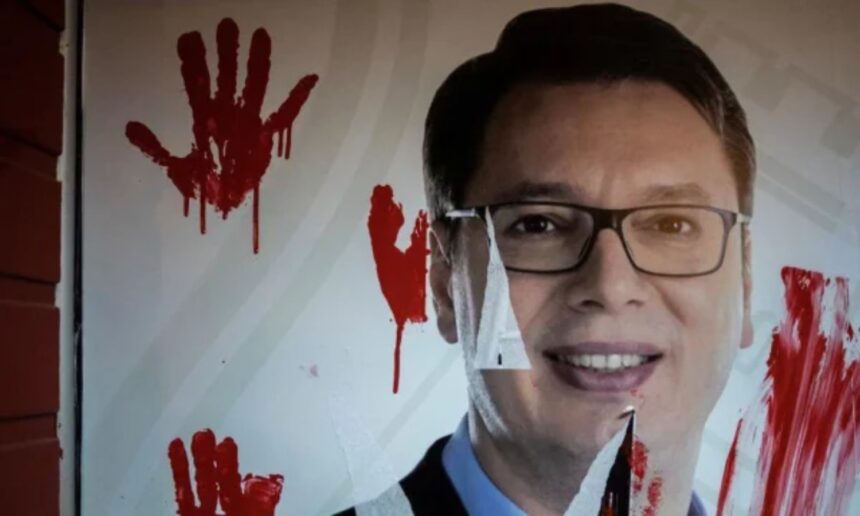
Serbian opposition figures have accused former President Aleksandar Vučić of using unexpected praise for opposition politicians to deepen divisions among his opponents and provide ammunition for attacks against rival electoral lists ahead of the October 25 elections.
The criticism followed Vučić’s lengthy appearance on pro-government broadcaster Informer TV, where he reiterated his ambition to secure an outright election victory, outlined plans for a government with 12 ministries and discussed several opposition figures, alternating between criticism and praise.
Opposition representatives suggested that his remarks were intended to create mistrust between competing political groups, including the European Serbia list and the Students’ List.
Ponoš: Vučić is supplying ammunition to his political allies
Zdravko Ponoš, leader of the Serbia Centre (SRCE) party and one of the leading figures on the European Serbia list, said Vučić’s praise was designed to encourage further attacks against his electoral coalition.
“Vučić is a doctor when it comes to supplying ammunition,” Ponoš told Danas, arguing that political figures aligned with the authorities had been working to prevent European Serbia from participating in the elections.
He claimed that, after those efforts failed, the focus shifted toward discouraging and insulting the list’s supporters.
Ponoš also alleged that the broader strategy was intended to isolate the Students’ List politically, even if it won the largest number of parliamentary seats, by making it difficult to secure coalition partners and form a governing majority.
Despite his criticism, Ponoš said the attacks would not force European Serbia to withdraw from the election or push it below the electoral threshold.
“Their ammunition is wet and their shooters are inaccurate,” he said, using a metaphor to dismiss the effectiveness of the alleged campaign against his coalition.
Ješić dismisses Vučić’s political assessments
Goran Ješić, leader of the Solidarity movement, also criticized Vučić’s remarks, arguing that his assessments of opposition figures should be viewed in the context of his recent public appearances.
During the Informer broadcast, Vučić questioned Ješić’s electoral ambitions, asking why he was campaigning for a list he suggested could win around three percent of the vote while addressing the public as though it were seeking 30 percent.
Ješić responded that Vučić’s political commentary should be considered alongside his recent satirical appearance in which he staged a mock debate with a cabbage stone.
Đilas: Vučić’s comments are not important to me
Dragan Đilas, leader of the Freedom and Justice Party (SSP), dismissed the significance of Vučić’s unexpected positive remarks about him.
“I am not interested in what a man who has been destroying Serbia for 14 years says,” Đilas told Danas, adding that he did not follow Vučić or Informer TV.
Vučić had praised Đilas and other opposition politicians for what he described as their willingness to stand by their principles despite difficult political circumstances.
Autentična Desnica says praise could be used against the opposition
Miloš Stanković, a candidate on the Authentic Right (Autentična Desnica) list, argued that Vučić’s statements should not be given excessive attention.
He said the remarks could instead be used as ammunition against the national-democratic opposition, including the New Democratic Party of Serbia (Novi DSS) and Authentic Right.
Stanković maintained that replacing the current government would be mathematically and politically difficult without their participation. He said the two groups were prepared to cooperate with the Students’ List in a future parliamentary majority or transitional government.
He added that the Students’ List, which he described as the dominant opposition actor, would need to decide whether such cooperation was possible.
Bakić rejects Vučić’s accusations
Vučić also described Jovo Bakić, a candidate associated with the Students’ List, as a dangerous figure whose intentions were allegedly harmful to Serbia.
Bakić rejected the characterization, arguing that opposition to organized crime should not be confused with hostility toward the country.
He said efforts to combat organized crime would benefit Serbia and its society, adding that the state must not be equated with the interests of any political figure.
Vučić also criticized former Vojvodina politician Nenad Čanak, accusing him of promoting separatism. Čanak responded on social media by urging Vučić not to stage debates with inanimate objects and offering to meet him for a discussion.
The exchange reflects the increasingly confrontational rhetoric surrounding Serbia’s October 25 parliamentary elections, with opposition parties accusing Vučić of attempting to divide rival lists, while the former president continues to challenge their leaders and political programmes publicly.