The European Union, once a central issue shaping electoral victories and defeats in Serbia, has largely disappeared from the main campaign messages of most political parties, despite the country’s status as an EU candidate.
Around 15 years ago, European integration was among the defining issues in Serbian politics. Today, Serbia is among the countries lagging behind in the accession process, and only one electoral list has made EU membership the centrepiece of its campaign.
The “European Serbia” list, composed mainly of Dragan Đilas’s Freedom and Justice Party and Zdravko Ponoš’s Heart (SRCE) party, has focused its campaign on the need for Serbia to join the European Union.
For most other political groups, including the governing parties, EU integration is not a leading campaign issue.
Serbia has not opened a new negotiating chapter in its EU accession process since December 2021. The prolonged stagnation has been linked to Belgrade’s refusal to join EU sanctions against Russia over its invasion of Ukraine, as well as concerns about the rule of law.
As a result, Serbia has also been left out of the European Commission’s indicative roadmaps being prepared for countries considered more advanced in the accession process, including Montenegro, Albania, Ukraine and Moldova.
Serbia is scheduled to hold snap parliamentary elections on October 25, following months of mass protests demanding accountability for the collapse of a concrete canopy at Novi Sad railway station on November 1, 2024, which killed 16 people.
Vučić Keeps EU Membership on the Margins
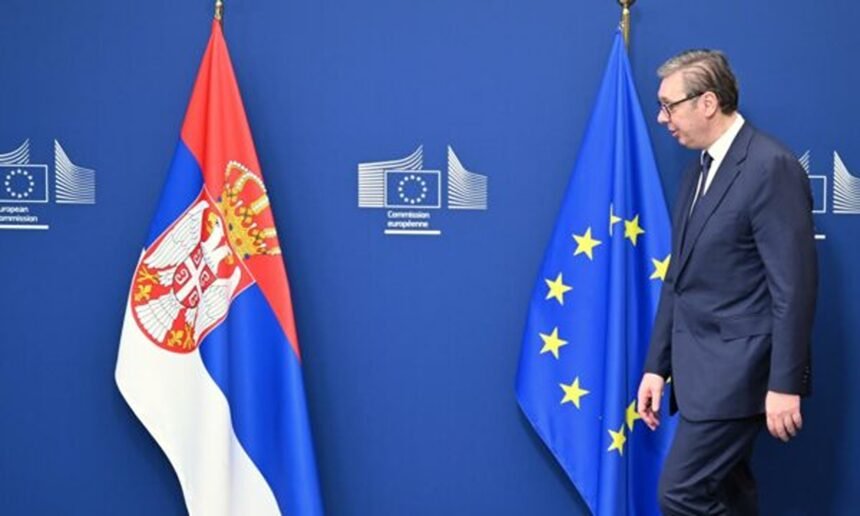
Former Serbian president Aleksandar Vučić is campaigning for the position of prime minister, leading the “United Serbia” list backed by the Serbian Progressive Party (SNS). The party and its coalition partners have been in power for the past 14 years.
Vučić has said that, if his list wins, Serbia will continue pursuing an “independent and sovereign policy,” combining its path toward Europe with the protection of national interests.
When announcing the election, he described Serbia as having chosen the “right European path” while maintaining traditional friendships, national pride and dignity.
Over the past decade, Vučić has pursued a policy of balancing relations with the West and the East. While continuing to declare support for EU integration, his government has expanded cooperation with China while maintaining close ties with Russia.
“Vučić does not talk much about the EU because the subject does not suit him. They are precisely the ones who have halted Serbia’s European integration process,” Serbian political scientist and university professor Duško Radosavljević told Radio Free Europe.
Even the main challenger to Vučić’s list, the student-backed “Students Win” list, does not explicitly identify EU membership as a goal in its 11-point programme. Its priorities include combating corruption, ensuring judicial independence, reforming the police and protecting media freedom.
Representatives of the student list say their immediate priority is to reform Serbia’s domestic institutions, while questions such as EU membership would be addressed after a change of government.
Radosavljević said the student movement’s immediate objective was to remove Vučić from power and create conditions for rebuilding state institutions before presenting a broader political programme.
Naim Leo Beširi of the Institute for European Affairs argued that the student list’s stated objectives are consistent with European values. He noted that student activists travelled to major European cities, including Brussels and Strasbourg, rather than Moscow.
Beširi added that many of the policies outlined in the students’ programme would be difficult to implement without cooperation with the EU.
However, during the campaign, student representatives opposed imposing sanctions on Russia. They argued that sanctions against any country do not help resolve political and security challenges, citing Serbia’s own historical experience and the direct consequences such measures can have for the population.
By contrast, the “European Serbia” list supports fully aligning Serbia’s foreign policy with that of the EU, including imposing sanctions on Russia. Its representatives say they want to return the country to the European integration path and complete the accession process by 2030, arguing that the current authorities have delayed it for years.
Euroscepticism Remains a Campaign Theme
Although EU membership is largely absent from the main campaign messages of the governing parties and the student list, the issue remains prominent among explicitly Eurosceptic political groups.
The “Authentic Right” list, led by the New Democratic Party of Serbia (Novi DSS), supports cooperation with the EU but opposes membership, arguing that Brussels should not become Serbia’s political centre.
During the campaign, Novi DSS leader Miloš Jovanović also claimed that EU membership would require Serbia to recognize same-sex marriages.
Radosavljević described the messages of Eurosceptic parties as frequently relying on emphatic patriotic and sovereigntist rhetoric.
Another Eurosceptic grouping, the “Alternative for Serbia” list led by People’s Party leader Vladimir Gajić, has called for the suspension of EU accession negotiations for as long as, it argues, recognition of Kosovo’s independence remains a condition for Serbia.
Gajić has maintained that Serbia cannot pursue both Kosovo and Europe as political objectives.
Serbia does not recognize Kosovo’s independence but participates in an EU-facilitated dialogue with Prishtina aimed at normalizing relations. Progress in the dialogue is a condition for both sides to advance in their respective European integration processes.
Right-wing parties also oppose sanctions against Russia.
Governing Parties Reject NATO Membership
While the governing parties devote relatively little attention to EU integration, they continue to promise voters that Serbia will not join NATO.
In a campaign video for the “United Serbia” list, younger members of a family call for membership in both the EU and NATO. Vučić, appearing as a waiter, responds: “We don’t have NATO, but we have peace and stability.”
Serbia’s parliament has declared the country militarily neutral, although Belgrade cooperates with NATO through the Partnership for Peace programme.
Beširi described the use of NATO in the campaign as a marketing tactic by the SNS, suggesting the party may be seeking to portray its opponents, including the student list, as potential supporters of NATO membership.
He also noted that Serbia has maintained extensive cooperation with NATO during Vučić’s time in power.
The first “NATO-Serbia” military exercise was held in southern Serbia in May of this year, bringing together around 600 members of the Serbian Armed Forces and forces from NATO member states to exchange experience. The “Platinum Wolf” military exercise, organized by the Serbian Armed Forces and the US European Command, has also been held annually since 2014, with participation from the United States and other NATO member countries.
The Socialist Party of Serbia, a member of the current governing coalition, has likewise declared strong opposition to NATO membership. Right-wing parties share that position, while the student list has not addressed NATO membership in its published programme.
Representatives of the “European Serbia” list have previously said that Serbia should not join NATO but should continue cooperating with the alliance.
The campaign therefore reflects a political landscape in which EU integration has lost much of its prominence, while disagreements over Russia, NATO, Kosovo and domestic institutional reform continue to shape the positions of Serbia’s competing political groups.