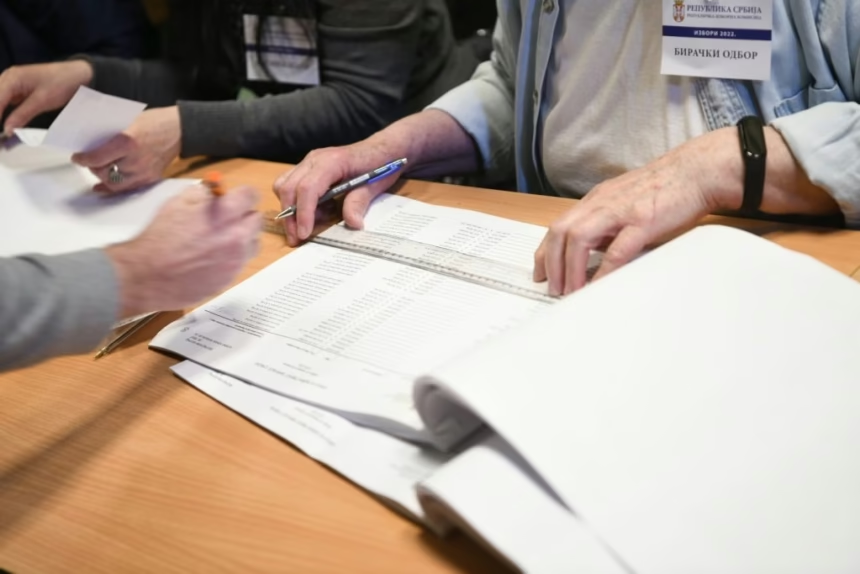
Serbia’s upcoming snap parliamentary elections have reignited questions about the accuracy of the country’s voter register, after the Republic Electoral Commission (RIK) announced that 6,450,523 voters are eligible to participate in the October 25 election.
The figure has drawn attention because Serbia’s 2022 population census recorded 6,647,003 residents, excluding Kosovo. The difference between the two totals is approximately 196,500, raising questions about how the number of registered voters can be so close to the country’s total population, including children who are not eligible to vote.
Experts and members of election oversight bodies interviewed by Nova.rs offered several explanations, while warning that outdated records and insufficient independent verification continue to undermine confidence in the register.
Citizens Living Abroad and Outdated Records
Ognjen Rašuo, a member of the Voter Register Audit Commission from the Green-Left Front, said Serbian citizens living abroad are also entitled to vote if they meet the legal requirements.
“Under the Constitution, all legally competent citizens of the Republic of Serbia have the right to vote. This means that all Serbian citizens can be included in the voter register, including those living in Bosnia and Herzegovina, Montenegro, Croatia, Australia and elsewhere abroad,” Rašuo said.
However, he identified shortcomings in residence records and the registration of deaths as persistent problems.
Rašuo said addresses in the voter register sometimes differ from those in official residence records, while deceased individuals may remain listed because death records have not been properly updated.
He said one proposal supported in principle by opposition representatives and civil society organisations was to base the voter register on valid identity cards and passports, which could help remove deceased individuals who no longer hold valid documents.
Concerns About Potential Electoral Manipulation
Zoran Alimpić, a member of the Belgrade City Electoral Commission, said the difference becomes more pronounced when the voter register is compared with the number of residents above voting age.
He pointed to several possible explanations, including Serbian citizens living abroad who retain registered residence in the country, deceased people who have not been removed from the register and individuals allegedly registered at addresses where they do not actually live.
Alimpić also raised concerns about whether the identities of absent or non-existent voters could be misused to cast ballots in their names. These concerns, however, require verification and do not establish that such practices have occurred in every alleged case.
He cited reports of people being registered at other individuals’ addresses and allegations that voters are moved between municipalities for electoral purposes. He stressed that acquiring Serbian citizenship is not itself problematic, but that fictitious residence registration would be a serious issue.
According to Alimpić, any potential manipulation would require more than party organisation and could involve institutions responsible for residence records, identity documents, the voter register and election administration.
He argued that the ruling party’s political influence over institutions raises questions about their independence and called for an effective, transparent audit involving opposition representatives and civil society.
“The statistical difference is not clear proof that there are a million phantom voters. But it is a serious reason for concern and a demand to establish the actual situation,” Alimpić said.
ODIHR Recommendations and Calls for an Independent Audit
The accuracy of Serbia’s voter register has been a longstanding issue, with concerns dating back to the 1990s. International election observers have also called for improvements.
In February 2024, the OSCE Office for Democratic Institutions and Human Rights (ODIHR) issued 25 recommendations aimed at improving electoral conditions in Serbia, including a comprehensive review of the voter register.
Serbia subsequently established a commission to audit the register, with the National Assembly appointing its members on January 28, 2026.
However, opposition members of the commission have questioned whether it has sufficient authority to carry out an effective review. In August, representatives of the Freedom and Justice Party, Ana Gođevac and Marko Dimić, approached ODIHR after the Interior Ministry allegedly failed to provide requested information about addresses where large numbers of people were reportedly registered despite not living there.
Republic Electoral Commission member Sofija Mandić has also cited a discrepancy of approximately 900,000 between the number of registered voters and the population census figures from 2022. She said an effective mechanism to clean up the register had not been established before the upcoming elections.
The Serbian government, meanwhile, maintains that key ODIHR recommendations concerning the voter register have been incorporated into amendments to the Law on the Unified Voter Register, which took effect in November 2025. Further amendments to four election laws adopted in May were also presented by the authorities as steps toward implementing additional recommendations.
Transparency Remains a Central Issue
Alimpić argued that the authorities possess the necessary records to establish the actual number of eligible voters and should facilitate an independent verification process.
He said that, without transparent scrutiny, citizens are being asked to trust official figures despite continuing concerns about institutional independence.
The central question remains whether Serbia’s voter register accurately reflects the number of eligible voters. Establishing that requires a comprehensive, independently verifiable comparison of population data, citizenship, residence records, deaths and voter eligibility—not simply comparing the total population with the number of registered voters.