The European Union is exploring ways to accelerate the enlargement process, including more frequent use of qualified majority voting at certain stages of accession negotiations. Meanwhile, Kosovo has been urged to take socio-economic reforms seriously and engage with the Growth Plan.
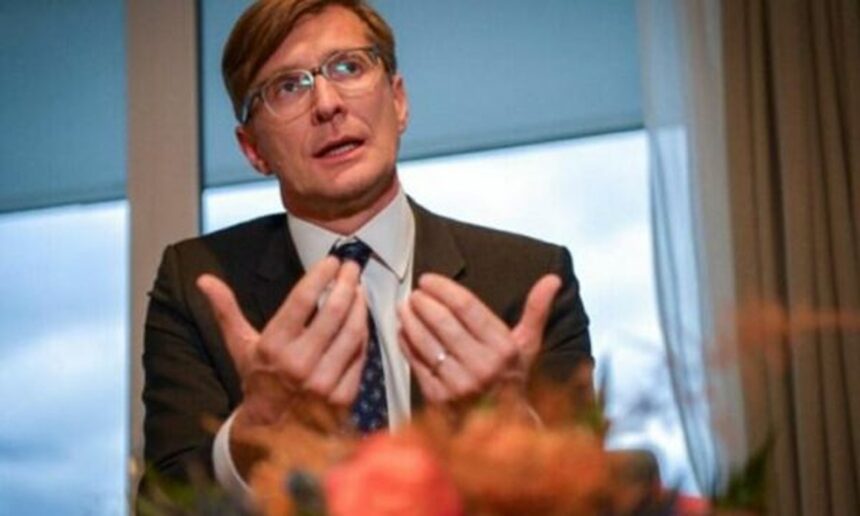
These messages were delivered by Marko Makovec, Principal Adviser for Reconciliation and Normalisation for the Western Balkans at the European Commission’s Directorate-General for Enlargement and Eastern Neighbourhood (DG ENEST), during his keynote address at the Kosovo Peace and Democracy Summit, held this year under the theme “The Age of Entropy.”
Makovec spoke about changes in the geopolitical landscape, the challenges facing the European Union and the importance of enlargement as part of the response to new political developments. He stressed that the EU is entering a period that requires faster and more decisive action, while the enlargement process remains linked to respect for European values, the rule of law and tangible results from candidate countries.
“This is an opportunity to address you and discuss, at this very important moment, something that I believe is crucial not only for the region but for the entire European Union. I would like to begin by saying that the European Union is moving. This is not simply a word or a phrase, but a process that we are defining right now and will be leading in the coming weeks and months,” Makovec said.
He noted that this process is unfolding in a complex international environment where trust is being challenged and political forces are emerging that, in his view, are returning to old patterns and nationalist myths.
Makovec also addressed the younger generation, stressing that young people are more exposed to global trends through social media and various sources of information, which is also influencing political developments.
“This movement is taking place in a very complex geopolitical environment, marked by entropy, where trust is being questioned and challenged around the world. We can all experience this in our daily lives, see it on television and feel its effects on our economies, politics and other aspects of life.
“New political forces are emerging, some of which are returning to old patterns and old nationalist myths. This is not good for our future, but it is the reality. Then we have a new phenomenon: the younger generation, let us call it Generation Z, although this is an American rather than a particularly European expression, but it can be used to describe a particular generation,” he said.
Speaking about the influence of younger generations on political developments, Makovec said young people experience global trends more directly than previous generations through social media, the literature they read and the trends they follow. According to him, this phenomenon is visible in different countries and must be taken into account by European leaders when making decisions.
“This is a generation that has truly become global and feels global trends much more strongly than I do, as someone who is already quite old, or than previous generations, many of whom are now in government positions. They experience these global trends much more through social media, the literature they read and the trends they follow.
“This is something we can see on the streets of Brazil, in the streets of Paris and also in Tirana. We all need to acknowledge this. I mention it because all of this is influencing decision-making within the European Union and compelling our leaders to act more decisively and quickly,” Makovec said.
He explained that this new approach is reflected in various EU policy areas, including the simplification of the single market and defence, but stressed that enlargement remains one of the key issues.
In this context, he referred to the European Commission’s communication of October 6, which, according to him, contains important proposals concerning the EU’s capacity to enlarge and how the process could move forward.
“We are doing this in the simplification of the single market, and we are doing it in defence. But I would like to focus more on enlargement, where the process is also underway. Just yesterday, the leaders first took note of, and then discussed, something I consider very important: the European Commission’s communication dated October 6,” he said.
According to Makovec, one of the communication’s key elements is the recognition that the European Union has the capacity to enlarge. However, the process requires policy, budgetary and governance preparations to ensure that a larger Union remains functional and capable of protecting its values.
“There are several very important elements in this communication. First, it recognises that the European Union has the capacity to enlarge. We have demonstrated this and have also identified the policies that need to be strengthened to ensure sufficient funding, appropriate policies and governance for future enlargement. The goal is to make the European Union larger and broader, while ensuring that it remains strong enough to defend our values and confront the tensions we are facing,” Makovec stated.
He emphasised that enlargement is not simply about increasing the number of EU member states, but also about safeguarding the fundamental principles on which the Union operates. According to him, respect for fundamental rights, European values and