After two years of protests, Serbia’s Gen Z-led student movement is seeking to move from the streets into government, with polls suggesting it could narrowly overtake the ruling Serbian Progressive Party in Sunday’s parliamentary elections.
Serbian President Aleksandar Vučić, who has won every election he has contested since 2012, faces one of the most significant challenges to his political dominance as a student-backed electoral list prepares to compete against his ruling Serbian Progressive Party (SNS) in the snap parliamentary elections on October 25.
A poll published on Tuesday by the independent research organisation New Serbian Political Thought placed the Student List ahead of Vučić’s party, with 44.5 percent support compared with 42.7 percent for the SNS. According to POLITICO, the findings marked the first time in more than a decade that an opposition list had led a national poll ahead of an election.
The figures represent a potential turning point in Serbian politics, although the pollster cautioned that the results reflected public opinion at a particular moment rather than a definitive election forecast.
“Gen Z and students are rising up and fighting for a government that will invest in their futures instead of actively undermining us before we properly start our adult lives,” Kosta Golubović, a 21-year-old law student at the University of Novi Sad, told POLITICO.
From street protests to electoral politics
The student-led movement emerged in November 2024 after a newly renovated railway station canopy collapsed in Novi Sad, killing 16 people, including two young children.
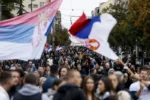
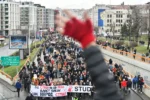
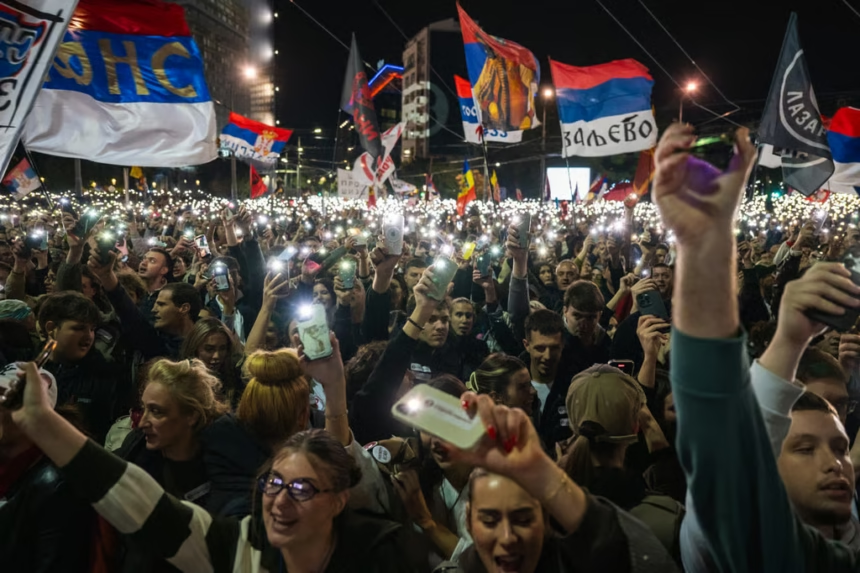
Memorial gatherings for the victims developed into mass demonstrations, with protesters demanding accountability over the disaster and broader action against corruption and government failures. The protests contributed to the resignation of the previous prime minister and grew into one of the largest protest movements in modern Serbian history.
A rally in Belgrade in March 2025 reportedly drew more than 325,000 people. Since then, students have continued demanding early elections and have sought to turn their public support into political change.
The movement has attempted to distinguish itself from established opposition parties by presenting a candidate list made up of professionals, including doctors, engineers and university professors, rather than relying primarily on career politicians.
Golubović said the student campaign had undertaken extensive door-to-door outreach across Serbia, challenging the SNS’s longstanding advantage in nationwide political organisation.
The movement has also built a substantial social media presence. According to figures cited by the students, its online network includes approximately 900 influencers with a combined reach exceeding 40 million followers.
Its campaign slogan, “Studenti pobeđuju!” — “Students Are Winning!” — has become a prominent feature of its online mobilisation.
A tense campaign and disputed polling
The campaign has unfolded amid tensions between the government and independent polling organisations.
Đorđe Vukadinović, editor of New Serbian Political Thought, said his organisation had faced intense criticism from government figures and pro-government tabloids over its findings. He described the reaction to previous polls as highly aggressive and said he had considered whether to publish the latest results.
Pro-government media and senior SNS figures have questioned the credibility of independent pollsters, while the student movement has continued to promote its own electoral prospects.
Vučić has also pursued an energetic campaign, using social media appearances, informal videos and unconventional advertisements to appeal directly to voters.
In one campaign advertisement, he portrays a restaurant waiter serving a Serbian family whose requests include avoiding sanctions against Russia, building new highways, increasing salaries and improving pensions.
Another advertisement features Vučić sitting opposite an empty chair bearing a photograph of Ilija Srdanović, the Student List’s lead candidate, alongside a stone traditionally used to weigh down barrels of pickled cabbage.
The campaign reflects Vučić’s efforts to present himself as a leader focused on everyday concerns while portraying the student movement as an inexperienced alternative.
Rule of law at the centre of the challenge
For the student movement, the campaign has centred on issues that organisers believe can unite voters across traditional political divisions, particularly the rule of law, accountability and corruption.
Igor Novaković of the International and Security Affairs Center told POLITICO that the movement had benefited from presenting a relatively unified platform rather than focusing on the ideological disagreements that have divided Serbia’s opposition in the past.
He described the movement as largely “depersonalized,” with an emphasis on institutional issues rather than a single dominant political figure.
The challenge comes after more than a decade of SNS rule, during which critics have raised concerns about the concentration of political power and the government’s influence over the media and state institutions.
Serbia’s relationship with the European Union has also remained complicated. Although the country is an EU candidate, Vučić’s government has refused to join Western sanctions against Russia and has maintained close ties with Moscow. European leaders have often prioritised cooperation with Belgrade on regional stability, migration and other strategic interests, prompting criticism that democratic concerns have received insufficient attention.
What happens if the students win?
A strong electoral result would not necessarily translate into an easy transfer of power. Novaković warned that a student-led government would face a deeply established political system and bureaucracy, making any transition difficult.
The movement’s supporters would also have to demonstrate that a campaign built around public mobilisation and institutional reform could translate its promises into effective governance.
However, even if the SNS retains power, the election could still weaken Vučić’s political position if the results show a substantial decline in public support.
As Novaković told POLITICO, the ruling party and government have already been weakened by the protests. A victory would not automatically restore their previous authority or legitimacy.
Sunday’s election therefore represents more than a contest for parliamentary seats. It is a test of whether a student-led movement that began with demands for accountability after a deadly infrastructure disaster can challenge the political dominance Vučić has maintained for more than a decade.