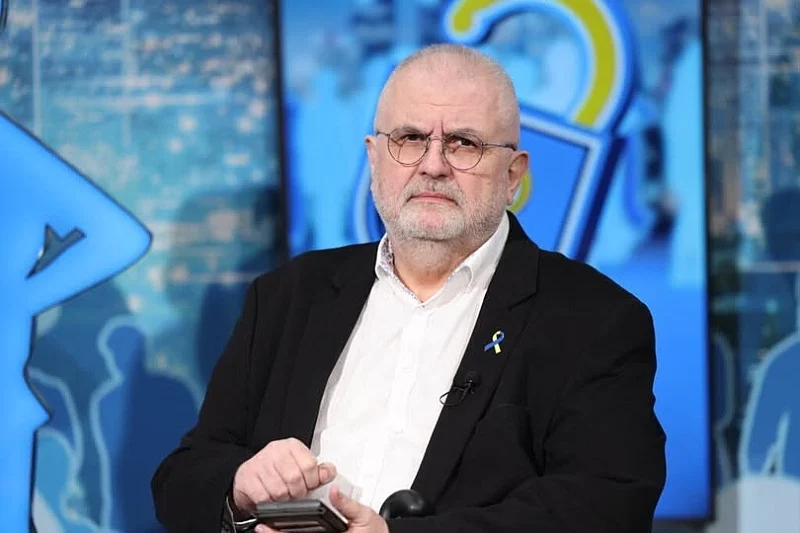
Former Vojvodina social democratic leader, writer and activist Nenad Čanak has announced that he has sought citizenship of Bosnia and Herzegovina in protest against what he described as unequal electoral rights between citizens of Serbia and residents of Republika Srpska who vote in Serbian elections.
Speaking on Federal Television’s Dnevnik D programme, Čanak discussed Serbia’s political situation, the upcoming parliamentary elections, the student movement and the relationship between Serbian President Aleksandar Vučić and Republika Srpska leader Milorad Dodik.
Čanak: The real political battle begins after election day
Commenting on Serbia’s upcoming parliamentary elections, Čanak said he did not expect rapid political change, arguing that the decisive struggle would begin after polling stations closed.
“Do you really think something can change overnight? In fact, the battle only begins on Monday. Everything so far has been a warm-up,” Čanak said.
He argued that winning votes was not enough to secure power, noting that a government must command the support of at least 126 of the 250 members of Serbia’s National Assembly.
Čanak also warned that repeat voting at certain polling stations could create opportunities for political bargaining by the ruling authorities.
He said Serbia’s electoral process had not been fair for the past two years, particularly since the collapse of the canopy at the Novi Sad railway station and the subsequent protests.
According to Čanak, pro-government media have sought to discredit the student movement by labelling its supporters “blockaders” and describing the student electoral list as a “Ustaša list.”
He recalled the opposition coalition formed by 18 parties in 2000 to challenge the rule of Slobodan Milošević.
However, Čanak also criticised the students, saying they had yet to present a clear strategy for governing after Vučić.
“Their entire energy comes from citizens’ anger. They are heterogeneous and do not have a clear vision of what comes next when they face the realities of politics,” he said.
Sharp criticism of Dodik
Čanak also made strong accusations against Milorad Dodik, the leader of the Alliance of Independent Social Democrats (SNSD), portraying him as a political pragmatist whose decisions are driven by the pursuit of power rather than a consistent ideology.
“Dodik is a travelling salesman,” Čanak said, alleging that Dodik changes his political positioning depending on the financial and political support available to him.
He also claimed that Russia uses Dodik to destabilise the Balkans and divert attention from its war in Ukraine. These were Čanak’s assessments and allegations, rather than independently established findings.
Čanak further argued that Dodik’s political future was closely tied to Russian President Vladimir Putin, suggesting that major changes in Republika Srpska would be unlikely while Putin remained in power.
Seeks Bosnian citizenship over voting rights
Addressing proposals to guarantee representatives of Republika Srpska seats in Serbia’s National Assembly, Čanak strongly opposed the idea, describing it as an attempt to manipulate the electorate.
He said he had applied for citizenship of Bosnia and Herzegovina to highlight what he sees as an imbalance in voting rights between the two sides of the Drina River.
“If Dodik can vote in Serbia, why shouldn’t I be able to vote in Banja Luka? How can this work in only one direction — people from Republika Srpska can influence our elections, while we cannot do the same?” Čanak asked.
He argued that those who contribute to a state’s budget should have a say in how it is governed, questioning why people from outside Serbia should influence decisions about its public finances while Serbian citizens cannot exercise equivalent influence in Republika Srpska.
Čanak also said resentment was growing in Serbia over the participation of voters from Republika Srpska in Serbian elections.
He referred to calls for a political separation along the Drina River, arguing that the current arrangements had become a source of frustration among some Serbian citizens.
“If life in Republika Srpska is so good under its current leadership, why are so many people leaving?” he asked.
His comments add to the ongoing debate over cross-border voting, political ties between Belgrade and Banja Luka, and the influence of voters from Republika Srpska on Serbia’s electoral outcomes.