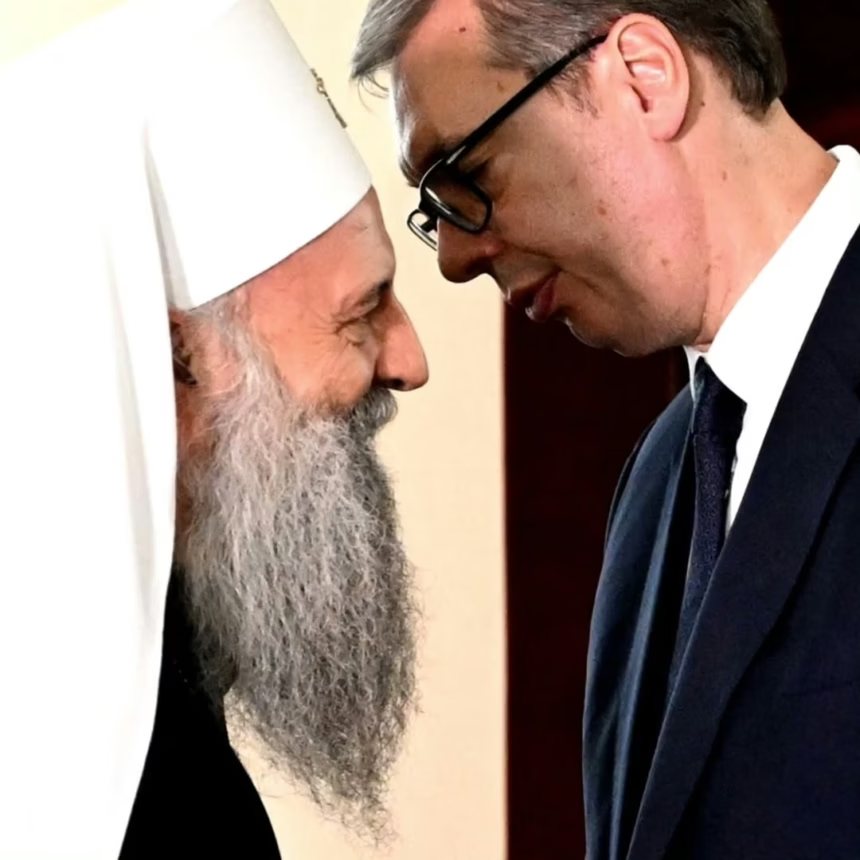
Serbian Patriarch Porfirije reportedly reacted with deep disappointment to Aleksandar Vučić’s election defeat, bringing renewed attention to the close relationship between the leadership of the Serbian Orthodox Church (SPC) and the Serbian Progressive Party (SNS) government.
According to sources cited by Serbian news outlet Nova.rs, a gathering at the patriarch’s residence in Belgrade’s Dedinje district had been celebrating an expected SNS victory on election night. Those present reportedly anticipated another term for Vučić and the continuation of the close cooperation between the Serbian state leadership and the Church.
The atmosphere changed after Vučić acknowledged defeat. The gathering ended shortly afterward, and Porfirije withdrew, with sources describing him as deeply upset and concerned.
The election result did not directly affect the patriarch’s position, which is determined by Church bodies. However, it raised questions about the political and institutional environment in which decisions concerning state funding, joint projects and disciplinary measures against critical clergy and theologians had been made.
Earlier that day, Porfirije had urged citizens to vote according to their conscience and accept the outcome with “calmness.” He described the result as the will of God, “perhaps not entirely understandable to us at a given moment.”
How opposition within the Church was weakened
The Serbian Orthodox Church’s relationship with the SNS government was not always uniform. While Metropolitan Amfilohije of Montenegro and the Littoral and retired Bishop Atanasije Jevtić were alive, Vučić’s policies had influential critics within the Church hierarchy, particularly over Kosovo.
In late 2017, Amfilohije supported an appeal to defend Kosovo and Metohija and subsequently warned that Vučić’s policies could lead to what he described as a betrayal of Kosovo. Pro-government media responded by portraying him as a politician in religious robes and suggesting that he sought to become patriarch.
In May 2019, Vučić attended a meeting of the SPC Assembly at the invitation of then-Patriarch Irinej. Reports of a heated exchange with Amfilohije emerged afterward. The metropolitan later made his position on Vučić’s Kosovo policy explicit.
“Vučić is a traitor. Through his behavior and actions, he is showing that he will betray Kosovo,” Amfilohije said.
Even Irinej, despite his close relationship with the Serbian leadership, occasionally set out positions that placed limits on the government’s approach. In September 2020, during negotiations between Belgrade and Prishtina, he told the author of the Nova article:
“The only agreement acceptable to the Serbian Orthodox Church is one in which Kosovo and Metohija remain part of Serbia.”
A year earlier, the Church’s Holy Synod had decided to award Vučić the Order of Saint Sava on the occasion of the 800th anniversary of the SPC’s autocephaly. Amfilohije opposed the Church taking sides with a political party, Atanasije said many bishops opposed the award, and Bishop Maksim questioned the discrepancy between the stated reasons for the honor and Vučić’s policy of territorial demarcation. Bishop Grigorije later argued that the award had overshadowed the significance of the anniversary.
The decoration was nevertheless presented, demonstrating how deeply attitudes toward Vučić had divided the Church.
Another dispute emerged during the religious processions in Montenegro against the Law on Freedom of Religion. In early 2020, Amfilohije asked Vučić to postpone a planned visit on Christmas Eve, amid concerns that his presence could divide protesters and benefit then-Montenegrin President Milo Đukanović. Grigorije claimed that Serbia’s authorities had supported Đukanović from the beginning.
Meanwhile, the pro-government tabloid Informer accused Amfilohije of working for the Montenegrin president, despite the metropolitan’s prominent role in leading protests against Đukanović’s law.
A shift in the Church’s balance of power
Amfilohije died in October 2020, two months after the Democratic Party of Socialists lost power in Montenegro. Even preparations for his funeral became a subject of disagreement over Vučić’s role.
According to several sources cited by Nova, Patriarch Irinej, Porfirije and Bishop Irinej Bulović supported allowing the Serbian president to deliver a speech at the funeral, arguing that it would contribute to Serbian unity. Other bishops, including Atanasije Jevtić, strongly opposed the proposal. Vučić ultimately did not speak.
Patriarch Irinej also died in November 2020, changing the balance of power within the SPC.
Grigorije continued to face criticism from politicians and pro-government media. When he announced in early 2021 that he wanted to bring together people working toward political change, the initiative was interpreted as preparation for a possible presidential candidacy. Ivica Dačić challenged him to decide whether he wanted to remain a bishop or become a candidate, while the Synod distanced itself from his statements.
Nova subsequently reported that the Synod had not even held a meeting before issuing its statement and that Irinej Bulović had been behind the response.
In February 2021, Porfirije Perić, then Metropolitan of Zagreb and Ljubljana, was elected patriarch. His reported closeness to Vučić had already attracted attention before his arrival in Belgrade.
The election was accompanied by suspicions of political influence, according to Church sources cited by Nova. Further questions emerged following an investigation by the Sarajevo-based Center for Investigative Reporting (CIN).
According to the investigation, which cited leaked Sky communications and other documentation, bishops were secretly recorded in the crypt of the Church of Saint Sava during the patriarchal election, despite assurances that they would not be filmed.
CIN reported that the cameras had been arranged by Ljuban Ećim, a former state security official, who subsequently received the recordings. Who wanted the material and what purpose it served remain unanswered questions.
State funding, cash payments and allegations of protection
The relationship between the Church and the state leadership also had a financial dimension, most visibly through the completion of the Church of Saint Sava in Belgrade.
After Amfilohije withdrew from the body involved in overseeing the construction, Nikola Selaković and Porfirije’s then-vicar, Bishop Stefan Šarić, reportedly gained important roles in subsequent decisions.
Sources within the SPC told Nova in 2020 that the two men had been involved in selecting contractors and managing funds for the interior decoration of the church.
The same sources described alleged cash payments abroad. They claimed that money was exchanged into dollars, with commissions allegedly paid to a banker and a businessman close to the SNS, before being delivered to a person involved in the church’s decoration.
They also alleged that one of Porfirije’s associates had been stopped while transporting money and that intervention from Serbia had prevented the incident from becoming public.
These allegations raise questions about how the payments were recorded, the legal basis for transporting cash and whether anyone intervened to prevent scrutiny. The claims have not been independently established in the material cited by Nova.
The scale of state funding is reflected in publicly reported figures. According to an assessment by Radar, at least €74.5 million in state funding had been provided for the Church of Saint Sava by early 2025. An additional approximately €2 million was approved in April 2025.
In June 2026, Porfirije and Prime Minister Đuro Macut, with Vučić present, signed an agreement worth more than €6 million for the final construction works.
The SPC also developed commercial property projects. Nova reported on the Dorćol Center complex, where apartment prices exceeded €4,000 per square meter, as well as an earlier development in New Belgrade comprising approximately 36,000 square meters and 127 apartments.
Documentation from 2024 also envisaged renovation and expansion works at the patriarch’s villa in Dedinje worth approximately €650,000.
Allegations involving Church officials
Questions about the protection of senior Church figures also emerged in connection with criminal complaints.
Marko Žarkov, a student at the SPC’s theological academy, accused Stefan Šarić of ordering his abduction. Šarić has not been charged. Two police officers, however, reached plea agreements over coercion. Žarkov disputed the version of events accepted in those proceedings.
According to information cited by Nova, the Church leadership was advised through an Israeli consultant associated with Vučić’s circle to present individual criticism as an attack on the entire institution. This approach, the report argued, turned questions of personal responsibility into appeals to believers to defend the Church.
A similar response followed a ruling by the District Court in Ljubljana in July 2026, when Porfirije received a four-month suspended prison sentence over allegations of workplace abuse involving former parish priest Željko Lubarda.
Lubarda claimed that pressure against him began after he reported alleged financial irregularities and refused to change his testimony. The SPC disputed his allegations and the regularity of the proceedings, describing the case as politically motivated.
The Synod said it had advised the patriarch not to appeal. Vučić also publicly defended Porfirije.
The Church leadership’s response to student protests
Student protests in Serbia exposed divisions between the SPC leadership and parts of its own clergy and congregation.
On April 22, 2025, while in Moscow with Russian President Vladimir Putin and Patriarch Kirill, Porfirije described developments in Serbia as a “color revolution.” Bishop Irinej Bulović helped him recall the expression. The patriarch expressed hope that the challenge would be overcome and conveyed Vučić’s greetings.
Some bishops took a different position. According to earlier reporting by Nova, six bishops sent Porfirije a letter emphasizing that students represented the country’s future and condemning statements by Bishop David of Kruševac, who had called the protesters Ustaše.
Among the signatories was Bishop Justin of Žiča. Priests in his diocese welcomed students during their marches, while students from Novi Pazar also stayed at Studenica Monastery on their way to Novi Sad. Justin additionally criticized police violence.
In autumn 2025, the Synod sent a commission to the Diocese of Žiča. Its members included Irinej Bulović, Metodije, Velibor Džomić, Miroslav Čolaković, Milan Andrić and Vladan Simić.
The official reason was concern over possible financial and material irregularities. Sources cited by Nova, however, claimed that the real reason was Justin’s support for the students and criticism of the government.
Porfirije asked Justin to cooperate with the commission. Justin was suspended on February 18, 2026, and Bishop Arsenije of Niš took over the administration of the diocese.
Metodije, meanwhile, reportedly changed his approach to Vučić. From a bishop who had avoided attending presidential lunches during Church assemblies, he became a senior cleric who presented Vučić with an award and thanked him for his support of the SPC. He later participated in the commission overseeing the diocese of his fellow bishop Justin.
According to Nova’s sources, Porfirije also privately urged individual bishops not to open Church buildings to students, treating their movement as hostile to the state.
On Saint Sava Day in 2026, students and citizens arriving after the “Knowledge Is Power” protest found the Church of Saint Sava closed. The stated reason was its opening hours. The same church had previously received Vučić early in the morning before his departure for New York.
Two days later, Church court decisions were issued against Blagoje Pantelić and Vukašin Milićević, excluding them from the Church community. Milićević was also defrocked. Both had criticized Porfirije’s closeness to the government.
Milićević said that during his hearing, he was questioned about his public appearances and whether he stood by his statements.
Disputes also extended to the Faculty of Orthodox Theology. Milićević was not reappointed as an assistant professor in March 2024, while Pantelić later challenged documentation concerning the proposed reappointment of Porfirije’s associate Dragan Radić, whose appointment was not supported by the relevant university council.
In May 2026, Porfirije and Macut, with Vučić present, signed a memorandum on establishing Saint Sava University. Critics warned that the project could separate theological education from the University of Belgrade and further restrict academic autonomy.
What remains after Vučić’s defeat?
Against this background, Porfirije entered election night with expectations of another SNS victory, according to Nova’s sources. The gathering at the patriarch’s Dedinje residence reportedly celebrated the anticipated continuation of the relationship between the Church leadership and the government.
After Vučić acknowledged defeat, the gathering ended.
The patriarch’s position remains a matter for the Church’s governing bodies. But questions raised by the election result extend beyond the political future of the SNS: why were critics within the Church disciplined, how was public money spent, and why did closeness to a particular government become a measure of acceptable conduct within the institution?
Porfirije had urged citizens to accept an unwelcome election outcome with calmness. Nova’s report argues that the same principle may now be relevant to the Church leadership’s own reckoning with decisions made during Vučić’s time in power.
The election result belongs to the ballot box. Questions about the Serbian Orthodox Church’s political alliances, financial arrangements and treatment of internal critics remain unresolved.