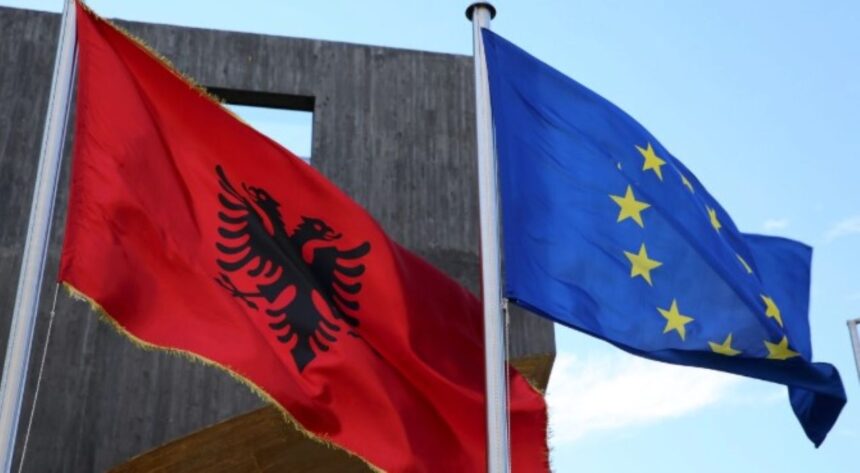
The European Commission has published its 2026 Progress Report on Albania, recognizing advances in judicial reform, the economy and several areas of EU integration while raising concerns about the functioning of democratic institutions, political interference in the judiciary, corruption and media freedom.
The report says Albania has met the EU’s interim benchmarks in the fundamentals cluster of accession negotiations, covering areas such as the judiciary, fundamental rights and the functioning of democratic institutions.
“Albanian authorities maintained their firm commitment to the strategic objective of EU integration as the country’s main priority, with the aim of closing all negotiation chapters by the end of 2027. Maintaining this pace will require the rapid delivery of high-quality EU-related reforms,” the Commission said.
The European Commission highlighted progress in judicial reform, the completion of the vetting process for judges and prosecutors, and the results achieved by the Special Prosecution Office against Corruption and Organized Crime (SPAK) in investigating high-level corruption.
It also noted positive developments in the fight against organized crime, economic growth, tourism and sectors including energy, education, customs and financial services.
Economic growth and judicial reform among positive findings
According to the report, Albania maintained strong economic growth in 2025, supported by domestic demand and tourism. Tourism also contributed to reducing the current account deficit to its lowest level on record.
The Commission additionally pointed to a declining public debt-to-GDP ratio, improvements in the labor market and the resilience of the banking sector.
In the field of justice, the report describes the completion of the vetting process for judges and prosecutors as an important achievement, saying it has further strengthened judicial independence, accountability and integrity.
SPAK also received positive assessments for its independence and tangible results in investigating high-level corruption.
The Commission noted progress in the fight against organized crime, particularly in strengthening prosecutorial investigative capacities, tackling money laundering and expanding international cooperation.
Positive assessments were also recorded in energy, education and culture, customs, the free movement of capital, company law, intellectual property rights, and policies concerning enterprises and industry. Albania was assessed as having a good level of preparation in several of these areas.
Political tensions continue to weaken Parliament
Despite the positive findings, the Commission identified persistent weaknesses in the functioning of democratic institutions.
It said the lack of meaningful political dialogue and continued confrontation between the governing majority and opposition had limited the effectiveness of Parliament.
“The lack of genuine political dialogue and public consultation activities, as well as clashes between the governing majority and the opposition, continued to limit its effectiveness. Parliament also failed to implement several decisions of the Constitutional Court,” the report stated.
The Commission also criticized the systematic rejection of opposition requests to establish parliamentary investigative committees, as well as what it described as the politicization of appointments to constitutional bodies and independent institutions.
“The frequent submission of legislative initiatives by the Council of Ministers, the systematic rejection of opposition requests to establish investigative committees, and the politicization of appointments to constitutional bodies or independent institutions all contributed to limiting Parliament’s oversight of the government,” the report said.
The Commission called for a comprehensive electoral reform, saying it was urgently needed ahead of Albania’s 2027 local elections.
Although the legal and institutional framework for elections was described as generally adequate, several longstanding recommendations from the OSCE Office for Democratic Institutions and Human Rights (OSCE/ODIHR) and the Venice Commission remain unaddressed.
EU calls for dialogue over protests
The report also addresses the wave of civic protests that began in May 2026 and student-led demonstrations in October, urging all sides to engage in constructive dialogue.
The Commission described the demonstrations as the largest civic mobilization in Albania since the country’s democratic transition, with tens of thousands of people participating at their peak.
It also noted that student-led protests took place in October and that violent incidents occurred between demonstrators and the Albanian State Police.
“Until now, no dialogue has taken place. All parties should make sincere efforts to engage in constructive dialogue,” the report said.
Concerns over political pressure on the judiciary
The Commission praised Albania’s continued implementation of the 2016 judicial reform and confirmed that the transitional vetting process for all judges and prosecutors had been completed following the conclusion of the appeals phase.
However, it warned that attempts by public officials and politicians to exert inappropriate influence over the judiciary had continued during the reporting period.
“Attempts by public officials or politicians to exert undue influence over the judicial system, including SPAK, as well as personal attacks against magistrates, continued during the reporting period,” the report stated.
SPAK was recognized for demonstrating independence and achieving positive results in the fight against high-level corruption.
Nevertheless, the Commission stressed that corruption remains a significant challenge and that the real impact of preventive measures has yet to be demonstrated, particularly in light of ongoing high-level investigations.
The report recommends further strengthening investigations, prosecutions and trials involving corruption, while securing more final convictions, particularly in high-profile cases.
Media freedom remains a concern
Media freedom was another area in which the Commission raised significant concerns.
The report said Albania does not provide sufficient legal safeguards for freedom of expression and that the media environment needs to improve to allow outlets to operate freely, independently and professionally.
It also pointed to the influence of political and economic connections on media independence and pluralism.
Among the problems identified were the economic penetration of the media market by politically connected business groups, overlapping political and commercial interests, a lack of transparency in funding sources, high levels of media ownership concentration, intimidation and smear campaigns, strategic lawsuits against public participation (SLAPPs), and precarious working conditions for journalists.
Public administration and fundamental rights
The Commission assessed Albania as moderately prepared in the area of public administration.
However, it criticized the government’s continued use of normative acts to approve budget revisions without parliamentary oversight.
Public consultations, the report added, were not consistently effective and were not followed by appropriate action.
On fundamental rights, the Commission highlighted concerns over prison conditions, property rights and the protection of minorities.
It said progress in prison reform had not matched the level of ambition required and that conditions in detention facilities continued to require close attention.
The report also called for improvements in the effective enjoyment of property rights and the rights of people belonging to minority groups.
The Commission urged Albania to complete the initial registration of land, digitize property titles and cadastral maps, and accelerate compensation for properties confiscated during the communist regime.
Albania has completed half of its Growth Plan milestones
The report also reviewed Albania’s implementation of the EU Growth Plan for the Western Balkans.
According to the Commission, Albania has fulfilled 33 of the 66 steps that were due to be completed by December 2025, while making substantial progress on most of the remaining measures.
Under the EU’s Reform and Growth Facility, Albania has access to more than €920 million in grants and loans.
The Commission’s overall assessment therefore reflects progress in several areas of Albania’s EU accession process, alongside continued expectations for reforms in democratic oversight, judicial independence, the fight against corruption and media freedom.