Healthcare services in several Russian regions are facing staff shortages, difficulties securing medicines and restricted access to medical treatment, as the Russian government plans to reduce funding for several federal healthcare programmes in 2027.
According to an analysis by Radio Free Europe/Radio Liberty, these problems could worsen following proposed cuts to the federal budget, as Moscow plans a significant increase in military spending amid its ongoing war in Ukraine.
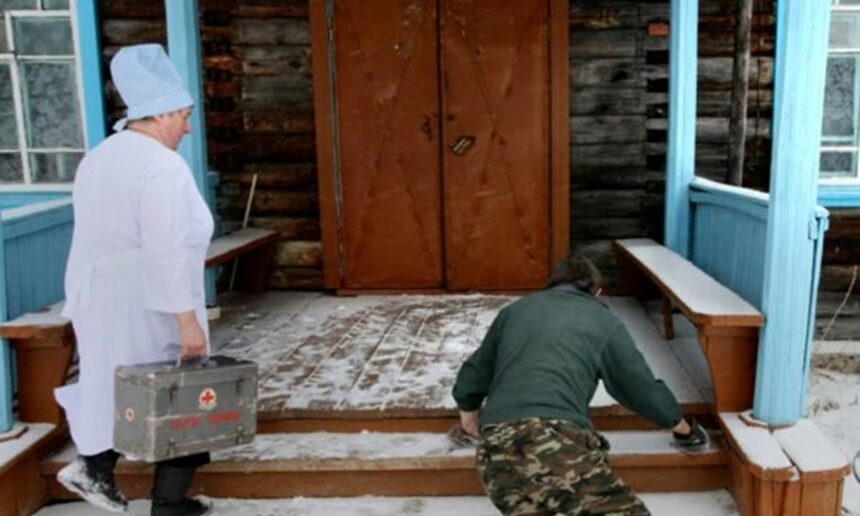
The consequences of underinvestment in healthcare are particularly visible in rural areas, where residents face shortages of specialist doctors and limited emergency services.
One such case was reported in the Yaroslavl region, northeast of Moscow, where a woman identified as Vera lost her mother after an ambulance took 50 minutes to arrive. Her mother had collapsed while waiting for an appointment with a surgeon.
According to Vera, the local clinic lacked sufficient staff and equipment to provide first aid. She said medical personnel were unable even to administer an adrenaline injection to her mother.
The village where the family lives and the surrounding settlements have expanded, but the local health centre still operates with only one medical assistant, who serves both adults and children. There is no paediatrician in the area, forcing families to travel to the city of Yaroslavl for specialised care or pay for private services.
Healthcare Cuts, Military Budget Increase
Funding for Russia’s national initiative, “Long and Active Life”, which includes 11 federal healthcare programmes, is expected to fall from 181 billion roubles, approximately $2.2 billion, in 2026 to 146 billion roubles, around $1.8 billion, in 2027.
The programmes cover primary healthcare, treatment of cardiovascular diseases and cancer, diabetes care, emergency services, rehabilitation and medical staff training.
At the same time, Moscow plans a substantial increase in military spending. According to budget documents obtained by Reuters, military expenditure is expected to reach 17.1 trillion roubles, approximately $211 billion, in 2027.
This represents a 27 per cent increase compared with the revised allocation of 13.5 trillion roubles for 2026.
The Russian government argues that increased funding through the compulsory health insurance system will compensate for some of the federal cuts. However, patient advocacy organisations warn that the change could create funding gaps, particularly in poorer regions.
Medicine Shortages and Difficulties for Patients
The problems extend beyond shortages of medical staff. In the Yaroslavl region, another resident, identified as Marina, described the difficulties she faced in obtaining morphine for her father, who was terminally ill.
To obtain prescriptions and medication, which was dispensed only in three-day supplies, she had to travel between several medical facilities.
“I was there at 6:45 in the morning, waiting in line to get one stamp, then rushing to another town to get another stamp and collect the medicine. I would return home at 5 p.m.,” she told Radio Free Europe/Radio Liberty.
Her mother also struggled to manage her diabetes because there was no endocrinologist in the area. For more serious health problems, the family had to rely on private doctors.
Similar situations have been reported in other Russian regions.
In the Pskov region, in the country’s northwest, a mother said her two-year-old son had been unable to receive medical treatment despite contacting several healthcare institutions after injuring his eye.
The hospital referred them to a children’s clinic, where the doctor said he was not an ophthalmology specialist. Emergency services suggested finding a private doctor, while a trauma centre also refused to treat the child.
According to the mother, the child had still not received the necessary medical care by the second day.
Problems have also emerged in maternity services. In the Vladimir region, plans to discontinue routine childbirth services at a hospital in the town of Kolchugino have sparked opposition from residents.
Under the plan, pregnant women would have to travel approximately 80 kilometres to the city of Vladimir to give birth. Residents have protested against the decision and appealed to the Ministry of Health.
Cancer Treatment Funding Faces Major Cuts
One of the most significant reductions concerns the federal cancer treatment programme.
Funding for the programme in 2026, initially planned at 144.9 billion roubles, was later reduced to 44.9 billion roubles. The draft budget for 2027 provides for just 3.87 billion roubles.
Russia’s Ministry of Health has said the reduction does not mean that support for patients is being withdrawn, but rather that the funding mechanism is changing. According to the ministry, most cancer treatments are now covered through compulsory medical insurance.
Nevertheless, during a discussion held on 13 October in the Federation Council, the upper house of Russia’s parliament, participants raised concerns about shortages of oncologists and medicines.
According to figures presented at the meeting, some regions had only five to seven of the 35 to 40 cancer medicines recommended for treatment.
On 15 October, Health Minister Mikhail Murashko announced that an additional six billion roubles would be allocated for medicines in 2027.
He also said that 113 billion roubles had been earmarked for regional medicine supplies and 285 billion roubles for centralised procurement, assuring that existing programmes would continue.
However, concerns about the healthcare system’s capacity have also been raised within state institutions.
On 29 October, during the first reading of the draft budget for the Federal Compulsory Medical Insurance Fund, Andrei Makarov, chairman of the Budget Committee in the lower house of parliament, highlighted exhausted treatment quotas, long waiting times for specialised services, staff shortages and difficulties transporting patients from the regions to federal medical centres.
Meanwhile, in the Siberian city of Krasnoyarsk, regional authorities plan to close two maternity hospitals by mid-January, citing a decline in birth rates and the condition of the buildings.
The decision has raised concerns among residents, particularly women who chose these facilities because they offered access to specialists in the event of complications during childbirth.
A mother of three who had given birth at one of the hospitals said she was shocked by the decision to close it.
The cases reported across different Russian regions show that the healthcare system’s problems are not limited to funding levels. They also involve unequal distribution of services, shortages of specialists and difficulties securing medicines.
While the Russian government promises to compensate for some of the cuts through alternative funding mechanisms, the planned increase in military spending raises questions about public spending priorities at a time when many citizens are struggling to access even basic healthcare services.