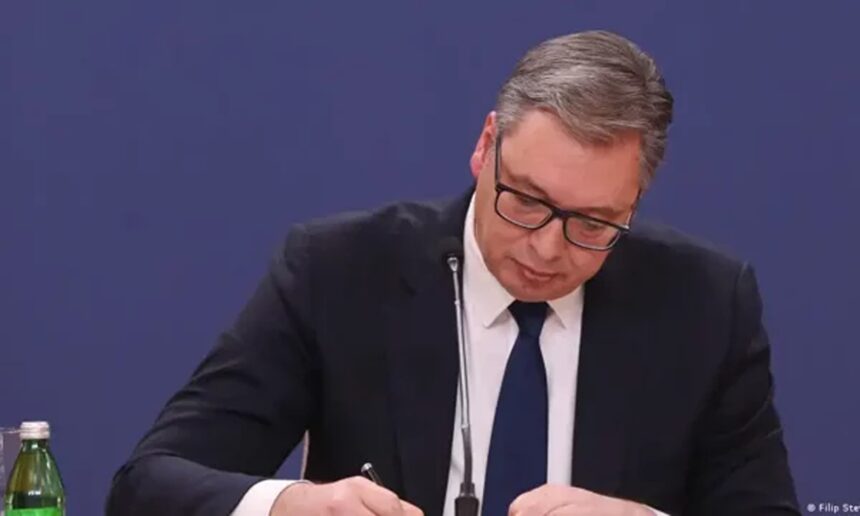
Aleksandar Vučić’s decision to pardon 49 people could potentially land him in the dock. If the victims of his decisions fail to obtain justice in Serbia, they may also seek justice before the European Court of Human Rights.
The Ministry of Justice has published the full list of 49 individuals pardoned by Aleksandar Vučić on 27 September, the day he resigned as President of Serbia. They include Dijana Hrkalović, State Secretary at the Ministry of Interior, at least 15 people accused of abuse of office, individuals prosecuted for money laundering, and people suspected of accepting bribes.
Vučić also pardoned around a dozen people who took part in attacks against protesters in Serbia over the past two years, sparking public outrage. Among them is Miloš Pavlović, who was on trial for the attempted murder of student Sonja Ponjović.
Last year, Vučić pardoned four activists from the Serbian Progressive Party (SNS) who attacked students in Novi Sad with baseball bats. He later pardoned a woman who, during the student blockades, struck a female student with her car, causing life-threatening injuries.
Sanja Radivojević of the Belgrade Centre for Human Rights (BCLJP) told DW that Vučić’s decision of 27 September represents a continuation of the abuse of the presidential pardon mechanism.
“We have highlighted this in connection with previous decisions to release from prosecution those accused of attacking students. A pardon Miloš Pavlović’s, for example terminates court proceedings and prevents a full investigation into responsibility for serious violence against a student who was peacefully exercising her right to protest and paying tribute to the dead,” she said.
The Arrest of Marko Kričak
On Sunday, 1 November, Marko Kričak, head of the Criminal Police Directorate, was arrested on suspicion of abuse of office in connection with a murder case at a restaurant in Belgrade earlier this year. Just two days later, reports emerged that he could also face responsibility for another criminal offence.
“Allegations of physical abuse and violent threats against Nikolina Singjelić required an immediate and independent response. But instead of an investigation into these allegations, he was promoted within the police hierarchy,” Radivojević said.
This is only one example of inadequate accountability. During the protests, other incidents involving the beating of minors were also reported in various parts of Serbia.
The Belgrade Centre for Human Rights and Research (BCHRP) filed 14 criminal complaints over the improper treatment of citizens by police between 28 June and 7 July 2025. None of these complaints has resulted in a court ruling.
Were the Pardons Legal?
Since Vučić announced on 27 September that he had pardoned 49 people, questions have been raised in Serbia over whether his decision complied with the law. Calls are growing for the Office of the Prosecutor for Organised Crime to determine whether Vučić violated the law.
Radivojević says the circumstances surrounding the pardons must be investigated.
“These circumstances include repeated pardons of individuals accused of violence against protest participants, the absence of publicly available reasons for such decisions, and the president’s statements that he was ‘correcting an injustice’ allegedly inflicted on these individuals by courts and prosecutors. All of this raises the question of whether his authority was used to shield certain individuals from criminal accountability and obstruct the work of the judiciary,” she said.
She added that, based on the documentation relating to each pardon, it should be determined whether the actions constituted abuse of office or another criminal offence.
Can Vučić’s Pardons Be Reviewed?
There are now calls for an examination of whether Vučić violated the law. Lawyer Mihailo Pavlović says that the only way to review these decisions is through proceedings before the Constitutional Court.
“The Constitutional Court has the authority to annul acts that violate the Constitution. However, it is questionable whether it could do so in this case, because the Constitutional Court would then violate the rights of the individuals who have been pardoned and definitively removed from criminal prosecution. In effect, the Constitutional Court would create a new violation of the rights of those who have received final pardons,” he explained.
Pavlović added that it is also possible to examine whether the pardon decisions themselves were the result of a criminal offence. However, it must first be established whether there are legal grounds to hold Vučić accountable for any violations.
Meanwhile, victims still have the option of seeking protection of their rights before the European Court of Human Rights.