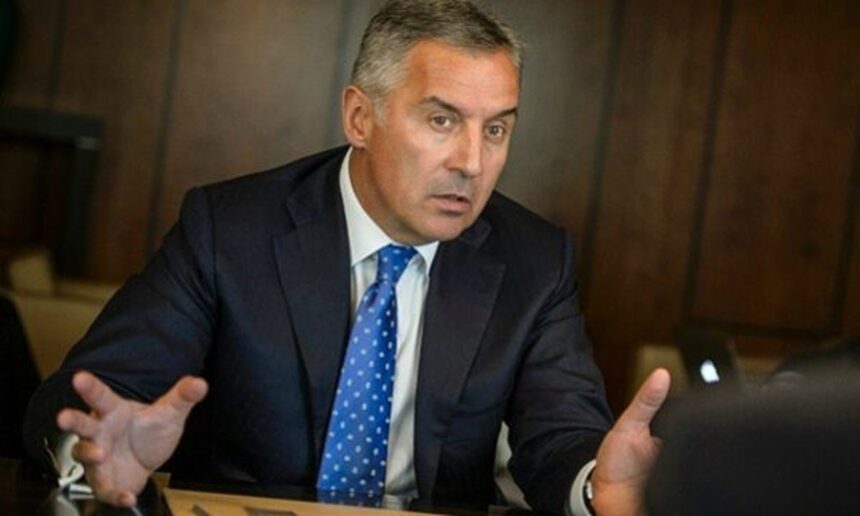
Former Montenegrin President Milo Đukanović has said that Serbia’s political future and its relations with Kosovo will be key indicators of the country’s political direction, warning that Aleksandar Vučić’s policies could continue depending on the composition and direction of the next Serbian government.
Speaking at a ceremonial plenary session in Cetinje, marking the 20th anniversary of Montenegro’s restoration of independence, Đukanović questioned whether Serbia would have a government representing the interests of the Serbian state or one representing the interests of Serbs across the region.
“The first question is whether Serbia will have a government of Serbia or a government of Serbs in the region. If it is the latter, then Vučić’s policy will continue,” Đukanović said.
He added that another decisive issue would be Serbia’s foreign policy and whether the country would commit itself to becoming a European state.
“The question of its position toward Kosovo will provide the answer as to whether Serbia is looking toward the future or digging into the past,” the former Montenegrin president stressed.
Criticism of Russia and Vučić’s Policies
Addressing geopolitical developments, Đukanović warned that legitimising the use of force and aggressive policies could have serious international consequences.
“Violent behaviour is being legitimised, and if this trend is not brought under control, I fear the geopolitical consequences,” he said.
According to Đukanović, some political forces pursuing such policies have already suffered setbacks, including in the US midterm elections.
He argued that Montenegro, as a small country, should focus on its region and domestic challenges, adding that it currently lacks the necessary capacity to confront the challenges emerging from the geopolitical situation.
Đukanović stressed that Montenegro should take advantage of emerging opportunities, particularly those connected with upcoming elections.
“It is foolish to repeat the same mistake,” he said, also referring to relations with Serbia, which he described as deeply damaged.
He added that political changes in Serbia should not trigger euphoria, arguing that it is essential to distinguish between a change of regime and a change of policy.
“If it is a change of regime, it does not bring much benefit. If it is a change of policy, then that is fine,” Đukanović said.
“The Destructive Government That Came to Power in 2020 Failed”
The former Montenegrin president also addressed domestic developments, arguing that the past six years have been characterised by stagnation and serious regression.
He said that progress toward European Union membership cannot conceal the problems he believes exist across all vital sectors of the state.
“The destructive government of 2020 failed,” Đukanović said, adding that Montenegro needs a government of national responsibility.
He stressed that the country must address its internal problems and that opportunities to change the political situation could emerge soon.
Đukanović also recalled the process of restoring Montenegro’s independence, saying there was reason to be proud of how the referendum was conducted and of the efforts made to build state institutions.
He also criticised the European Union’s lack of enthusiasm in the past, arguing that had Brussels shown even half the enthusiasm for enlargement that exists today, Montenegro would have joined the EU back in 2016.
Former EU envoy for Montenegro’s independence referendum, Miroslav Lajčák, also addressed the event, saying Montenegro is close to joining the European Union but that membership will not happen automatically.
Lajčák also referred to issues Montenegro must resolve with Croatia by the end of the year, stressing that accession requires a firm focus on the European objective.
Meanwhile, Aleksandar Radoman, Dean of the Faculty of Montenegrin Language and Literature, criticised the influence of parliamentary speaker Andrija Mandić on Montenegrin politics, describing him as the most powerful politician in the country.
Radoman alleged that security institutions, the prosecution and the police were being placed at the service of political interests, while also raising concerns about the state of the rule of law in Montenegro.