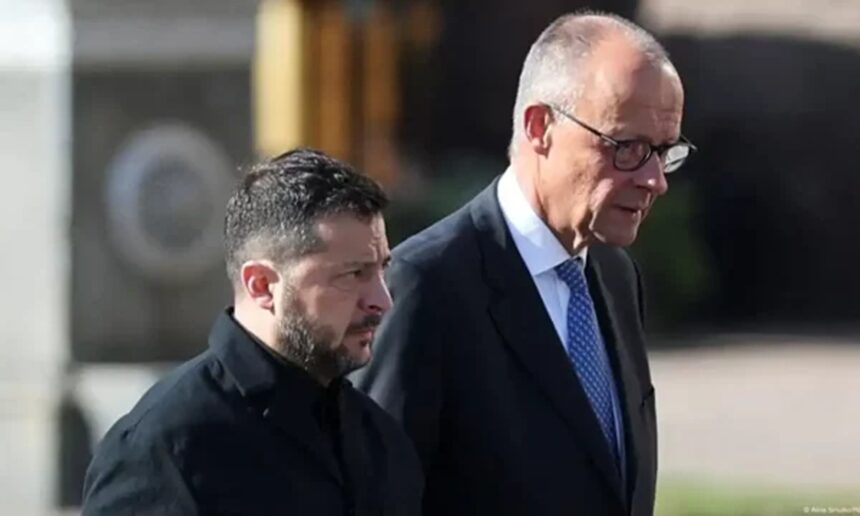
An additional €45 billion in EU funding is expected to reach Ukraine next year, but not all member states are prepared to contribute. German Chancellor Friedrich Merz is increasing pressure ahead of an informal EU summit.
A dispute over future support for Ukraine has erupted ahead of European meetings in Dublin. On Tuesday, Slovak Prime Minister Robert Fico accused German Chancellor Friedrich Merz (CDU) of “blackmail” and behaving “inappropriately” after Merz demanded that all EU member states contribute without exception.
Merz, meanwhile, reiterated that supporting Ukraine “is not the responsibility of individual member states” but “a shared responsibility” of the European Union.
“I will not give in to this,” Fico told journalists. “We are a sovereign country,” the Slovak prime minister stressed, adding that “we have our own opinion on this matter.”
German Chancellor Friedrich Merz had previously called on all EU member states to make a “fair contribution” toward covering Ukraine’s multi-billion-euro funding shortfall. In a letter to European Council President António Costa, he indirectly warned that progress on other financial matters could be blocked if a common commitment to supporting Ukraine was not secured.
According to the letter, obtained by the German Press Agency (dpa), such a commitment is an “essential prerequisite” for resolving the funding issue and discussing other matters, particularly those with financial implications. Ukraine faces a funding gap of €45 billion next year.
Merz is also calling for a common solution during negotiations on the EU’s long-term budget for 2028–2034, backed by all member states, to ensure sustainable, multi-year financing for Ukraine as it continues to face Russian aggression. The European Union aims to reach an agreement on the new financial framework by the end of this year.
“A Matter of Common European Security”
“Supporting Ukraine is a matter of our common European security, and this must also be reflected in the distribution of the burden of assistance,” Merz wrote in his letter to Costa.
He urged the European Council president to make the issue a priority at the EU’s informal summit scheduled for Friday in Dublin.
The European Commission had previously estimated that Ukraine’s funding gap for next year would reach €70 billion, of which the EU is expected to cover €45 billion. Last year, the European Union approved €90 billion in assistance for Ukraine for the 2026–2027 period.
However, these funds are not considered sufficient. Ukrainian President Volodymyr Zelensky had already requested an additional €70 billion from Western allies in October to finance his country’s defence against Russian aggression.
Following that request, EU leaders asked the European Commission to present a proposal for securing additional funding.
Bulgaria and Slovakia Oppose New Assistance
Nevertheless, several member states are showing resistance. Bulgarian President Rumen Radev and Slovak Prime Minister Robert Fico have stated that their countries will not support new EU financial packages for Ukraine.
Hungary and the Czech Republic are also considered uncertain partners on the issue.
Hungarian Prime Minister Péter Magyar recently met German Chancellor Friedrich Merz in Berlin, with support for Ukraine among the main topics of discussion. During the meeting, Merz stressed that assistance for Ukraine should come “entirely from the European budget”.
Germany remains Ukraine’s largest donor within the European Union, which also explains Merz’s insistence on a broader and fairer distribution of the financial burden among member states. /DW