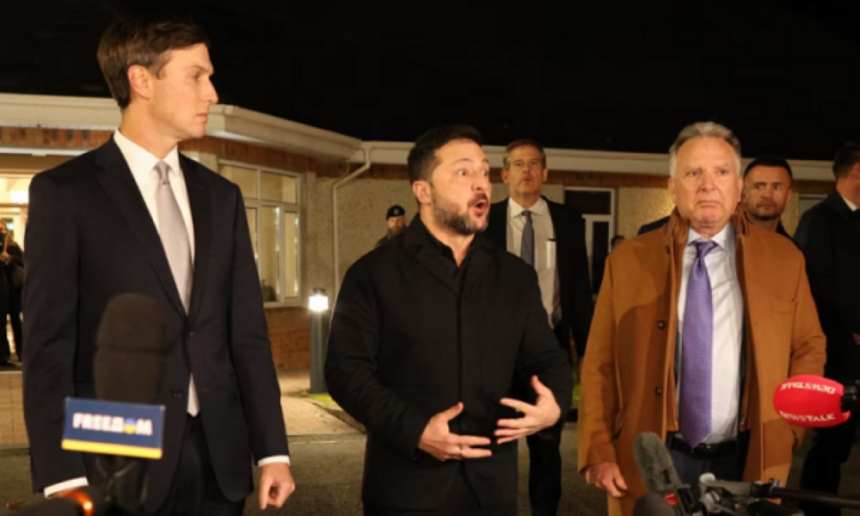
Three days of diplomatic efforts involving Moscow, Kyiv and Washington have produced limited progress towards ending Russia’s war against Ukraine. US envoys say the sides have agreed to include European countries in the next round of negotiations. However, Vladimir Putin’s territorial demands and continued Russian attacks suggest that a comprehensive peace agreement remains far from reach.
The most significant development came on November 12, when US President Donald Trump’s envoys, Jared Kushner and Steve Witkoff, announced that Putin had agreed to allow European representatives to participate in the next round of peace talks.
European involvement in discussions concerning the continent’s security could strengthen Ukraine’s negotiating position, particularly as the proposed arrangements would have direct consequences for European countries.
Nevertheless, Putin continues to demand that Russia gain full control of four Ukrainian regions Moscow claims to have annexed. He has also rejected the deployment of foreign peacekeeping forces in Ukraine.
Kushner Says Diplomatic Efforts Have Made Progress
Following meetings with Putin in Moscow, Ukrainian President Volodymyr Zelensky in Dublin, and European national security advisers, Kushner described the three days of diplomatic discussions as having produced “meaningful progress.”
He said both sides had agreed to include European partners in the next round of negotiations, adding that discussions would address territorial disputes between Russia and Ukraine as well as broader European security arrangements.
Kushner also sought to reassure Kyiv that no wider European security agreement would be finalized without addressing Ukraine’s security concerns. Apart from humanitarian measures, he said, nothing would be finalized until a comprehensive agreement had been reached.
After meeting Zelensky in Dublin, Kushner described their conversation as “very good” and welcomed progress towards a potentially major prisoner exchange.
He said Putin was at least willing to “give it a try” when it came to European participation in the negotiations.
According to Kushner, Washington was working towards what could become the largest prisoner exchange since the beginning of the war, potentially allowing thousands of people to reunite with their families. He acknowledged, however, that significant differences remained between the parties.
Thomas Melia, a former senior US State Department official and senior fellow at Georgetown University’s Center for Democracy and Governance, welcomed the prospect of European involvement, arguing that it would strengthen Kyiv’s position.
“The more Europeans are involved, the stronger Ukraine’s position will be,” he told Radio Free Europe, pointing to European leaders’ commitment to Ukraine’s defence and sovereignty.
European Involvement Remains Uncertain as Putin Maintains His Demands
Putin’s position following the Moscow meeting offered few indications that the Kremlin was prepared to change its negotiating demands.
The Russian president has insisted that discussions should also address European security, suggesting that four-party negotiations could begin once European countries appoint an authorized representative to speak on their behalf.
This approach has raised concerns that Moscow could use discussions about European security to shift attention away from its invasion of Ukraine and deepen divisions among Western allies.
EU foreign policy chief Kaja Kallas argued that Europe already had an established security architecture, pointing to existing agreements that Russia had repeatedly violated. Without a ceasefire and respect for existing commitments, she warned, discussions about a new security arrangement risked distracting from the central issues.
European leaders have so far been reluctant to appoint a single negotiator. French President Emmanuel Macron stressed that Europeans would make their own decisions regarding their security, while German Chancellor Friedrich Merz said the priority was to get Putin to engage seriously in negotiations.
Geoffrey Pyatt, who served as US ambassador to Ukraine from 2013 to 2016 and now chairs the advisory board of Ukrainian energy company DTEK, told Radio Free Europe that he saw little evidence of a genuine change in Moscow’s objectives.
Pyatt said Ukrainians remained determined, adding that discussions about European participation could create the impression that diplomacy was advancing without necessarily producing meaningful changes in Russia’s position.
Prisoner Exchange Could Be the Most Tangible Result as Fighting Continues
A major prisoner exchange could emerge as the most concrete humanitarian achievement of the latest diplomatic efforts in the short term.
Melia welcomed the possibility of a significant number of prisoners returning home, arguing that such an outcome would be valuable even if the war continued.
However, he cautioned against confusing humanitarian progress with political progress. Russia continues to attack civilians and civilian infrastructure in Ukraine, while Ukrainian forces are targeting Russian facilities with military significance.
Bill Cole, founder of the Peace Through Strength Institute, warned that negotiations could drag on without changing the balance of power on the battlefield or bringing the two sides closer to an agreement.
Speaking to Radio Free Europe, Cole suggested that negotiations could continue into early 2027. He argued that the United States and its European allies should invest more heavily in unmanned systems and Ukraine’s drone capabilities to weaken Russia’s military strength.
He described Ukraine’s battlefield experience as a strategic asset for the West, arguing that Washington was not making sufficient use of Ukrainian expertise to improve its own military capabilities.
Cole also referred to Kushner’s comparison of diplomacy to “pushing a big rock uphill,” saying it reflected the US administration’s understanding of how difficult achieving meaningful progress would be.
He said he would be watching to see whether Washington was prepared to change its approach if negotiations failed to deliver results.
Starlink Restrictions Add to Uncertainty
The diplomatic efforts unfolded amid new restrictions affecting Ukraine’s military communications, which rely heavily on Starlink satellite services.
Zelensky said problems involving Starshield, SpaceX’s military satellite service, had made it more difficult for Ukrainian forces to intercept increasingly sophisticated Russian drones.
Kyiv requested explanations from Washington, with the Ukrainian president saying the restrictions appeared intentional and were unlikely to have resulted from a technical malfunction.
US Senators Jeanne Shaheen and Thom Tillis criticized the reported restrictions and called on the Trump administration and SpaceX to restore Ukraine’s access to the services. They also pledged that Congress would investigate who had ordered or approved the restrictions.
Melia questioned explanations provided by the White House, Elon Musk and the companies involved, describing them as unconvincing and suggesting that important information was being withheld.
Pyatt said the latest developments had not changed his assessment of Moscow’s intentions.
“Russia has not changed its objectives and is not negotiating seriously,” he said, calling for increased pressure on Moscow.