Representatives of Kosovo Serbs today filed a criminal complaint against former Serbian officials Aleksandar Vučić, Ana Brnabić, Petar Petković and Goran Rakić, accusing them of abuse of official position and violations of the Constitution of Serbia.
The complaint calls for investigations into several issues, including the Brussels Agreement, the Franco-German proposal, the Washington Agreement and the murder of Oliver Ivanović, the Serbian news portal NASH reports.
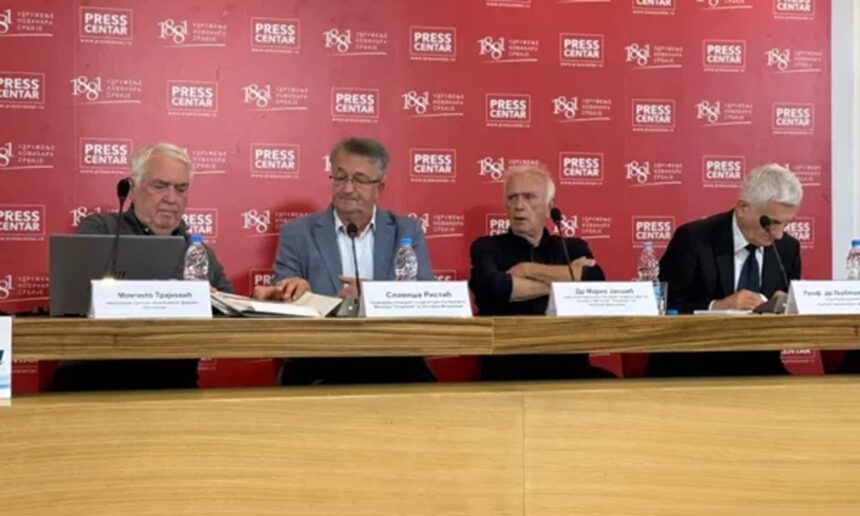
The complainants include Momčilo Trajković, president of the Serbian National Forum in Gračanica; Slaviša Ristić and Marko Jakšić, president and member of the “Fatherland” Movement of the Serbian People; Ljubiša Dabić, president of the Serbian National Council; and retired general Momir Stojanović.
According to the complaint, there are grounds to suspect that former Serbian officials repeatedly exceeded their authority and abused their official positions during the political dialogue on Kosovo.
“The subject of the complaint is the suspicion that, during the negotiations, the suspects acted beyond the limits of their powers, without institutional decision-making or by circumventing established procedures. This conduct resulted in consequences for citizens’ rights and Serbia’s public interest,” Trajković said.
The 25-page complaint asks Serbia’s Higher Public Prosecutor’s Office to obtain the original documentation, question the relevant individuals and establish who took specific actions, when, in what capacity and with what intentions.
Trajković said the 2013 Brussels Agreement was also among the matters covered by the complaint, arguing that the damage caused by its implementation should be determined.
“The role of the Serbian List and possible pressure on the Serb population must be investigated, along with local and parliamentary elections and the position of representatives, the integration of judges, prosecutors and police officers, telecommunications and energy agreements concerning Lake Ujman, vehicle licence plates and public statements, the 2020 Washington Agreement, the Franco-German proposal and its 2023 implementation annex, the murder of Oliver Ivanović, as well as the events in Banjska,” Trajković said.
Ristić cited the transfer of cadastral records to Kosovo authorities as one example, claiming that Kosovo Serbs can no longer obtain information about their land plots in Serbia.
“If you, as the owner of land in Kosovo, cannot obtain confirmation in Belgrade that you own that land, what is that if not a renunciation?” Ristić asked.
He also claimed that the Serb population in Kosovo had been reduced by half compared with 2012.
Jakšić said that the boundary between Kosovo and the rest of Serbia had effectively been established in 2012.
“There are a large number of things the state has done. For example, in 2016, Vučić pledged, through an agreement with Isa Mustafa, that Belgrade would not prosecute Albanians from Kosovo. If any Albanian had committed serious war crimes, Belgrade would not prosecute them. This is contrary to the Constitution of Serbia,” Jakšić said.
He also cited Kosovo’s recognition as a separate participant in sporting events during the previous government as another example.
Jakšić further claimed that Vučić’s government had relinquished control of the energy sector and handed it over to Prishtina.
“The Franco-German plan, which Vučić accepted, states that Serbia recognises Kosovo’s independence, territorial integrity and sovereignty,” Jakšić said.
Oliver Ivanović was convicted at first instance of war crimes against Albanian civilians
The inclusion of Oliver Ivanović’s murder in the criminal complaint also warrants recalling the war-crimes proceedings against him concerning events in Mitrovica during the 1999 conflict.
On 21 January 2016, the Basic Court in Mitrovica found Ivanović guilty at first instance of war crimes against the civilian population and sentenced him to nine years in prison. The case concerned the killing of four Albanian civilians on 14 April 1999, following the expulsion and separation of Albanian residents from their homes.
According to the Humanitarian Law Centre, the trial panel heard 81 witnesses, including 55 prosecution witnesses. In its reasoning, the court stated that direct evidence placed Ivanović at the scene, wearing a uniform and carrying a weapon, alongside members of Serbian forces. Several witnesses identified him there, and the court described their statements as credible and convincing. Fond za humanitarno pravo+1
The indictment had alleged that Ivanović, acting as a leader of a Serbian paramilitary/police unit, incited subordinates to commit war crimes and ordered the killing of nine civilians, four of whom were killed. The Humanitarian Law Centre also noted that the court did not find him guilty of command responsibility and that questions remained about his precise role in the events. Fond za humanitarno pravo+1
In February 2017, the Court of Appeals overturned the first-instance conviction and ordered a retrial. However, the proceedings against Ivanović ended without a final judgment after he was assassinated on 16 January 2018. Consequently, his first-instance conviction was never upheld by a final court ruling.