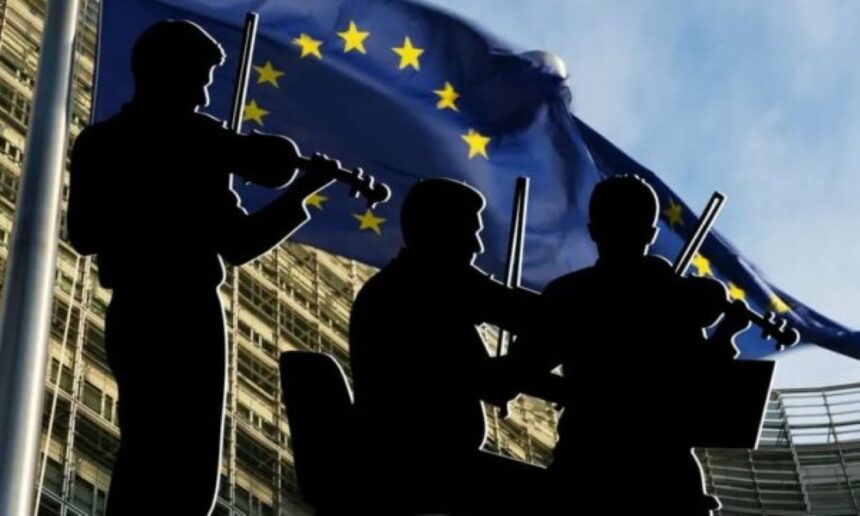
The European Commission has formally expressed regret over the performance of the Serbian nationalist song “Oj, Kosovo, Kosovo” during the opening concert of the EU Enlargement Forum in Brussels.
In a written response to Report TV, the Commission clarified that it had neither selected nor approved the song, stressing that its performance did not reflect the institution’s position towards Kosovo.
The European Commission’s full response:
“As Commissioner Kos stated this morning, the song in question was selected by the musical group and was not approved by the Commission. We regret the band’s choice. It touches on particular sensitivities, especially given the painful history and different experiences of communities in Kosovo.
The song in no way reflects the position of the European Commission or Commissioner Kos towards Kosovo and its history.
We cannot change our shared past, but we can choose our shared future. And that future must be European — a future without divisions, where everyone feels at home.
We are not asking people to forget their differences. We are building a Europe where differences are no longer a reason for people to live separately.
As one of the speakers at yesterday’s event said: Differences are good, divisions are not.
It is in this spirit that we continue to support Kosovo on its path towards the European Union.
Representatives from all candidate and potential candidate countries are actively participating in the Forum. It is true that five of our candidate countries have government representatives attending the event.
Kosovo is represented by civil society representative Donika Emini, from D-Square, who is participating in a dedicated panel on reconciliation.”
The song “Oj, Kosovo, Kosovo”, dating back to 1989, was performed instrumentally, without lyrics, by the Slovenian group Marko Hatlak & Kapobanda during the “Melodies of Unity” concert at Albert Hall in Brussels.
The song’s lyrics describe Kosovo as “my beloved land” and refer to Prince Lazar and Miloš Obilić, two prominent figures in Serbian history and tradition associated with the 1389 Battle of Kosovo.
It also references the Gračanica Monastery and Vidovdan, the day on which Serbs commemorate the historic battle. Through these references, the song connects Kosovo to Serbian national history and identity, presenting it as a land belonging to Serbs.
The Commission’s written clarification comes amid criticism over the choice of music at an event intended to promote European unity and reconciliation, particularly given the sensitivities surrounding Kosovo’s history and its relations with Serbia.