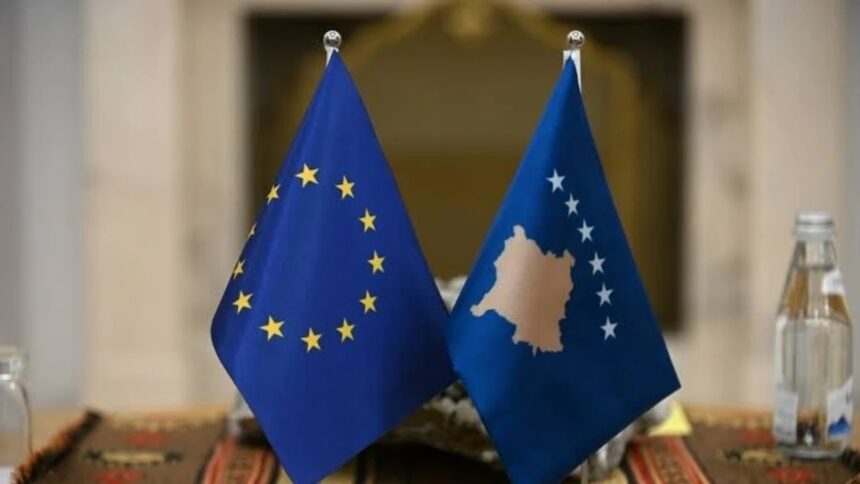
Representatives of Kosovo and the European Commission have held their eighth meeting of the Subcommittee on Economic and Financial Issues and Statistics in Pristina, במסגרת the Stabilisation and Association Agreement (SAA).
Held on 19 November, the annual meeting focused on Kosovo’s economic and financial developments, budgetary and fiscal policies, the business environment, public financial management, statistics and public internal financial control.
Particular attention was given to Kosovo’s progress towards European Union integration and the implementation of recommendations outlined in the European Commission’s 2026 Enlargement Package.
Discussions on economic and fiscal developments covered the growth and structure of gross domestic product (GDP), foreign direct investment, inflation, labour market trends and the external financial balance. Participants also reviewed Kosovo’s fiscal outlook, budgetary challenges and risks, as well as preparations for the 2027 budget.
The need to adopt a new Medium-Term Expenditure Framework was also highlighted, following the period of institutional instability. The framework is intended to establish a clear fiscal strategy and strengthen its link with the annual budget process, while improving consultations and the involvement of civil society.
The EU stressed the importance of maintaining macro-fiscal stability by respecting expenditure and deficit limits set out in fiscal rules, while prioritising transformative spending that supports economic growth.
Participants also examined structural reforms aimed at strengthening Kosovo’s ability to withstand competitive pressures and market forces. Discussions covered the business environment, the energy sector, privatisation, private sector development, the digitalisation of business registration and efforts to attract productive foreign direct investment.
The European Commission acknowledged progress in financial supervision but underlined the need to improve corporate governance in publicly owned enterprises.
The meeting also addressed developments in the free movement of capital. The EU welcomed Kosovo’s recent application to join the geographical scope of the Single Euro Payments Area (SEPA), submitted following further alignment of its framework for preventing money laundering and combating the financing of terrorism.
On statistics, participants reiterated that reliable, high-quality data are essential for developing sustainable, inclusive and evidence-based economic policies. They highlighted the importance of improving access to administrative data sources and ensuring their systematic use.
The discussions also emphasised the need to strengthen the institutional capacity of the Kosovo Agency of Statistics, particularly by ensuring sufficient human and financial resources for the Agricultural Census, which has been postponed until 2027.
Regarding public financial control, the EU called for faster progress towards establishing a comprehensive public internal financial control system. Participants also highlighted the urgent need to improve the implementation of external audit recommendations, strengthen internal audit capacities and increase transparency in public reporting.
As Kosovo’s strongest partner and largest provider of financial assistance, the European Union reaffirmed its commitment to continued cooperation under the Stabilisation and Association Agreement, supporting reforms aimed at bringing Kosovo closer to EU membership.