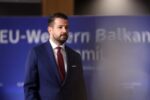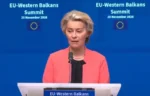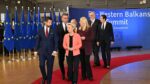
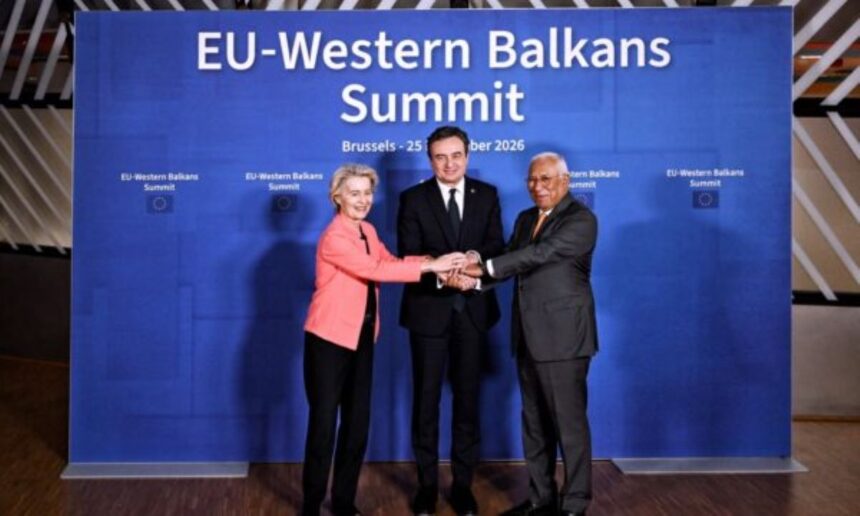
The annual EU–Western Balkans summit has opened in Brussels, with the region’s European integration prospects, the Kosovo-Serbia dialogue and financial assistance under the EU Growth Plan high on the agenda.
According to RTK correspondent Gjeraqina Tuhina, five of the six Western Balkan leaders are participating in the summit, while Serbia has chosen not to send a representative.
The summit’s final declaration condemns the glorification of war criminals and historical revisionism, while urging countries that have not yet aligned their sanctions policies with the European Union to do so.
The appeal is primarily directed at Belgrade, as all other Western Balkan countries have fully aligned their foreign and security policies with the EU.
The Kosovo-Serbia dialogue also features prominently in the declaration. EU leaders stress that all agreements reached within the dialogue framework must be implemented without delay, warning that the lack of progress towards normalising relations is hindering both countries’ European integration prospects.
Kosovo is represented at the summit by Prime Minister Albin Kurti, who has once again called for the country to be granted EU candidate status.
Kosovo remains the only Western Balkan country without candidate status, despite submitting its membership application four years ago, which has yet to be examined by the relevant EU institutions.
Kurti also addressed Serbia’s future leadership, calling for the arrest of Milan Radoiçiq and his extradition to Kosovo to face justice.
Meanwhile, decisions on the allocation of funding under the EU Growth Plan are expected to be confirmed soon, determining which countries will receive additional financial support and which will lose access to funds.
North Macedonia, Montenegro and Albania are expected to benefit from funding that Kosovo, Serbia and Bosnia and Herzegovina are set to forfeit.
The exact amounts are expected to be announced by the European Commission.