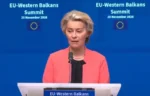
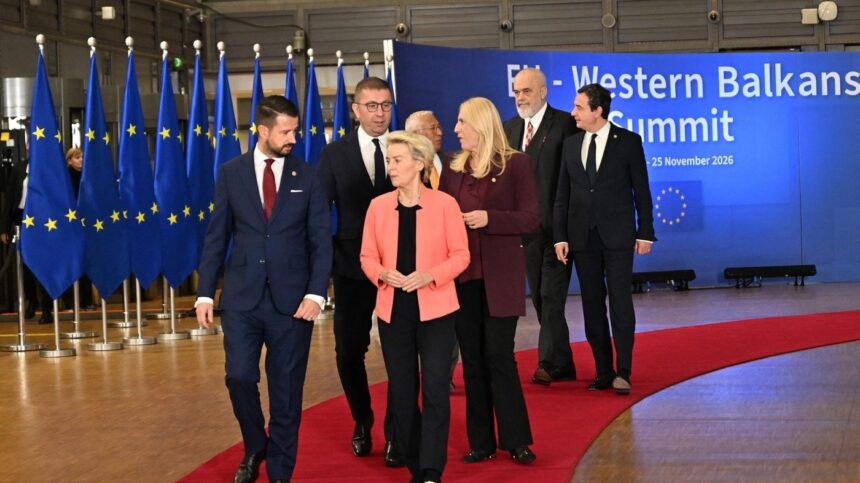
European Union leaders have reaffirmed that EU enlargement is a realistic prospect for the Western Balkans, urging countries across the region to accelerate key reforms and demonstrate their commitment to European values through concrete actions.
The position is outlined in the agreed declaration of the EU–Western Balkans Summit in Brussels, which has received the approval of all 27 EU member states. Western Balkan partners have been invited to endorse the document, although Serbia is not expected to join, given its absence from the summit and the fact that it does not yet have a fully operational government.
The declaration reiterates the EU’s “full and unequivocal support” for the region’s membership perspective, describing enlargement as a geostrategic investment in Europe’s peace, security, stability and prosperity.
“The future of the Western Balkans is within our Union. Enlargement is a real possibility that must be seized,” the document states.
European leaders welcomed the progress achieved since the previous summit in Montenegro in June, while emphasising that each candidate country will advance towards membership based on its own merits. The EU also acknowledged the need to continue its internal preparations and reforms ahead of admitting new members.
Democracy, rule of law and media freedom among key demands
The declaration places particular emphasis on democratic standards, fundamental rights and the rule of law, calling on Western Balkan governments to demonstrate their commitment through concrete reforms and measurable results.
It specifically highlights freedom of expression, independent and pluralistic media, gender equality and a strong civil society as essential elements of functioning democracy.
The document also strongly condemns the glorification of war criminals, genocide denial and historical revisionism, describing such practices as incompatible with fundamental European values.
Western Balkan countries are urged to promote respect and solidarity with all victims of war crimes and to implement rulings issued by international and domestic courts.
Regional cooperation, reconciliation and good neighbourly relations are also identified as essential for the region’s European future.
The declaration calls for the implementation of international agreements in good faith, including the Prespa Agreement between Greece and North Macedonia and the Treaty of Friendship, Good Neighbourliness and Cooperation between North Macedonia and Bulgaria.
The final version also strengthens language concerning the succession of the former Yugoslavia, explicitly demanding that all outstanding obligations under the Succession Issues Agreement be fulfilled and unresolved matters settled.
European leaders further called for renewed efforts to resolve outstanding cases of missing persons and address unresolved war crimes issues, ensuring accountability and justice.
Kosovo–Serbia dialogue remains a condition for progress
The declaration states that the failure to normalise relations between Belgrade and Prishtina continues to slow down the European integration process of both sides.
EU leaders reiterated their full support for the EU-facilitated dialogue and encouraged both parties to use the current political moment to engage constructively and make progress towards implementing all previously reached agreements.
“We encourage both partners to seize the current political moment for constructive engagement in the dialogue and to make concrete progress without delay towards the full implementation of all agreements reached,” the declaration states.
The reference to the current political moment comes as Serbia undergoes the formation of new institutions following the October 25 parliamentary elections.
The document also makes clear that financial assistance under the Western Balkans Reform and Growth Facility is conditional on constructive engagement, measurable progress and concrete results in the normalisation of relations.
Alignment with EU foreign policy and sanctions against Russia
The declaration stresses that alignment with the EU’s Common Foreign and Security Policy, including the implementation of European sanctions and preventing their circumvention, remains a strong indication of the region’s strategic commitment to the bloc.
European leaders welcomed those Western Balkan partners that have fully aligned themselves with EU foreign policy and urged the remaining countries to follow their example.
The document also reaffirms support for a comprehensive, just and lasting peace in Ukraine, based on international law and credible security guarantees, while pledging continued assistance to Ukraine in defending its sovereignty and territorial integrity against Russian aggression.
Gradual integration and the €6 billion Growth Plan
The EU reiterated that bringing the Western Balkans closer to the bloc even before full membership remains one of its strategic priorities.
The declaration refers to ongoing discussions about new proposals for gradual integration into the EU. Such arrangements would depend on alignment with relevant EU legislation, be based on individual progress and remain reversible if the required conditions are no longer met.
However, the document does not specify what these new proposals would involve or establish a timetable for their introduction.
European leaders welcomed progress in integrating the region into the EU’s single market, including efforts to eliminate additional roaming charges, integration into the Single Euro Payments Area (SEPA), and measures to facilitate trade and cross-border transport.
Western Balkan governments have also been urged to accelerate reforms to make full use of the €6 billion Growth Plan for the region, which is now entering its final phase.
Security, energy and fight against organised crime
The declaration also highlights the importance of closer cooperation between the EU and Western Balkan countries in security and defence, energy, transport and migration management.
Other priorities include combating corruption and organised crime, as well as addressing hybrid threats and foreign information manipulation.
EU leaders also called on regional governments to communicate more clearly to their citizens the EU’s role as the Western Balkans’ main investor and trading partner, its largest provider of financial assistance and a reliable security partner.
The declaration reinforces the EU’s commitment to enlargement while making clear that progress towards membership will depend on concrete reforms, regional cooperation, alignment with European foreign policy and the resolution of outstanding disputes.