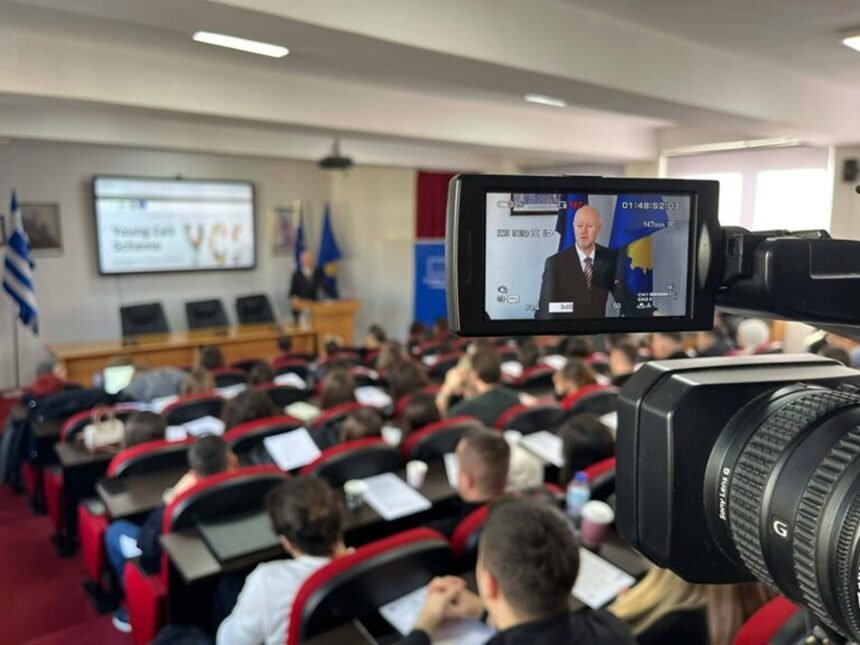
The EU Winter School 2025 officially opened today, bringing together international experts, institutional representatives, students, and professionals from Kosovo and the region to discuss this year’s central theme: “FinTech and the Digital Economy — Blockchain, Innovation, and the New Geopolitics of Digital Finance.”
The four-day program aims to provide a platform for participants to analyze technological transformations impacting the global economy and the functioning of institutions.
Andrra Nurkollari, President of EYCA Kosovo, emphasized that the edition’s goal is to equip young people with analytical and critical thinking skills.
“Over these four days, through discussions and debates, participants will form their own perspectives, equipping themselves with the tools to think critically and to engage meaningfully with the systems evolving around us every day.”
Nurkollari added that concepts like FinTech, AI, and blockchain are no longer abstract; they shape how economies operate, how institutions deliver services, and how citizens interact with them, presenting both exceptional opportunities and serious regulatory, ethical, and security challenges.
Bardhyl Dobra, Acting Deputy Minister of Internal Affairs, highlighted the importance of the program during a period of global transformation:
“The convergence of FinTech, the economy, and artificial intelligence is transforming markets and the way societies interact with technology. This winter school provides a space where young people, academics, professionals, and policymakers can analyze these changes and understand their impact on the future of the Western Balkans and Kosovo.”
He also noted the emphasis on female participation in FinTech as a key priority.
Hubert Perr, Director of Cooperation at the EU Office in Kosovo, spoke about the importance of academic exchange programs and youth investment:
“EU exchange programs, such as Erasmus and Erasmus+, offer exceptional opportunities for students and integrate Western Balkan countries into the European Union. Our projects in Kosovo support young academics and strengthen public administration, providing youth with both the responsibility and the opportunity to contribute to public service after benefiting from scholarships.”
This edition of the Winter School offers a rare opportunity for participants to understand the impact of digital technologies, digital currencies, and data governance on the global economy and security, preparing them for future challenges and opportunities in the Western Balkans.