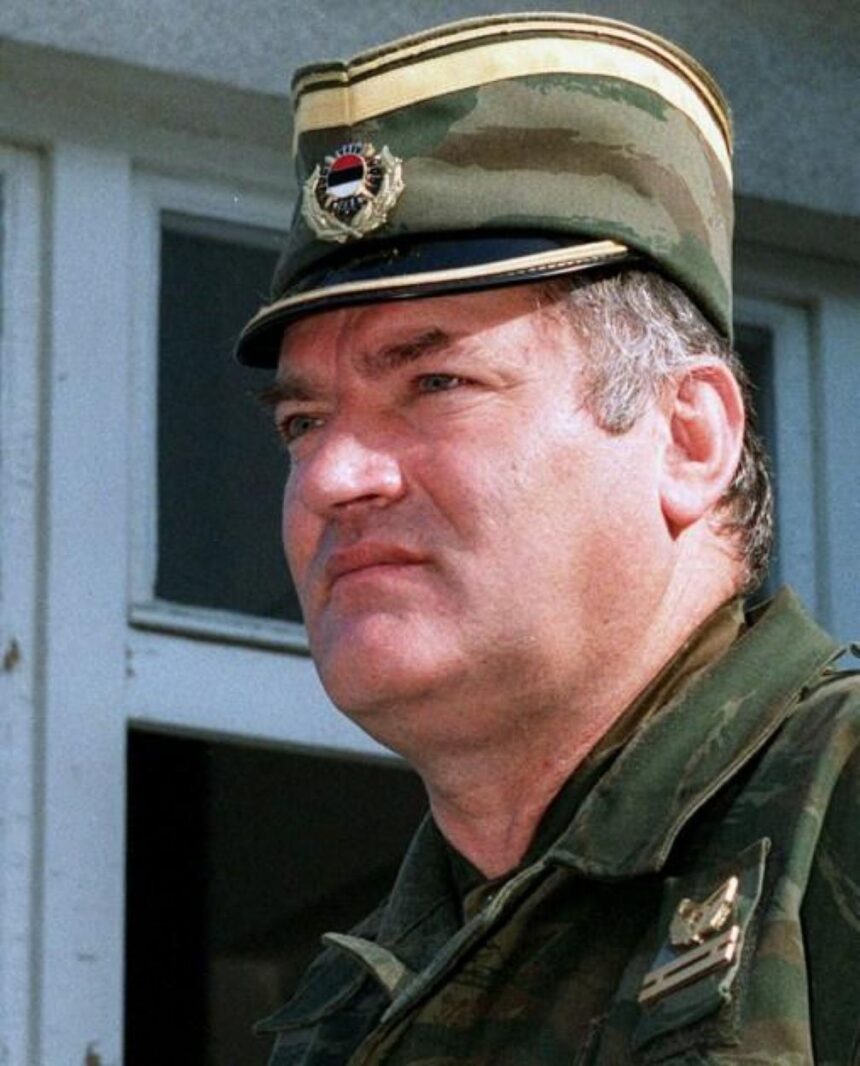
Ratko Mladić, the former commander of the Bosnian Serb Army who was convicted of genocide, crimes against humanity and war crimes, has died at the age of 84, prompting renewed scrutiny of one of the most notorious figures of the Bosnian war.
Reuters’ extensive retrospective recalls Mladić’s central role in the 1992–1995 conflict, including the siege of Sarajevo and the 1995 Srebrenica genocide, in which more than 8,000 Bosniak men and boys were killed after Bosnian Serb forces overran the UN-declared safe area.
The agency describes Mladić as a figure associated with some of the war’s most brutal episodes. Bodies of victims were initially buried in mass graves before some were exhumed and moved to secondary locations in an apparent effort to conceal evidence of the killings.
The International Criminal Tribunal for the former Yugoslavia ultimately found that Mladić participated in a joint criminal enterprise aimed at permanently removing Bosniaks, Croats and other non-Serbs from areas claimed by Bosnian Serbs.
Mladić consistently rejected the legitimacy of the tribunal. During proceedings, he dismissed the court and, after receiving a life sentence in 2017, continued to deny the allegations against him.
Srebrenica and the destruction of Sarajevo
Mladić’s military career became inseparable from the campaign conducted by Bosnian Serb forces during the war.
Under his command, Sarajevo was subjected to a prolonged siege and sustained bombardment by artillery, tanks, mortars and heavy machine guns. Reuters recalls that approximately 10,000 people were killed during the siege.
Srebrenica became the defining crime associated with Mladić.
After Bosnian Serb forces captured the enclave in July 1995, thousands of men and boys were separated from women and children and subsequently executed. The operation was followed by efforts to conceal the evidence by moving bodies between burial sites.
Mladić was later convicted of genocide in relation to Srebrenica, as well as persecution, extermination, murder, deportation, terror and other crimes.
He was acquitted of genocide charges relating to six other Bosnian municipalities.
A commander celebrated by some, condemned by others
Mladić remained a deeply polarizing figure long after the war.
For many Bosniaks and other victims of the conflict, he became a symbol of the campaign of ethnic cleansing and mass violence carried out during the war. For a segment of Serbian nationalist society, however, he continued to be portrayed as a military hero.
That divide was reflected in his years as a fugitive.
Although wanted by the international tribunal, Mladić managed to remain in Serbia for years after the war. He was finally arrested in 2011, sixteen years after the end of the conflict.
By then, his health had significantly deteriorated. He had suffered a stroke and later a heart attack, and his appearances before the tribunal were increasingly marked by serious medical problems.
The Hague conviction
In 2017, the tribunal sentenced Mladić to life imprisonment.
The judgment found him responsible for genocide at Srebrenica, crimes against humanity and war crimes committed during the Bosnian conflict. His appeal was rejected in 2021, making the life sentence final.
Even after his conviction, Mladić continued to seek humanitarian release, citing his deteriorating health. Those requests were repeatedly rejected.
His death therefore closes the life of a man whose name remains permanently connected to some of the darkest crimes committed in Europe since the Second World War.
For survivors and victims’ families, however, his death does not end the historical or legal significance of the crimes for which he was convicted.
The legacy of Ratko Mladić remains inseparable from Srebrenica, the siege of Sarajevo and the broader campaign of ethnic persecution that accompanied the destruction of Bosnia and Herzegovina during the 1990s.