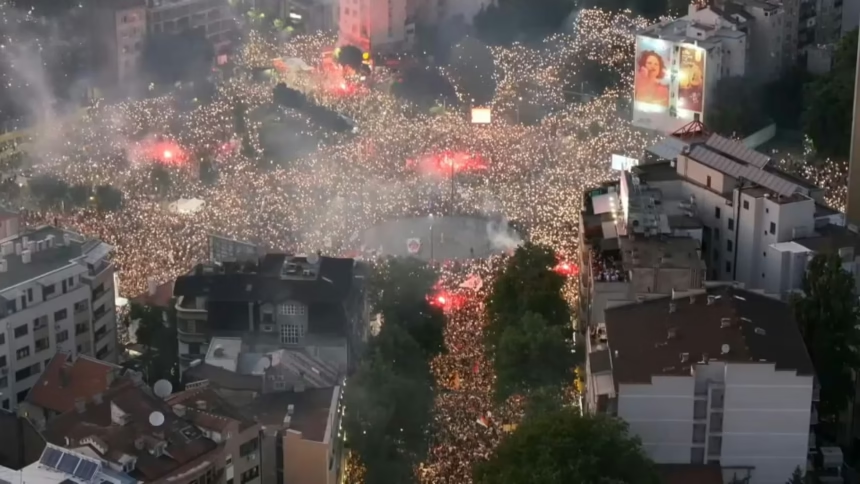
Mass protests, the fall of the government, institutional crises, open conflicts between the executive and the judiciary, major corruption scandals, and a record number of attacks on journalists marked 2025 as one of the most turbulent years in Serbia’s recent history.
Throughout the year, Serbia experienced unprecedented civic mobilization, triggered by the deadly collapse of a railway station canopy in Novi Sad in late 2024. The tragedy, which claimed 16 lives, became a symbol of systemic corruption, institutional negligence, and political unaccountability.
A Year of Massive Protests
Student-led protests evolved into nationwide demonstrations, spreading to nearly every major city. According to independent estimates, up to 325,000 people gathered in Belgrade on March 15, making it one of the largest protests in Serbia’s history.
While authorities significantly downplayed attendance figures, the scale of public dissent clearly exposed the widening gap between the government and society.
President Aleksandar Vučić and the ruling SNS responded by organizing counter-rallies, widely criticized as state-sponsored political mobilization rather than genuine grassroots support.
Government Collapse Amid Violence
In January, Prime Minister Miloš Vučević resigned, following a violent attack on protesting students by individuals linked to the ruling party.
Despite the resignation, President Vučić later pardoned the attackers, a move that drew sharp criticism from civil society and international observers, reinforcing concerns over selective justice and political impunity.
“Ćacilend” and the Normalization of Political Intimidation
The creation of a months-long pro-government tent camp near the Serbian parliament, unofficially known as “Ćacilend”, became a powerful symbol of state tolerance for intimidation, disorder, and parallel political structures.
Numerous incidents were recorded, including violence against protesters, journalists, and opposition lawmakers, while senior officials openly praised the camp’s occupants.
Alleged Use of Sonic Weapons
One of the most controversial moments of the year occurred during the March protests, when panic erupted following what witnesses described as an acoustic shock.
Although authorities denied using illegal crowd-control weapons, independent investigations strongly suggested the deployment of a directed acoustic device, contradicting official claims and further eroding public trust.
Open War on Prosecutors
President Vučić launched an aggressive campaign against the Prosecutor’s Office for Organized Crime after investigations reached high-ranking officials in cases linked to the Novi Sad tragedy and the controversial “General Staff” redevelopment project.
Legal experts warned that proposed legal changes could effectively neutralize independent prosecution, placing it under tighter political control.
Record Attacks on Journalists
2025 saw an alarming surge in violence against journalists, with more than 300 incidents recorded, including physical assaults, threats, and police abuse.
Vučić himself repeatedly verbally attacked reporters, further fueling a hostile environment toward independent media.
Militarization and Political Spectacle
A large military parade in September, branded “Strength of Unity,” was widely criticized as political theater amid deep social polarization.
Attendance was reportedly restricted to ruling party supporters, undermining the event’s declared message of national unity.
Conclusion
Rather than stabilizing the country, 2025 entrenched authoritarian governance patterns, weakened institutional independence, and intensified social divisions.
Despite repeated claims of democratic legitimacy, Serbia entered 2026 facing profound questions about accountability, rule of law, and the future of its democratic institutions.