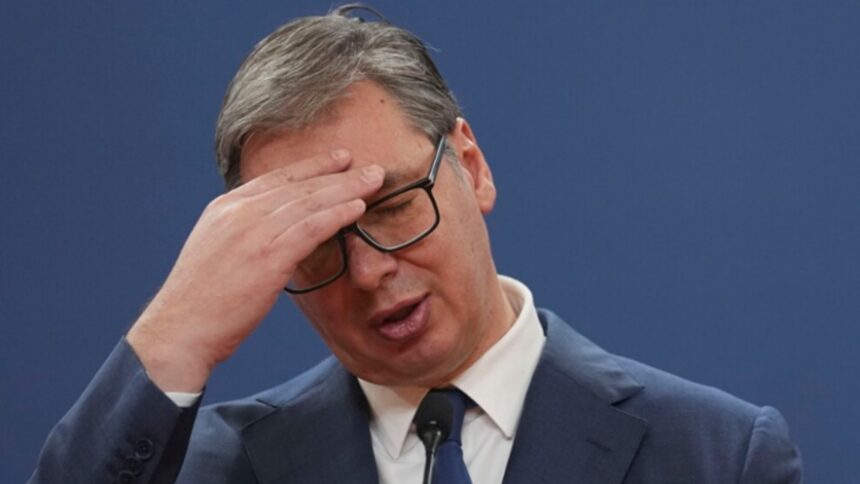
For over a decade, Aleksandar Vučić has governed Serbia through a robust “stabilocracy”—a model of power that has proven resilient against scandals, mass protests, and international pressure. By positioning himself as the indispensable “guarantor of stability” in a volatile region, Vučić successfully balanced the interests of the West and Russia while maintaining a tightening grip on domestic institutions.
However, as of late April 2026, a convergence of domestic unrest, shifting geopolitical alliances, and unresolved security scandals suggests that this long-standing model is entering a period of terminal exhaustion.
The Collapse of the “Stability” Narrative
Vučić’s authority was built on the premise that he was the only leader capable of preventing chaos. Every crisis—whether a flare-up with Kosovo or internal dissent—was framed as a reason for more centralized power. But today, that “stability” is increasingly viewed in Brussels and Washington as a dangerous stagnation.
The logic of personalist regimes relies on managing the fear of things getting worse. Yet, across Serbia, a sense of collective fatigue is turning into persistent defiance. The current wave of protests is no longer seen as a fleeting emotional outburst; it is a rejection of a system where corruption has become the state’s primary language and institutions serve as tools for party discipline rather than public service.
The “Radoičić Shadow” and the Credibility Gap
Perhaps the most significant blow to the regime’s international standing remains the aftermath of the Banjska attack in late 2023. The role of Milan Radoičić, the paramilitary leader who admitted to organizing the deadly ambush, continues to haunt Belgrade’s diplomacy.
The fact that Radoičić remains a free man in Serbia has created an insurmountable credibility gap. For Western partners, this is no longer a judicial technicality but a political litmus test. Vučić finds himself in a strategic trap:
- The Domestic Risk: Prosecuting Radoičić risks alienating the nationalist base and unsettling the internal power networks that sustain the regime.
- The International Cost: Failing to act increases the risk of diplomatic isolation, financial conditionality, and the potential freezing of EU accession funds.
A Shifting Geopolitical Landscape
The external pillars that once shielded Belgrade are crumbling. The recent electoral defeat of Viktor Orbán in Hungary has deprived Vučić of his most vocal defender within the European Union. Orbán provided a template for “illiberal democracy” that made Serbia’s trajectory seem like a regional trend rather than a democratic deviation. Without this shield, Serbia stands exposed.
Furthermore, the era of “strategic ambiguity” regarding Russia is coming to an end. In a Europe reshaped by security concerns following the wars in Ukraine and Iran, Belgrade’s refusal to align with EU foreign policy is no longer viewed as “neutrality” but as a “gray zone” of Russian influence.
Economic Vulnerability and the “Operating Team”
As the European Union moves closer to potentially freezing funds for Serbia, the regime’s “asphalt diplomacy”—the practice of masking democratic decay with large-scale infrastructure projects—is failing. The recent formation of a new “Operating Team” by the Serbian government to accelerate EU talks has been met with skepticism in Brussels, where officials are now demanding “results, not committees.”
Conclusion: The Erosion of Invincibility
While Vučić still controls the security apparatus, the majority of the media, and a vast patronage network, his model is losing its sustainability. When a leader can no longer maneuver to avoid the costs of his policies, he begins to look vulnerable.
The combination of persistent street protests, international pressure, and the unresolved legacy of the Banjska attack suggests that the Vučić era is no longer producing the stability it once promised. In the spring of 2026, the question is no longer whether the regime has power, but how much longer that power can survive its own contradictions.