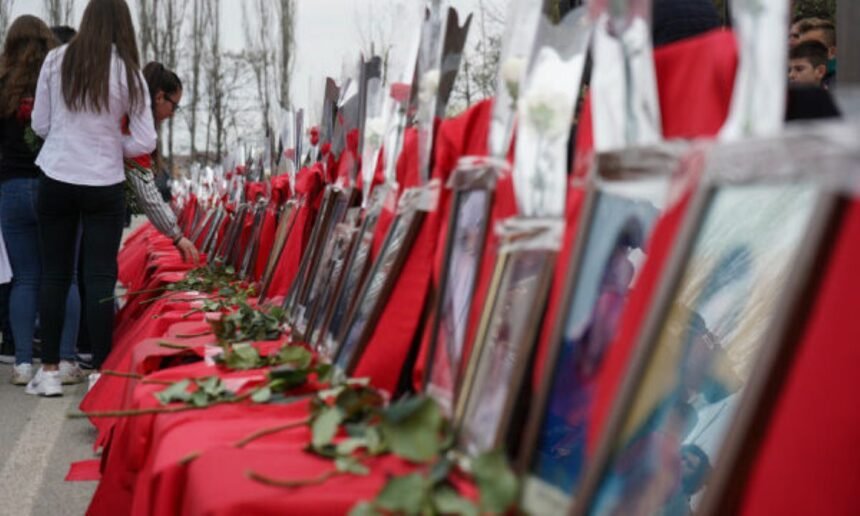
Today marks the 27th anniversary of the Meja Massacre, the largest and most brutal mass execution of the Kosovo War, where 376 innocent civilians were systematically murdered by Serbian forces on April 27, 1999.
Known as the “Srebrenica of Kosovo,” the massacre in the village of Meja, near Gjakova, remains a symbol of the profound suffering and the unresolved legacy of the conflict.
A Planned Operation of Terror
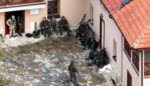
On the morning of April 27, 1999, Serbian military, police, and paramilitary units surrounded the areas of Reka e Keqe and Lugu i Carragojës. In a cold, calculated operation, they blocked all escape routes except for the road leading to Meja.
Refugee convoys fleeing the violence were intercepted at a specialized checkpoint. There, men and boys between the ages of 15 and 60 were forcibly separated from their families. While women and children were ordered to continue toward the Albanian border, the men were led away to be executed.
The Scale of the Crime
Within a few hours, 376 ethnic Albanians were killed. The perpetrators included:
- Serbian Army and Police units
- The “Red Berets” (Special Operations Unit)
- Local paramilitaries and masked individuals
The executions were carried out in the same villages where the victims lived, with men being dragged from their homes or pulled from the convoys. Tragically, April 27 was also the day of the “Federal Republic of Yugoslavia Day,” a date Slobodan Milošević’s regime marked with celebrations as the bloodiest day of the war unfolded.
The Search for Justice and Closure
The aftermath of the massacre has been a decades-long struggle for the families of the victims. Many bodies were initially hidden in mass graves across Kosovo, while others were transported to Serbia—notably the Batajnica mass graves—in an attempt to conceal evidence of the war crimes.
To this day, 27 years later:
- The Missing: Several victims are still missing, with their remains believed to be located in unmarked sites within Serbia.
- Repatriation: Families continue to demand the return of remains from Serbia, a process that has been marred by political delays.
- Accountability: While some high-ranking Serbian officials have been convicted by international tribunals, many direct perpetrators remain free.