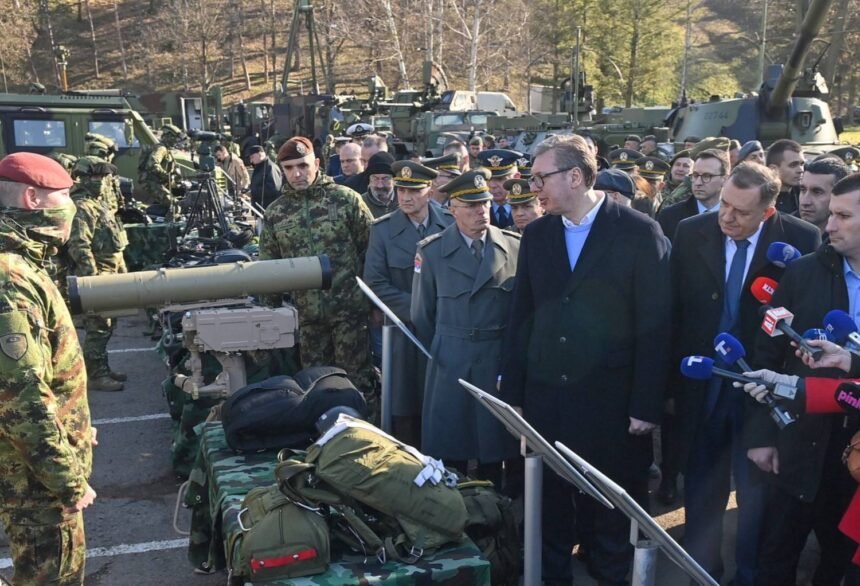
As the regional arms control framework marks another anniversary, the Dayton-era architecture faces accusations of obsolescence, providing a convenient veil for President Aleksandar Vučić’s aggressive high-tech military expansion.
Every June, the foreign ministries of Croatia, Serbia, Montenegro, and Bosnia and Herzegovina celebrate the anniversary of the Florence Agreement. They recite the same statistics: over 10,000 weapons destroyed and hundreds of inspections conducted since 1996. While these figures represent a successful 20th-century disarmament, critics argue the agreement has become a “manual for blindness” in the 21st century.
Since the OSCE concluded its supervision in 2014, the region’s military landscape has undergone a radical transformation—one that President Aleksandar Vučić has exploited to turn Serbia into a regional outlier in high-speed and unmanned weaponry, all while remaining technically “compliant” with an outdated treaty.
The CFE Template: Counting Yesterday’s War
The Florence Agreement was designed to prevent a repeat of the heavy-conventional wars of the 1990s. It established strict ceilings on five specific categories:
- Battle Tanks
- Armoured Combat Vehicles
- Artillery (75mm and above)
- Combat Aircraft
- Attack Helicopters
This framework assumed that the only way to wage war in the Balkans was with T-55 tanks and towed artillery. However, the Serbian military of 2026 bears little resemblance to the force that signed the Dayton Accords. By focusing on “heavy steel,” the agreement has essentially stopped counting the tools of modern conflict.
Vučić’s Strategic “Blind Spot”
Under the leadership of Aleksandar Vučić, Belgrade has engaged in a massive procurement drive that intentionally targets hardware sitting entirely outside the Florence Agreement’s jurisdiction.
Earlier this year, photographs of CM-400AKG air-launched ballistic missiles under the wings of Serbian MiG-29s sent shockwaves through regional security circles. These missiles, capable of high-speed standoff strikes, do not fall into any of the agreement’s five categories. The same applies to Belgrade’s growing arsenal of:
- Loitering Munitions: Domestically produced “suicide drones.”
- Long-range Attack Drones: Procured through bilateral channels with China and the UAE.
- Surface-to-Air Systems: The Chinese FK-3 and Russian Pantsir batteries.
By routing these acquisitions through non-European partners, Vučić has successfully changed the regional air-defense equation while keeping his “books” closed to neighbors.
The Kosovo Exclusion: A Deliberate Void
Perhaps the most glaring failure of the current architecture is the total exclusion of Kosovo. As a non-signatory to the Dayton Accords, Kosovo has no seat at the table where Belgrade’s military trajectory is supposedly made transparent.
This is not a historical oversight; it is a structural feature that Vučić’s administration continues to defend. By refusing to recognize Kosovo, Serbia ensures that the only state most directly threatened by its military buildup is legally barred from inspecting it. This asymmetry is profound: Kosovo fields no air force and no missile systems, yet it faces a neighbor that is integrating Mach 6 standoff capabilities.
Trilateral Responses to a Common Threat
The vacuum left by the Florence Agreement has forced a fragmented security response. In March 2025, Albania, Croatia, and Kosovo signed a trilateral declaration for defense cooperation. While framed as NATO interoperability, it is a clear attempt to create a deterrent against the unchecked Serbian buildup.
Unlike the “Florence Four,” these new arrangements—including Serbia’s deepening coordination with Hungary and Republika Srpska—do not generate aggregate visibility. They are responses to a security environment that the Florence Agreement was never written to include.
Conclusion: The Memory of a Regime
The Florence Agreement is not failing due to bad faith; it is failing because its terms belong to a different map and a different war. As foreign ministries prepare their commemorative statements this June, the numbers they cite will be real, but they will not be an answer to the current crisis.
The next regional arms control architecture will need to count drones, missiles, and cyber-warfare capabilities. Most importantly, it must include Kosovo. Until then, the Florence Agreement remains an architecture of blindness, shielding a Serbian arms race that the rest of the region can see, but is legally forbidden from counting.