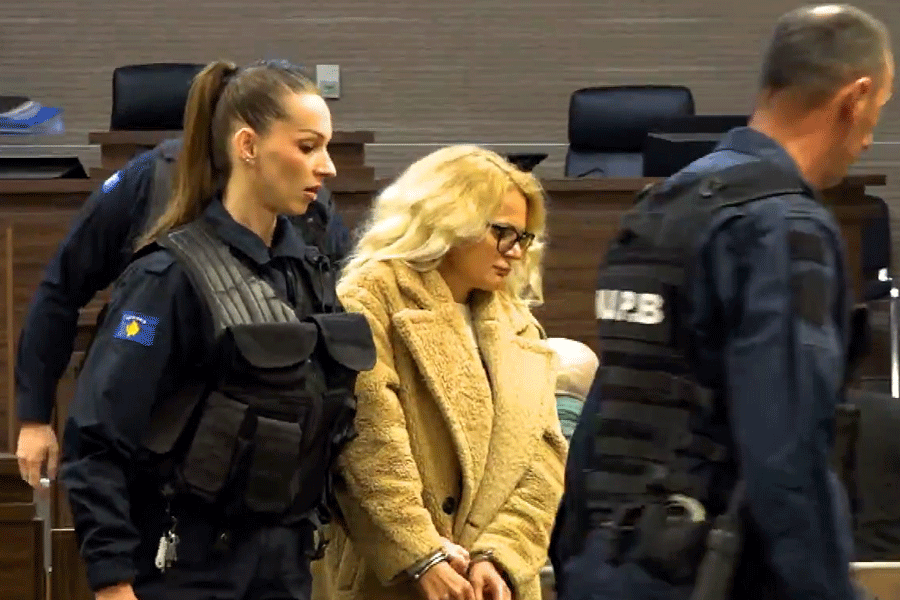
As the Basic Court of Prishtina prepares to announce its verdict today, explosive new evidence has emerged revealing how the Serbian Intelligence Agency (BIA) directed a former OSCE official to distort international reporting on Kosovo.
The case of Jelena Gjukanović, a former staff member of the Organization for Security and Co-operation in Europe (OSCE), has transitioned from a standard espionage trial into a geopolitical scandal. Investigations have uncovered a sophisticated information warfare operation designed to manipulate the perceptions of 57 member states in Vienna.
Direct Instructions from the BIA
New materials obtained by Dukagjini and KosovaPress highlight a direct link between Gjukanović and Aleksandar Vlajić, a confirmed BIA agent previously convicted by Kosovo authorities. The communications show Vlajić providing granular instructions on how to “structure the story” regarding North Kosovo.
The BIA’s primary objectives, according to the leaked messages, were to:
- Criminalize Police Actions: Frame standard Kosovo Police operations and the deployment of special units as “politically coordinated” aggressions.
- Cultivate Negative Narratives: Ensure that international factors perceived Kosovo’s security measures as destabilizing and ethnically motivated.
- Utilize Local Proxies: Use specific NGOs and “closed conversation” networks in the north to feed pre-fabricated narratives into official international channels.
The “Davenport Report” and High-Level Meddling
Perhaps the most damaging revelation involves Gjukanović’s claims regarding the OSCE leadership. In her messages to the BIA, she detailed her interactions with then-Head of the OSCE Mission, Michael Davenport.
According to Gjukanović’s reports to her handlers:
- Selective Reporting: A comprehensive report was being prepared for the OSCE Secretariat in Vienna that would exclusively catalog alleged “attacks” on Serbs by the Kosovo Police.
- Belgrade’s Veto Power: Gjukanović claimed that Davenport intended to consult with Serbian Foreign Minister Ivica Dačić to “fine-tune” the report before presenting it to the 57 member states of the OSCE.
- Institutional Infiltration: The messages suggest that the BIA didn’t just want information; they wanted to dictate the official international record of the Republic of Kosovo.
Implications for the Verdict
The Prosecution has asked for the maximum sentence of 25 years, arguing that Gjukanović’s actions didn’t just compromise local security, but actively damaged Kosovo’s standing on the global stage by poisoning the information flow to major international bodies.
While the verdict is expected at 13:15, these new revelations raise broader questions about the vulnerability of international missions in Kosovo to intelligence penetration by Belgrade.