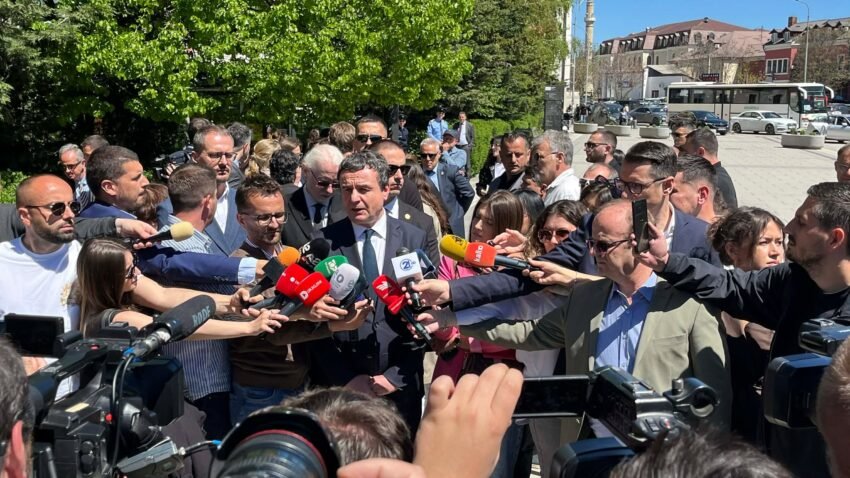
On the National Day of Missing Persons, Prime Minister Albin Kurti called on the international community to exert decisive pressure on Serbia, asserting that Belgrade holds the truth and the keys to the secret archives regarding the disappeared.
Standing before the Monument Dedicated to Persons Enforcedly Disappeared during the War, Kurti was joined by accredited ambassadors in Pristina for a somber wreath-laying ceremony. His message was clear: after 27 years, the absence of answers is a deliberate act of obstruction by the Serbian state.
The Human Toll: “A Nine-Year-Old Boy Was the Last Buried”
The Prime Minister highlighted the ongoing tragedy of the 1,565 individuals who remain missing since the 1998-1999 conflict. He reminded those present of the recent burial of Sinan Dauti, a nine-year-old boy from Prekaz, whose remains were only recently identified—a stark reminder that children were among the primary victims of forced disappearances.
The Geography of Secrecy: 11 Unrevealed Mass Graves
Kurti provided specific details regarding the scale of the concealment operation carried out by the Milošević regime and allegedly sustained by the current Serbian administration:
- The “16 Sites” Admission: Kurti noted that Serbian officials themselves have publicly communicated the existence of 16 mass graves in total.
- The Gap: To date, only 5 mass graves have been uncovered in Serbia.
- Batajnica: He cited the Batajnica site, near Belgrade, where 744 bodies were exhumed, as evidence of the systematic nature of the crime.
- The Missing Information: Kurti emphasized that Serbia refuses to provide the specific coordinates or archival data for the remaining 11 suspected mass graves.
A Call for Global Action: “We Lack Jurisdiction Over Serbia”
The Prime Minister addressed the legal impasse facing Kosovo’s institutions, including the Institute of Forensic Medicine and the Special Prosecution:
- International Duty: Because Kosovo lacks legal jurisdiction over Serbian territory, Kurti appealed directly to European and American partners to demand transparency from Belgrade.
- Trials in Absentia: He highlighted that Kosovo’s legal system now allows for the trial and sentencing of war criminals in absentia, a tool the Special Prosecution is using with the government’s full support.
- The Race Against Time: Kurti warned that as witnesses age and pass away, the window for achieving justice and identifying remains is closing rapidly.
“Where the responsibility lies, there lies the truth,” Kurti stated. “The international factor must exert more pressure on Serbia so that the truth is revealed and the perpetrators are brought to justice.”
Institutional Commitment
Despite the challenges, Kurti assured the families of the missing that the Governmental Commission for Missing Persons and the Kosovo Police are making “maximum efforts” to uncover the fate of their loved ones. However, he concluded that without Serbian cooperation—orchestrated through international diplomacy—the path to closure remains blocked.