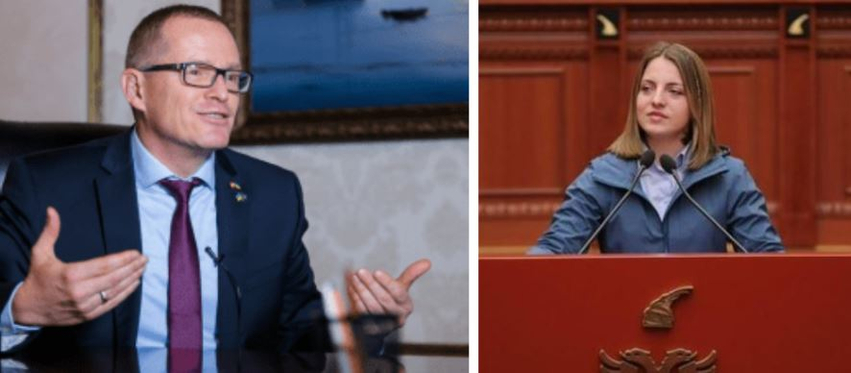
Günther Fehlinger-Jahn, a self-proclaimed candidate for president of Austria, has voiced support for independent Albanian MP Marjana Koçeku and her demand that Serbia recognize Kosovo’s independence.
The issue has attracted wider international attention following a heated exchange on social media platform X between Koçeku and Vladimir Štimac, a figure associated with Serbia’s student movement.
The dispute began after Štimac declared that Kosovo is and will remain part of Serbia. Koçeku strongly rejected his position, arguing that Serbia cannot claim to be moving towards democracy while maintaining territorial claims over Kosovo.
She stressed that political change in Serbia must go beyond removing President Aleksandar Vučić. According to the MP, a genuine democratic transition requires a fundamental shift in the country’s political narrative and its approach to Kosovo.
Koçeku called on Serbia’s Student List to demonstrate a clear break with nationalist rhetoric and territorial claims, describing recognition of Kosovo’s independence as the first step towards a new relationship between the two countries.
She also urged Serbia to acknowledge responsibility for crimes committed during the Kosovo war, including the killing of civilians, enforced disappearances and sexual violence.
At the same time, Koçeku emphasized that the rights of Kosovo’s Serb community must be protected, while the rights of Albanians in Serbia should also be guaranteed. She specifically raised concerns over the administrative deregistration of Albanian addresses in the Preševo Valley.
The exchange drew the attention of Romana Vlahutin, former European Union ambassador to Albania, who shared Koçeku’s response and presented it as a message from the younger generation of Albanians to Serbia’s student movement.
Fehlinger-Jahn also expressed support for Koçeku’s position. He chairs the Austrian Committee for NATO Enlargement and has announced his intention to run for Austria’s presidency in the 2028 election.
The debate has once again highlighted a central question for the Western Balkans: whether Serbia’s emerging political movements will bring a genuine change in the country’s policy towards Kosovo or continue to uphold long-standing positions in Belgrade.
Koçeku’s central message is that Serbia’s democratization must be accompanied by respect for Kosovo’s sovereignty, recognition of its independence and equal protection of minority rights in both countries.