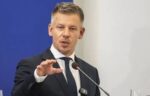
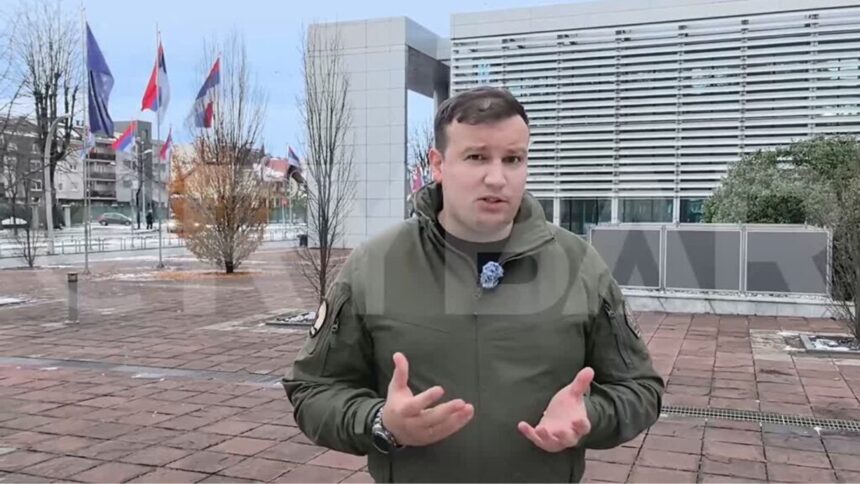
Just days before his arrest in Montenegro, Mikhail Zvinchuk, the founder of the Russian network Rybar, was in Serbia and Bosnia and Herzegovina, where he and his team were reportedly filming a documentary series about relations between Russia and the Balkans.
Zvinchuk, a former associate of the Russian Ministry of Defence who is under European Union sanctions for supporting Russia’s war against Ukraine, was detained in Montenegro on 9 October alongside four other Russian nationals. Western countries and US authorities have linked Rybar to foreign influence operations, disinformation and propaganda.
Montenegro has decided to expel Zvinchuk and the four other Russian nationals on national security grounds.
Days before his detention in Montenegro, Mikhail Zvinchuk, the founder of the Russian network Rybar, which is under Western sanctions for supporting the war against Ukraine and spreading propaganda, had been in Bosnia and Herzegovina and Serbia, according to footage he posted on his social media accounts.
According to footage published on the social media platform VKontakte, Zvinchuk had been in Serbia since 27 September. Three days later, he appeared outside the National Assembly in Belgrade.
In one of his reports, published on 3 October, he stated that his team was filming a documentary series in the Balkans about relations between Russia and the peoples of the region, as well as Balkan history.
“We are staying in the Balkans, where we are filming a documentary series about various aspects of relations between Russia and the peoples of the Balkans, as well as the history of this region, without which it is impossible to understand how to operate here,” he said in a report dated 3 October.
As part of his Balkan tour, which preceded his arrest in Montenegro, Zvinchuk spent several days in Bosnia and Herzegovina. According to Radio Free Europe, he landed at Sarajevo Airport on 2 October at around 2:30 p.m. and initially checked into a hotel in Sarajevo before travelling to Banja Luka.
According to footage he published, he also visited Mostar while filming in Donja Gradina on 6 October, a site that forms part of the memorial complex dedicated to the victims of the Ustaše-run Jasenovac concentration camp.
In one of the videos published from Bosnia and Herzegovina on 6 October, he referred to the results of the country’s general elections held two days earlier, describing “Russia as a political driver and people’s belief that it is the guarantor of the freedom of the Serbian people.”
Expulsion from Montenegro
According to information obtained by Radio Free Europe, Zvinchuk left Bosnia and Herzegovina on 7 October through the Zupci border crossing, travelling to Montenegro.
He was detained in Montenegro on 9 October alongside his wife and three other Russian nationals during an operation conducted by the police and the National Security Agency (ANB). A decision was subsequently made to expel them on national and internal security grounds.
Earlier, the Russian network Rybar issued a statement on Telegram, emphasising that Zvinchuk was in Montenegro legally and intended to film the Cetinje Monastery.
Ties to Prigozhin
The Rybar Telegram channel was established in February 2018. One of its earliest posts concerned an Israeli air operation over Syria during which an Israeli F-16 fighter jet was shot down.
Initially, the channel focused primarily on the Middle East. Following Russia’s full-scale invasion of Ukraine in February 2022, it shifted its attention to the battlefield in Ukraine.
Before the war, the channel had approximately 30,000 followers. By October 2026, its main channel had grown to around 1.56 million followers.
According to an investigation by the Russian media outlet The Bell, Yevgeny Prigozhin, the founder of the Wagner mercenary group, had financially supported Rybar since 2019.
During 2020 and 2021, Rybar maintained a column on RIA FAN, the flagship portal of Prigozhin’s Patriot media group. In interviews, Zvinchuk stated that his ties with Prigozhin’s media structures ended in 2022.
In March 2023, the company Rybar was established with registered share capital of 12,000 roubles, equivalent to approximately €130. Its founders are Mikhail Sergeyevich Zvinchuk, Valeria Vladimirovna Zvinchuk and Denis Valerievich Vulf.
According to Russia’s Unified State Register of Legal Entities, the company’s primary business activity is advertising agency services. During its first two years of operation, the company’s revenue ranged from €80,000 to €200,000. On its website, Rybar states that it relies on donations.
The network includes a Telegram channel of the same name, a channel on the Rutube platform and a community on VKontakte.
On its website, Rybar describes itself as one of the Russian Telegram channels most frequently cited by foreign media and says it focuses on military analysis, information warfare and visual propaganda.
“Today, our team is at the forefront of information warfare, defending the interests of the Russian Federation. We know how to conduct information warfare easily and effectively and how to present Russia in the right light,” the project’s description states.
According to data from Telemetr, a platform that collects statistics on Telegram channels and groups, Rybar averaged approximately 142,000 views per post and published around 26 posts per day.
Zvinchuk has said that his experience working in the Russian Ministry of Defence, where he previously served in the public relations department, enabled him to develop his own approach to analysing military information.
Expanding Influence in the Balkans
Rybar has developed a network of channels covering different parts of the world, including Balkanar, which focuses on the Balkans and publishes in Russian under the slogan “Chronicles of Europe’s Powder Keg.”
Balkanar primarily publishes commentary on current political and security developments in the region, frequently criticising the European Union, NATO and Western support for particular political actors. At the same time, it presents Russia’s role and its relations with local political structures in a positive light.
For example, the channel covers elections in Serbia largely through analytical commentary but uses Russia as a reference point for assessing political developments.
It portrays positively the promises made by the Student List that Serbia will not impose sanctions on Russia. It also highlights reports that the Kremlin supports Serbian President Aleksandar Vučić, while describing Vučić’s pro-European pledges as a performance staged for Brussels.
The channel openly expresses sympathy for the leadership of the Republika Srpska (RS) entity and portrays its former president and ruling party leader, Milorad Dodik, as a successful lobbyist with access to both Russian President Vladimir Putin and the administration of US President Donald Trump.
It describes the High Representative of the international community in Bosnia and Herzegovina as “illegitimate” and accuses Sarajevo and its “Western handlers” of attempting to centralise the country and create electoral chaos.
Balkanar takes a critical stance towards Montenegro because of its pro-Western foreign policy, describing the introduction of visa requirements for Russian citizens as “a radical step to win Brussels’ approval.”
The channel portrays the perceived Russian threat as fabricated and characterises NATO exercises and procurement programmes as unnecessary.
According to data from Telemetrio, Balkanar had approximately 18,600 followers at the beginning of October and averaged around 12,400 views per post.
During the first eight days of October, the channel was mentioned or reposted 80 times across more than 23 different Telegram accounts, primarily through other Rybar channels operating in foreign languages.
Relations with Serbia and Bosnia and Herzegovina
Zvinchuk has visited countries across the region several times in recent years.
In April 2024, he delivered a lecture at the Hotel Moskva in Belgrade about Telegram as a tool for controlling the information space, including an analysis of the most popular Serbian-language Telegram channels.
On 27 June, Serbian public broadcaster RTS aired a programme in which Zvinchuk discussed developments on the Ukrainian front and Telegram’s role in information dissemination.
The Republika Srpska entity had previously announced cooperation with Rybar to establish a “media school.” In 2024, the entity’s Agency for Information and Communication Technologies confirmed that such an agreement was being prepared, while Rybar announced training sessions in the Serbian language.
In November 2025, Zvinchuk recorded a video analysis of the snap presidential election in Republika Srpska in Banja Luka, in front of the RS Government building, and published it on his channel.
Investigation by Czech Journalists
In September, the Czech news outlet Seznam Zprávy published an investigation into the activities of Rybar operatives in Europe.
The investigation alleged that members of the team travelled to European countries and recorded interviews with politicians, journalists and experts, while those interviewed were not always clearly informed about the project for which the footage was being produced.
Czech authorities questioned Russian nationals Vitaly Chaschukhin and Igor Dolmatov, who were linked to Rybar, and subsequently ordered them to leave the country.
According to the Czech outlet at the time, filming had also been planned in Serbia, Bosnia and Herzegovina, Slovakia, Austria, Hungary, Belgium and France.