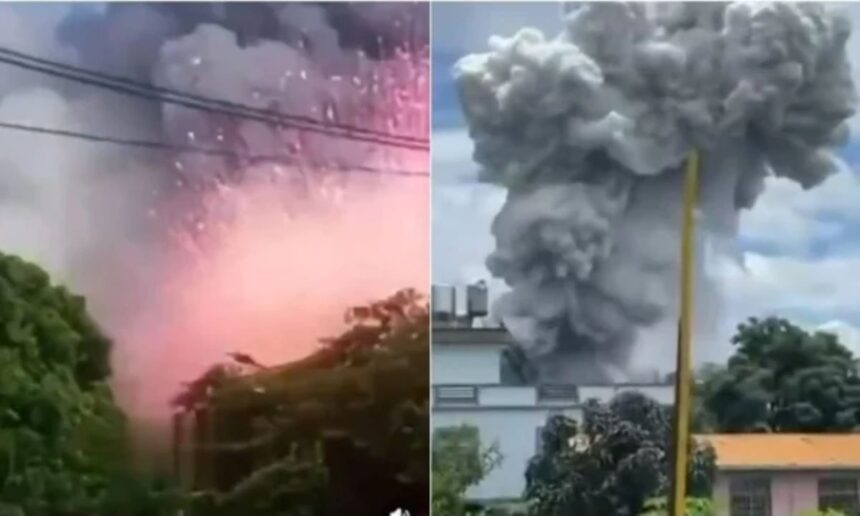
A massive, unexplained explosion ripped through an industrial storage facility in northeastern Myanmar on Sunday, May 31, 2026, killing at least 55 people and wounding dozens more. The facility, located near the Chinese border, was controlled by a powerful regional rebel militia.
The catastrophic blast occurred at approximately 12:30 PM local time in Kaung Tat village (also referred to as Kaungtup), situated in the Namhkam township of Myanmar’s volatile Shan State.
Overwhelming Devastation and Casualties
The force of the detonation was so severe that it instantly leveled surrounding infrastructure, leaving a massive crater where the storage building once stood. First responders and local journalists reporting from the ground described an apocalyptic scene.
“Everything was completely destroyed beyond recognition,” resident Moe Z told reporters, noting that a massive mushroom cloud of smoke billowed into the sky. “Over half of the village’s houses have been destroyed. The houses near the center of the blast were blown completely to pieces, to the point where not even the house posts remain.”
Independent media and rescue agencies, including the Shwe Phee Myay News Agency and the BBC, confirmed that the death toll has climbed to at least 55 victims, including 25 women and 30 men. At least six children, including a one-year-old toddler, are among the dead. Furthermore, three Chinese nationals were confirmed killed due to the village’s proximity to the border.
More than 74 injured individuals were rushed to the Namhkam General Hospital, where local medical teams issued urgent appeals for blood donations. Emergency workers have deployed backhoes and heavy machinery to sift through mounds of pulverized concrete and debris in a desperate search for survivors trapped beneath the rubble.
Accidental Detonation of Mining Gelignite
The disaster occurred within territory entirely administered by the Ta’ang National Liberation Army (TNLA), one of Myanmar’s most powerful ethnic minority armed factions. The TNLA has waged a decades-long insurgency for greater autonomy from the central government and has held control over the Namhkam area following a sweeping offensive against the state military.
In an official statement released via Telegram, the Palaung State Liberation Front/TNLA expressed its deepest condolences to the victims’ families and clarified the nature of the facility. The group emphasized that the blast was not caused by a military airstrike or drone attack, but was rather an industrial accident.
The TNLA’s economic department had been using the facility to store large quantities of gelignite intended for commercial use in local stone quarries and ruby-rich mining sectors. Gelignite, widely used in rock blasting, is notoriously volatile and can become highly unstable over time if exposed to poor storage conditions or temperature fluctuations.
Political Context
Myanmar has been mired in a brutal, multi-front civil war since the military junta seized power in a February 2021 coup, ousting the democratically elected government.
While the TNLA is a prominent member of the rebel alliance fighting the junta, the group is currently maintaining a shaky, China-mediated ceasefire with the Myanmar military. The TNLA stated that an official task force has been assembled to investigate the precise trigger of the ignition, promising to hold those responsible for the poor storage of the explosives legally accountable while funding immediate rehabilitation and relief efforts for the devastated village.