Global military defense budgets are climbing at a rapid pace, with the most severe shifts concentrating in the world’s most economically dynamic territory: the Asia-Pacific. At the annual Shangri-La Dialogue (SLD) security conference in Singapore—convened by the London-based International Institute for Strategic Studies (IISS)—defense ministers, military commanders, and intelligence experts gathered to map out a worsening security climate increasingly dominated by massive arms buildups.
1. Worsening Geopolitical Fragmentation in Asia
The opening tone of the summit was set by Singaporean Prime Minister Lawrence Wong, who warned of a highly volatile future: “The reality in this changed world is that there will be more instability—we will move from one storm to another.”
A string of consecutive localized military crises over the past year has severely disrupted regional peace stability:
- Subcontinental & Border Friction: A brief, high-intensity border war broke out between India and Pakistan in May 2025. Meanwhile, border clashes between Pakistan and Afghanistan escalated dramatically to include cross-border Pakistani airstrikes.
- Southeast Asian Unrest: The territorial war between Thailand and Cambodia only concluded via a shaky treaty, the civil war in Myanmar continues to destabilize borders, and maritime standoffs persist in the South China Sea.
The underlying geopolitical fault line remains the intense rivalry between the United States and a rapidly modernizing Chinese military. Evan A. Laksmana, a senior expert at IISS, summarized the environment bluntly: “Regional states—whether large, medium, or small—cannot evade this deteriorating security environment.”
Vietnamese President To Lam pushed for a legally bound framework to keep competitive dynamics from devolving into outright conflict. He emphasized that a stable regional order cannot be built on continuous fear, noting that for developing nations, “development is not a secondary option behind security.”
2. Rearmament Outpaces Development
Despite calls for collaborative economic development, regional powers are prioritizing hard defensive capabilities.
Data released by the Stockholm International Peace Research Institute (SIPRI) shows that military expenditure across the Asia-Pacific spiked by 8.1 percent, reaching a staggering $681 billion.
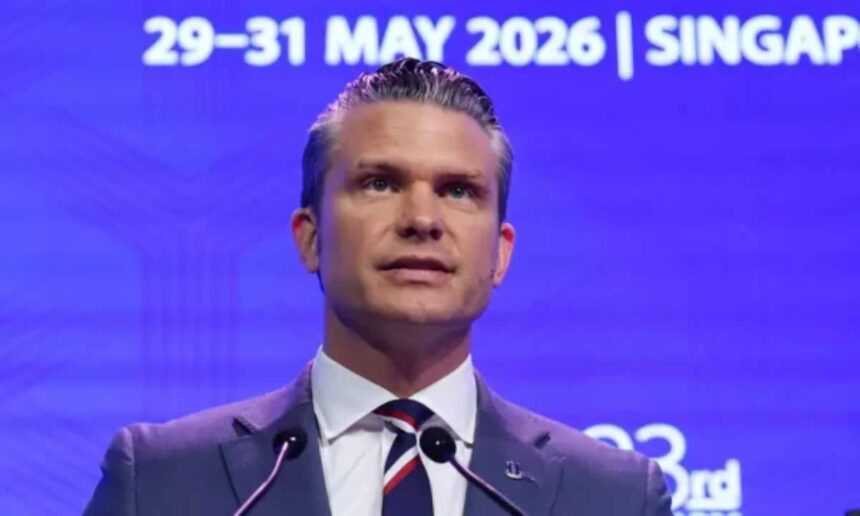
U.S. Defense Secretary Pete Hegseth signaled that even these figures are insufficient to maintain deterrance. Highlighting that the United States expects its own annual defense budget to touch $1.5 trillion, Hegseth issued a direct challenge to Asian allies to invest more heavily in their own domestic defense systems.
“For too long, the security of the region has relied too heavily on the military power of the United States,” Hegseth stated, while praising the increased defense contributions of partner nations including South Korea, the Philippines, Australia, Singapore, Malaysia, Thailand, Vietnam, and India.
Other international delegations expressed profound concern over the humanitarian fallout of this production boom. Mirjana Spoljaric, President of the International Committee of the Red Cross (ICRC), delivered a stark warning against the unchecked arms race: “Where weapons are produced, they are used. This brings catastrophic human and material losses.”
3. The Taiwan Dilemma and Strategic Stability
In a striking rhetorical pivot from previous summits, Secretary Hegseth omitted any direct mention of Taiwan during his keynote address—a sharp contrast from warnings regarding a potential Chinese cross-strait invasion.
The shift reflects a highly delicate diplomatic realignment between Washington and Beijing. U.S. President Donald Trump and Chinese President Xi Jinping recently forged a tentative framework aimed at fostering “constructive relations and strategic stability.”
[U.S. Armaments Package for Taiwan: $14 Billion]
                       |
                       v
       [Awaiting Final Executive Action]
                       |
       +---------------+---------------+
       |                               |
       v                               v
[Washington's Stance]          [Beijing's Warning]
Testing diplomatic leverage   "Weapons transfers undermine
with President Trump.         regional strategic stability."
Former Chinese Deputy Foreign Minister Cui Tiankai welcomed the renewed diplomatic channels but reinforced Beijing’s strict red line, stating that continued U.S. weapons transfers to the island are unacceptable. A massive $14 billion arms package for Taiwan remains pending, with the final authorization resting entirely on the desk of the U.S. President.
4. A Multipolar Network of Alliances
While the United States remains the indispensable Western military anchor in the region, analysts emphasize that Washington can no longer police the Pacific entirely on its own. As former diplomat Bilahari Kausikan observed: “Europe cannot contain Russia without the US, and Asia cannot balance China without the US.”
To adapt to this reality, middle and smaller regional powers are bypassing traditional bilateral frameworks to build a complex, horizontal web of secondary security pacts. Japan, for example, is rapidly deepening independent military logistics and intelligence ties with Australia, the Philippines, and India.
Western European powers are also expanding their operational footprints to support this network. Germany, represented by defense official Nils Hilmer, confirmed it is expanding its operational presence in the Pacific through active participation in large-scale naval maneuvers, such as the upcoming RIMPAC exercises. According to strategic experts, this shift signals a permanent transition away from unilateral security toward integrated, multi-national deterrence.