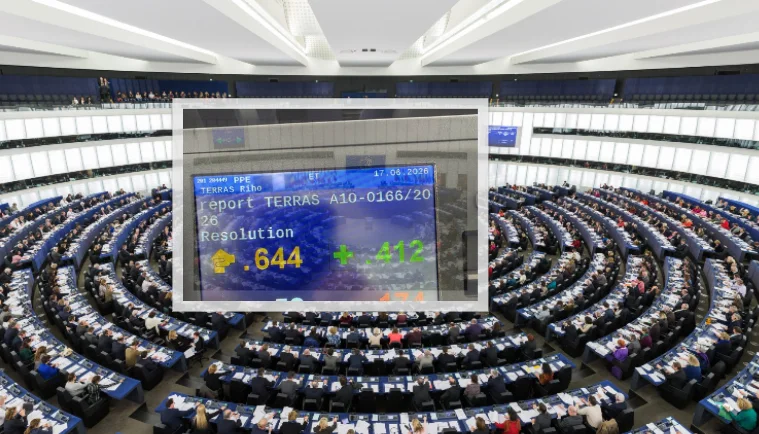
The European Parliament has formally adopted the comprehensive progress report on Kosovo with a solid legislative majority, as announced by the text’s primary author, MEP Riho Terras.
The critical resolution cleared the parliamentary floor with 412 votes in favor, 174 against, and 58 abstentions. Following the vote, Terras emphasized on social media that internal domestic overhauls and constructive participation in the EU-facilitated stabilization dialogue remain the definitive baselines for Pristina’s continental integration.
While the document heavily supports Kosovo’s strategic European path, it issues strict warnings that internal political standstills have fundamentally jeopardized international development funding.
1. The Cost of Political Friction: Risks to the EU Growth Plan
The adopted text offers a blunt assessment of Kosovo’s internal political climate over the past year, warning that partisan gridlocks have active economic consequences.
The Legislative and Financial Bottlenecks in Pristina

 [ THE LOST YEAR ]          ──► POLITICAL BLOCKADES
 • The European Parliament assesses that Kosovo has lost a critical year of
   development due to continuous, polarizing political standstills.

 [ ELECTION OVERHANG ]      ──► DELAYED LEGISLATION
 • Lawmakers warn that the upcoming months will face severe administrative
   slowdowns as political parties pivot into intense election cycles.

 [ FISCAL JEOPARDY ]        ──► GROWTH PLAN AT RISK
 • This persistent instability directly threatens Kosovo's ability to implement
   timely reforms required to draw down funding from the multi-billion EU Growth Plan.
2. Diplomatic Breakthroughs: Candidate Status and Sanctions Relief
Despite the sharp criticisms regarding internal governance speeds, the report delivers several major political victories for Pristina, signaling strong parliamentary solidarity against arbitrary blockades.
Major European Policy Shifts Handed to Kosovo
┌────────────────────────────────────────────────────────────────────────┐
│                                                                        │
│  [ CANDIDATE STATUS ASSIST ] ──────────────────────────────────────┐   │
│  • The European Parliament explicitly endorses Kosovo's application    │   │
│    for EU Candidate Status, calling on the European Council and member │   │
│    states to immediately advance the formal procedural review. │
│                                                                        │   │
│  [ CONDEMNING THE MEASURES ] ──────────────────────────────────────┤   │
│  • The report firmly welcomes the lifting of EU punitive measures      │   │
│    against Pristina, explicitly branding those sanctions as entirely    │   │
│    "unjustified" and deeply harmful to everyday Kosovar society.│
│                                                                        │   │
│  [ REAFIRMING INTEGRATION ] ───────────────────────────────────────┘   │
│  • The text serves as a powerful, unified political message backing     │
│    Kosovo's sovereign European perspective, contingent on reform.│
└────────────────────────────────────────────────────────────────────────┘
3. Justice Mandate: The Banjska Ultimatum and Regional Security
A significant portion of the European resolution targets regional security, demanding strict criminal accountability from Belgrade regarding cross-border paramilitary operations.
| Security Focus | Parliamentary Findings & Language | Core Geo-Political Demands |
| The Banjska Attack | The report explicitly classifies the armed confrontation as a coordinated terrorist attack. | Demands that all individual actors, financiers, and state proxies responsible for organizing the assault face immediate justice. |
| The Radoičić Case | Lawmakers voiced deep institutional anxiety regarding the complete lack of prosecution inside Serbia. | Directs harsh criticism at Belgrade for allowing paramilitary commander Milan Radoičić to remain completely free without criminal proceedings. |
| The Normalization Dialogue | Re-anchors the EU-facilitated Pristina-Belgrade framework as an essential, non-negotiable metric. | Declares that true integration cannot occur for either state until all previous bilateral agreements are fully implemented in good faith. |
MEP Terras’s approved report sets a demanding tone for Kosovo’s incoming leadership. While Brussels is actively unlocking political doors—demanding candidate status progression and the removal of unfair punitive measures—the financial rewards of the EU Growth Plan will remain entirely locked until the country cleans up its political gridlocks and shows progress in normalization.