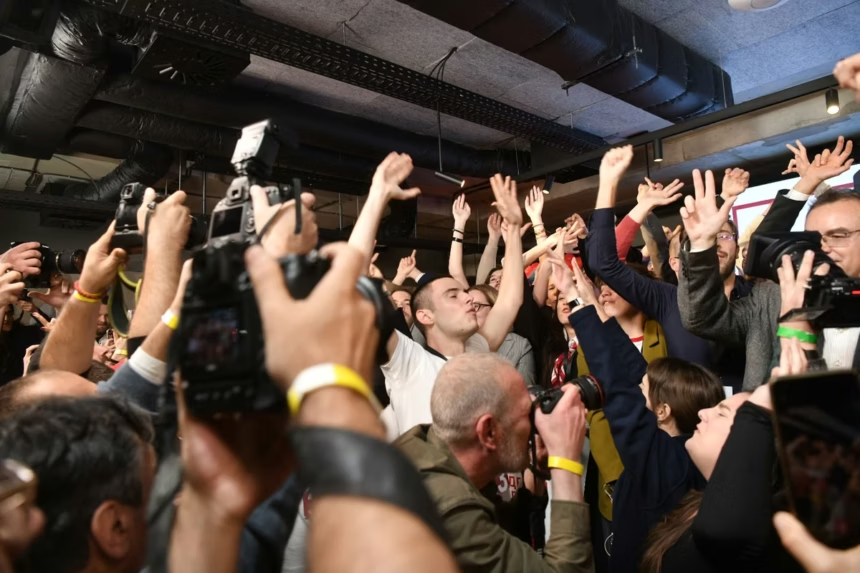
The biggest challenge facing Serbia’s student movement will be transforming itself from a protest movement into a political organisation capable of forming and running a government, the American magazine Foreign Policy (FP) has reported.
In an analysis by journalist Alex Ero, the magazine notes that the Student List’s decentralised structure, lack of a recognisable leader and ideological diversity helped secure its electoral victory. However, those same characteristics could create difficulties when it comes to governing the country.
The Student List won approximately 53 percent of the vote and secured 140 parliamentary seats in the October 25 elections, ending the Serbian Progressive Party’s (SNS) 14 consecutive years in power. SNS won 103 seats.
Voter turnout was close to 70 percent, while the new government must be formed within 90 days of the publication of the final election results.
According to Ero, the student movement has yet to resolve fundamental questions about its leadership, including the selection of a prime minister-designate and how to reconcile the different political positions within the movement.
Student List representative Ilija Srdanović has said that appointments to the future government will be decided collectively, while student plenums intend to maintain an oversight role.
However, the analysis warns that this arrangement could create two competing centres of decision-making. Elected representatives will need to make decisions quickly, while the plenums seek to preserve direct participation in the political process.
Differences Over Kosovo, Russia and EU Integration
Another challenge concerns ideological differences within the movement, particularly over Kosovo, relations with Russia and Serbia’s European integration.
These divisions could make it difficult to reach a common position on major foreign policy issues and could complicate the new government’s decision-making process.
The incoming administration will also face the task of reforming state institutions, including the public administration, police and intelligence services, where personnel associated with SNS remain present.
Ero cautions that indiscriminate dismissals and purges could result in another wave of political interference in state institutions rather than their depoliticisation.
Economic Challenges and SNS Influence
The new government will also have to address citizens’ economic concerns.
The student movement’s economic programme remains insufficiently defined, while its investment plans have raised questions among economists, according to the analysis.
Ero also warns against underestimating former Serbian President Aleksandar Vučić and the remaining influence of SNS.
Despite losing power, the party retains 103 parliamentary seats, as well as influence in local governments, the state administration and the media, alongside established political and economic networks.
Presidential Elections Could Complicate the Transition
The upcoming presidential election, expected to take place by the end of December, represents another major test for the student movement.
The Student List will have to nominate a presidential candidate while simultaneously working to establish a new government.
According to Ero, a potential defeat in the presidential race could create a situation in which the movement would have to share power with a president opposed to its political programme.
The Foreign Policy analysis concludes that although the student movement has succeeded in ending SNS’s long-standing dominance through the parliamentary elections, building a functioning political system will require considerably more than an electoral victory.