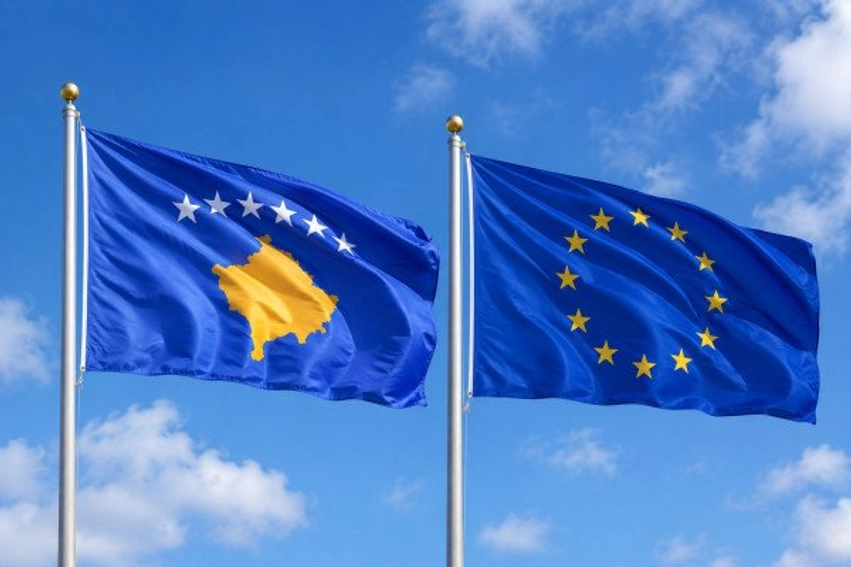
As Brussels prepares to host four high-profile intergovernmental conferences with Albania, Montenegro, Ukraine, and Moldova, institutional leaders in Kosovo are attempting to leverage this new geopolitical momentum to break the years-long deadlock on Pristina’s application for European Union candidate status.
With the six-month rotating Presidency of the Council of the European Union shifting from Denmark to Ireland on July 1, 2026, Kosovo’s diplomatic apparatus is intensifying efforts to place its December 2022 membership application onto the formal European agenda before the end of the year.
De-linking Kosovo’s EU Path from Serbia
Kosovo’s Chief Negotiator with the EU, Jeton Zulfaj, stressed that the bloc’s current enlargement strategy has evolved from a routine technical exercise into an absolute geopolitical and strategic necessity.
While celebrating Albania’s swift diplomatic advancement, Zulfaj strongly argued that Pristina’s European progress must be evaluated purely on its individual democratic reforms and rule-of-law indicators rather than being held hostage by the Belgrade-Pristina dialogue.
                  ┌── Merits & Reforms: Advancements in democracy & rule of law.
KOSOVO'S STRATEGY ┼── Strategic De-linking: Disconnecting EU integration from Serbia's stagnation.
                  └── Irish Presidency: Leveraging Dublin's pro-enlargement stance for agenda placement.
Zulfaj pointed out that tethering Kosovo’s future to a neighboring country that displays no genuine appetite for European integration severely distorts the merit-based system:
“Serbia is not only failing to move forward, but it has zero desire to do so, which is why it has fallen so far behind in democracy and rule-of-law indexes… For us, it is vital that we are not trapped by Serbia’s lack of will for normalization. We must have our own path of progress and be assessed on our own merits.”
— Jeton Zulfaj, Kosovo’s Chief Negotiator with the EU
The Irish Presidency: A Friendly But Pragmatic Ally
Under the official mandate motto “Strength With Unity” (running until December 31, 2026), Dublin has placed Western Balkan integration near the top of its executive agenda.
European integration expert and former diplomat Alma Lama noted that while the Irish presidency is an exceptionally positive development due to Ireland’s historic support for Kosovo’s sovereignty, Pristina should expect zero institutional favoritism.
| Analytical Perspective | Key Assessment & Identified Challenges |
| Enlargement Realities | The EU’s core expansion policy remains firmly merit-based; no bloc or sympathy-driven accessions will be granted. |
| Diplomatic Hurdles | While Ireland can fast-track the bureaucratic review of Kosovo’s application, it requires full consensus among all member states. |
| Internal Vulnerabilities | Kosovo’s ongoing domestic institutional paralysis—operating with an acting government and an gridlocked parliament—stalls effective lobbying. |
“If the institutional crisis continues and Kosovo lacks fully legitimate representatives… I do not believe we will see any breakthrough in relations with the European Union.”
— Alma Lama, European Integration Expert
With five EU member states (Spain, Greece, Cyprus, Slovakia, and Romania) still refusing to recognize Kosovo’s independence, Pristina faces a steep uphill battle. The Ministry of Foreign Affairs will need to balance intense lobbying in Dublin with concrete domestic stabilization if it hopes to transform this brief geopolitical window into a binding European pathway.