The future of US troops in Kosovo remains uncertain as Washington reviews its military presence in Europe.
Germany has confirmed that it remains in close and continuous coordination with Washington and NATO allies over the future of the Kosovo peacekeeping mission, KFOR. However, it has not clarified whether a possible reduction in the US contingent in Kosovo has been discussed.
“US forces play an important role in KFOR,” a spokesperson for Germany’s Ministry of Defence told Radio Free Europe.
Asked whether allies had discussed the possibility of reducing the American contingent in Kosovo, the spokesperson said: “The German government is in close and continuous coordination with NATO and its allies, including the United States, regarding the future of KFOR.”
The spokesperson added that details of the mission’s operational planning could not be made public for security reasons.
The response follows consultations held in Brussels on 17 November, where NATO allies discussed the future of the US military presence in Europe with senior Pentagon official Elbridge Colby.
Ahead of the meeting, German Defence Minister Boris Pistorius said changes to the number of US troops in Europe were expected, although the scale of any reductions remained unclear.
He stressed the need for coordination with Washington to avoid gaps in European defence.
Following the consultations, Colby said he hoped the review of the US military presence in Europe would be completed by 1 December.
He did not confirm whether troop numbers would be reduced, but said the United States needed to distribute its forces according to its global priorities, including commitments in the Indo-Pacific region.
However, he stressed that this did not mean the US was withdrawing from its commitments in Europe.
Could US troop numbers in Kosovo be reduced?
US authorities have already signalled changes to their contribution to KFOR.
In June, US European Command confirmed that it would gradually adjust the American contribution to the mission in line with NATO plans.
According to a US official, the adjustments would be implemented in phases and based on risk assessments, Radio Free Europe reported.
In a response to the broadcaster on 16 June, the official did not specify how many troops could be affected by the changes.
A further request for clarification was sent to the US Department of Defence on 20 November but received no response.
Meanwhile, a Radio Free Europe source who requested anonymity said there was a plan for a significant reduction in the US military presence in Kosovo.
According to the source, the number of American personnel could fall from approximately 650 currently to around 50 by February 2028.
The stated aim, the source said, is for the United States to retain only a limited military role in Kosovo within two years, although some positions could remain at KFOR headquarters in Camp Film City in Pristina.
Radio Free Europe said it had been unable to independently verify this information.
Neither US authorities nor NATO have publicly announced such a plan.
What changes has NATO announced?
In June, NATO announced that it would gradually adjust its military presence in Kosovo, with the aim of returning troop numbers to pre-2023 levels within a year.
The decision was justified by improvements in the security situation.
NATO had deployed additional forces in 2023 following an escalation of tensions in northern Kosovo, including attacks on KFOR personnel and the armed attack in Banjska.
In a response to Radio Free Europe on 20 October, a NATO official said the mission had approximately 4,600 troops from member and partner countries.
The official said any changes would be gradual and dependent on security assessments. They could be suspended or reversed if conditions on the ground required it.
The alliance has stressed that it could reinforce KFOR if security in Kosovo or regional stability were threatened.
NATO has not clarified how the restructuring could affect the US contingent, but has welcomed Washington’s longstanding contribution and the deployment of additional American troops to the mission.
Could Germany increase its presence?
Asked whether Germany would consider sending additional troops to Kosovo in the event of a reduction in the American contingent, the German Defence Ministry did not provide a direct answer.
“The German government does not speculate about possible decisions by other governments,” the spokesperson told Radio Free Europe.
The spokesperson recalled that in June, the German parliament extended the mandate of German forces in KFOR for another year, authorising the deployment of up to 400 troops.
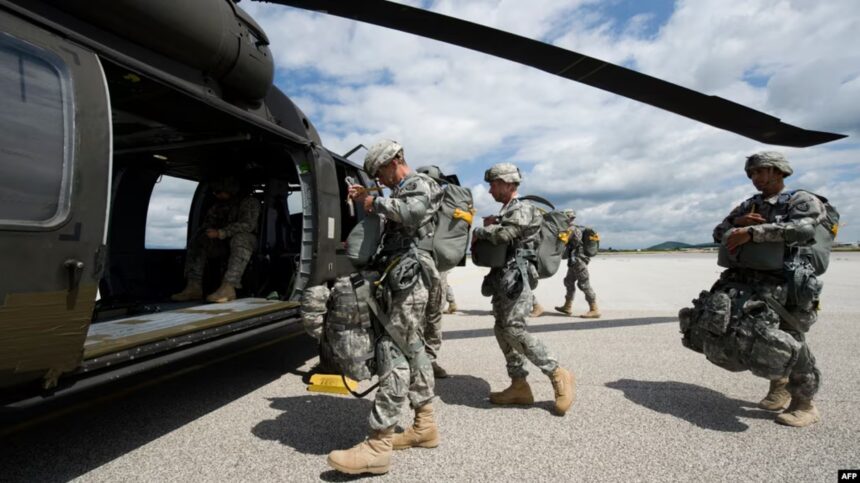
The United States leads KFOR’s Regional Command East, headquartered at Camp Bondsteel near Ferizaj.
American forces have been present in Kosovo since 1999, when NATO deployed its peacekeeping mission following the end of the war.
KFOR operates under United Nations Security Council Resolution 1244.
NATO has emphasised that, despite the planned adjustments, the mission’s mandate and its commitment to Kosovo’s security remain unchanged.