The Basic Court of Pristina will officially open the initial trial proceedings against 21 former Serbian police and military personnel indicted for their alleged roles in the notorious 1999 Reçak massacre.
The initial hearing is scheduled for July 20, 2026, as confirmed by Mirlinda Gashi, the spokesperson for the Basic Court of Pristina.
The standard criminal process will be handled through a formalized in absentia framework. The Special Prosecution Office of the Republic of Kosovo (PSRK) submitted the formal indictment on December 30, 2025, alongside a petition for an in absentia trial because all 21 defendants have fled the jurisdiction and remain completely inaccessible to Kosovo law enforcement organs.
Indictment Parameters and Operational Framework
The defendants—identified by their initials as O.S., R.M., K.J., G.R., Ž.T., B.J., M.L., R.M., D.DJ., B.M., D.J., M.Š., D.A., S.V., B.M., Z.S., M.J., G.P., D.N., Č.A., and Z.J.—face severe charges of “War Crimes Against the Civilian Population.”
According to the prosecution’s charging documents, the individuals acted in joint criminal enterprise as active components of the military forces of the Federal Republic of Yugoslavia and the Serbian Ministry of Internal Affairs (MUP). Specifically, the indictment targets members operating within the 243rd Mechanized Brigade of the Third Army’s Pristina Corps.
[The Reçak Encirclement and Assault Operation]
  Phase 1: Tactical Encirclement (Positions: "Pishat", "Gështenjat", and "Çesta")
     │
     ├──► Phase 2: Heavy Artillery & Distance Shelling of Civilian Infrastructure
     ├──► Phase 3: House-to-House Sweeps & Separation of Demographics
     │              ├── Women & Small Children ──► Mass Forced Expulsion
     │              └── Detained Adult Males   ──► Summary Executions
     ▼
  Outcome: 42 Civilians Murdered | ~20,000 Displaced Across Regional Villages
Brutality and Regional Deportation Detailed by Investigators
The special prosecution’s investigative files paint a graphic picture of the assault executed on January 15, 1999, in the village of Reçak (Shtime municipality). The state’s evidence demonstrates that before the mass executions, the joint military and MUP units subjected local villagers to extreme physical torture, utilizing rifle butts, iron chains, wooden clubs, and heavy structural instruments to beat detained civilians.
| Operational Action | Impact on Civilian Population |
| Encirclement & Shelling | Preemptive containment using military armor to lock down civilian escape routes. |
| Systematic Torture | Severe physical trauma inflicted on unarmed men prior to execution. |
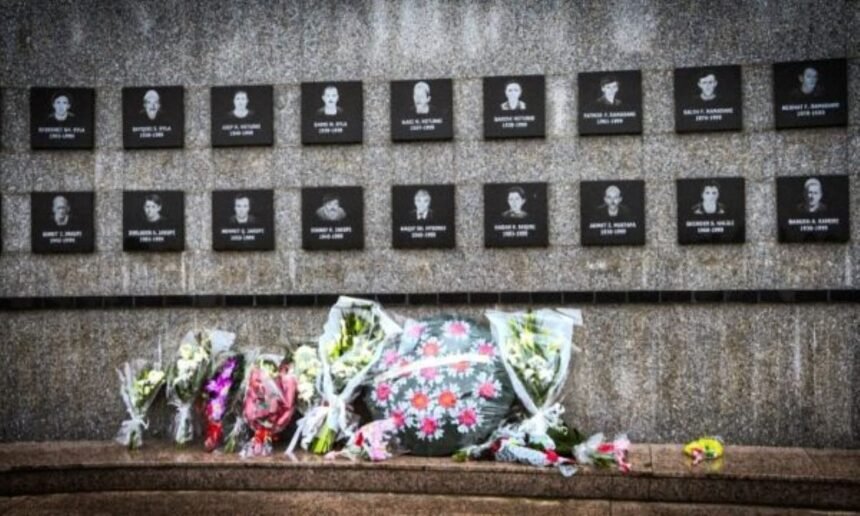
| Summary Executions | Targeted slaughter of 42 defenseless ethnic Albanian civilians within the village. |
| Mass Ethnic Cleansing | Forced expulsion of approximately 20,000 civilians from Reçak and surrounding villages (Topillë, Petrovë, Kraisht, Mullapolc, Dremjak). |
Legal Milestones and Regional Context
The January 15, 1999 tragedy in Reçak was an pivotal turning point in the Kosovo War. The discovery of the bodies by international monitors, led by Ambassador William Walker of the OSCE Kosovo Verification Mission, shocked global conscience, directly accelerating the diplomatic and military interventions that ultimately led to the NATO air campaign.
Because the suspects reside safely inside Serbia—which refuses to extradite individuals to face justice in Pristina—Kosovo is utilizing its revised Code of Criminal Procedure, which fully permits in absentia trials for war crimes and crimes against humanity. Human rights monitoring groups note that this trial will rely extensively on historical eyewitness testimonies and forensic data amassed over the last 27 years to deliver a binding legal verdict.