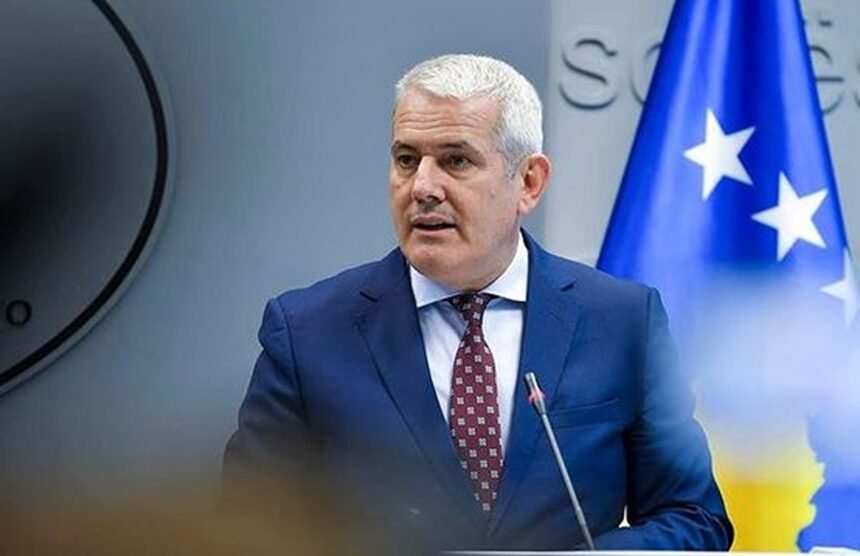
Kosovo’s Acting Minister of Internal Affairs, Xhelal Sveçla, confirmed on Tuesday, June 2, 2026, that state institutions are actively auditing and processing long-awaited financial compensation for mandatory overtime hours accumulated by the Kosovo Police.
Speaking during a high-profile press conference, Sveçla sought to ease brewing labor concerns within the law enforcement ranks while firing back at opposition critics ahead of the general elections.
Balancing Back-Pay with Capital Investments
Sveçla outlined a dual-track strategy designed to compensate officers immediately while shielding the state’s primary security budget from future structural deficits. The Ministry of Internal Affairs (MPB) is currently developing a modernized administrative tracking system to guarantee error-free compensation tracking moving forward.
[The Ministry's Dual-Track Strategy]
   ├── Immediate Action: Process and disburse all verified police overtime back-pay. ✅
   └── Long-Term Strategy: Deploy a modernized tracking system to protect capital investment funds. ⚙️
The minister rejected assertions that the administration had neglected frontline officers, framing his tenure as uniquely attentive to police welfare.
“There is no Kosovo government that has not worked to improve conditions for the Kosovo Police,” Sveçla stated. “In fact, we have been criticized by political opponents for being hyper-focused on this sector. Given current circumstances, optimizing our support isn’t excessive—it’s an absolute necessity. Since I took office, not a single hour of overtime has gone unpaid.”
Sveçla clarified that while every additional hour worked will be fairly compensated, the new resource management system will prevent operational expenditures from draining the agency’s primary financial reserves. The administration aims to keep the core budget geared toward critical long-term infrastructure and capital investments.
Defending the New Citizenship Law Against Political Attacks
Beyond police labor disputes, the Interior Minister utilized the press briefing to push back against a wave of electoral criticism surrounding Article 31 of the recently amended Law on Citizenship of the Republic of Kosovo.
Opposition factions have fiercely attacked the clause, claiming the administration introduced a destabilizing new legal mechanism. Sveçla dismissed the backlash as a manufactured political stunt, clarifying that Article 31 is identical to pre-existing foundational mandates established under Article 155 of the Kosovo Constitution.
[The Legal Genealogy of Article 31]
  Ahtisaari Package (2007) ──> Constitutional Amendment (2012) ──> Law on Citizenship (2026)
The contested provision outlines that the Republic of Kosovo formally recognizes the right to citizenship for all citizens of the former Federal Republic of Yugoslavia who were permanent residents of Kosovo on January 1, 1998, along with their direct descendants—regardless of their current residency or secondary citizenship status.
- The Historical Baseline: Sveçla reminded reporters that this specific right originates directly from the Comprehensive Proposal for the Kosovo Status Settlement, universally known as the Ahtisaari Package.
- The Opposition’s Inconsistency: The minister noted that during constitutional updates in 2012, it was the current opposition parties—who were in power at the time—that voted to permanently transfer this transitional rule into the permanent, foundational chapters of the Constitution.
“This is not a new provision fabricated or recognized for the first time by this administration, despite what opposition figures are loudly proclaiming,” Sveçla concluded. “The very policy they are criticizing today stems directly from legal frameworks they themselves voted into our constitutional order.”