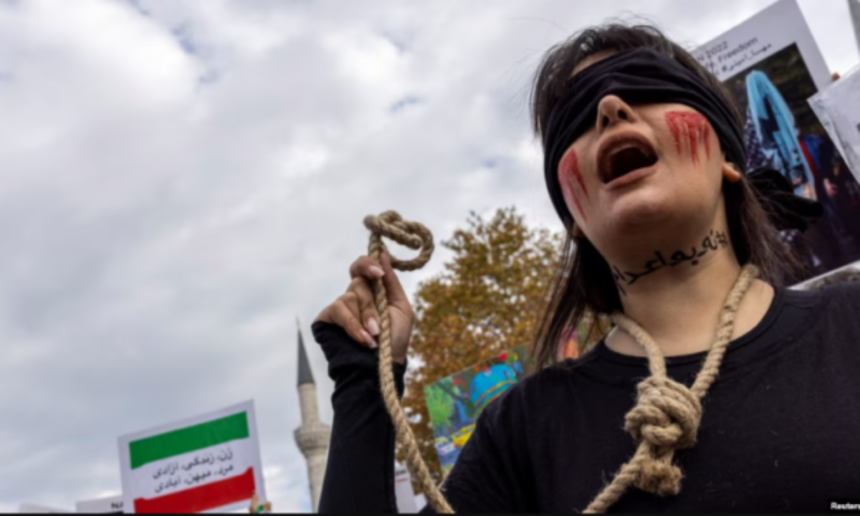
Iran has executed two men accused of spying for Israel, as the Islamic Republic continues a sharp increase in executions linked to national security charges following its ongoing conflict with Israel and the United States.
According to Iran’s judiciary-affiliated Mizan News Agency, Omid Behzad and Pouria Safvat were hanged in the early hours of August 3 after being convicted of espionage on behalf of Israel’s intelligence service, Mossad.
Iranian authorities alleged that the two men provided “significant assistance” to Mossad by supplying coordinates, photographs, and information on military and security facilities during the June 2025 conflict—referred to by Tehran as the “12-Day War”—as well as during the current conflict that began on February 28.
The judiciary claimed that the Intelligence Organization of the Islamic Revolutionary Guard Corps (IRGC) identified the suspects by monitoring their interactions with foreign-based media outlets, news channels, and digital communications. Officials also alleged that forensic examinations of Behzad’s mobile phone revealed evidence of the activities and said he confessed during the investigation, including to using location-based applications such as Google Maps to identify and transmit coordinates of sensitive sites.
Authorities further accused Safvat of direct cooperation with Mossad but did not publicly present evidence supporting the allegation.
Human rights organizations have repeatedly questioned the credibility of confessions obtained in Iran, arguing that detainees are frequently subjected to coercion and denied due process. Rights groups have also expressed concern over the lack of transparency surrounding national security prosecutions and closed judicial proceedings.
Since the outbreak of the current conflict with Israel and the United States, Iran has significantly increased executions involving individuals accused of espionage, political offenses, or links to banned opposition groups. Human rights organizations estimate that more than 50 people facing security-related charges have been executed since the conflict began, while some monitoring groups believe the actual number is considerably higher.
The charges commonly used in these cases include espionage for hostile states, collaboration with Israel or the United States, “moharebeh” (“enmity against God”), and armed rebellion through alleged membership in the exiled opposition group Mojahedin-e Khalq (MEK).
On July 27, United Nations human rights experts accused Iranian authorities of using executions to “spread fear throughout society, deter future protests, and silence dissent,” warning that intensified repression risks fueling further opposition rather than restoring stability.
According to the latest verified figures cited by human rights monitors, at least 433 people have been executed in Iran so far this year. International observers continue to raise concerns over the fairness of judicial proceedings, citing allegations of forced confessions, limited access to legal representation, and violations of due process.