European representatives and the United States have agreed to review Europe’s broader security arrangements following the end of Russia’s war against Ukraine, as a new round of peace negotiations began in Abu Dhabi.
In statements released separately by US envoy Steve Witkoff and the European Council, the parties said Ukraine and its European partners had agreed with Washington on the need to address postwar security concerns and reduce the risk of future conflict across the continent.
“The shared objective is to develop a practical and mutually reinforcing security framework that strengthens Ukraine’s long-term security and builds the confidence necessary to reach a negotiated settlement,” the statements said.
The discussions also focused on how existing European security institutions and agreements could be strengthened after the war.
Preparatory meetings involving representatives from the United States, Ukraine and European countries took place on Tuesday morning, ahead of the trilateral negotiations with Russia. Two officials familiar with the discussions described the initial exchanges as substantial and said the atmosphere was positive.
Europe’s future security architecture remains a sensitive issue for governments across the continent, particularly amid concerns that US President Donald Trump could reduce American security commitments to Europe. His administration has repeatedly urged NATO allies to assume greater responsibility for their own defence.
Russia, meanwhile, has called for restrictions on NATO’s presence and activities in Europe and has repeatedly opposed Ukraine’s potential membership of the alliance. Kyiv and its closest partners have consistently rejected Moscow’s demands on the issue.
One of the central questions surrounding the negotiations is whether a broader agreement on European security would form part of a final settlement to end the war in Ukraine or be addressed separately at a later stage.
Ukrainian President Volodymyr Zelenskyy and several of Kyiv’s key supporters have previously argued that Russia should not be allowed to make a wider agreement with NATO a condition for ending the war.
The Abu Dhabi meeting marks the first trilateral negotiations involving Ukraine, Russia and the United States in nine months. Washington’s delegation is led by Witkoff and Jared Kushner, Trump’s son-in-law, who are seeking to broaden the discussions to include Europe’s long-term security and ensure European governments have a role in shaping the outcome.
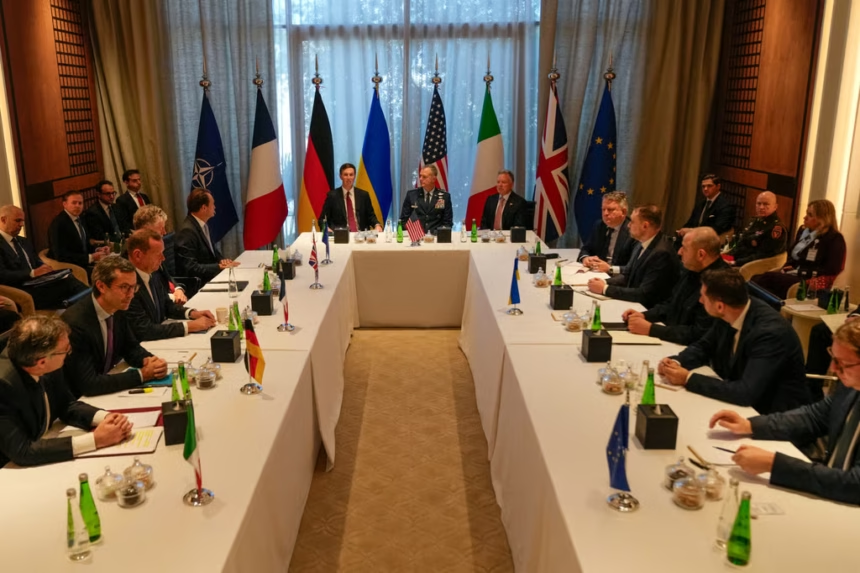
Ahead of the trilateral talks, US and Ukrainian representatives met with officials from the European Commission, the European Council, the United Kingdom, Germany, France, Italy and NATO.
The joint statements said participants had discussed mechanisms to manage security risks and prevent dangerous escalation. They also reaffirmed their commitment to a strong postwar European security framework, emphasizing that NATO would remain central to collective defence across the Euro-Atlantic region.
The discussions come as NATO allies face continued pressure from Washington to increase defence spending. Under an agreement reached amid US demands, members committed to raising their security and defence-related spending to 5 percent of gross domestic product by 2035. The Trump administration has also indicated that it intends to reduce American troop deployments in Europe.