Serbia faces a demanding reform agenda as it seeks to advance its European Union accession process, with democratic standards, the rule of law and institutional independence remaining key priorities, Julian Vassallo, Chargé d’Affaires of the EU Delegation to Serbia, said in Novi Sad.
Speaking at the presentation of the European Commission’s 2026 Annual Report on Serbia, Vassallo stressed that technical alignment with EU legislation cannot compensate for democratic backsliding, while progress in individual negotiating chapters cannot replace advances in fundamental areas.
He said the formation of a new government would mark the beginning of substantial work to ensure that European integration becomes a goal embraced by Serbian society as a whole, rather than remaining solely a government priority.
“Serbia will have to bridge divisions in society, rebuild trust in institutions, restore media independence and pluralism, and create space for honest dialogue on important issues, including what the European path actually entails,” Vassallo said.
He emphasized that the EU accession process must be based on facts and open debate rather than manipulation and distorted representations of reality.
“Candidate status requires a credible commitment that translates into concrete action. We welcome the willingness expressed by the winning list to place democracy and the rule of law at the centre of its policies. The European Union sees a strong and democratic Serbia as part of our Union, and we stand ready to work closely with the new government and support its reforms,” he said.
Vassallo described the new political mandate as an opportunity for a fresh start, arguing that Serbia has the potential to regain its position among the leading EU candidate countries if it adopts renewed priorities aligned with European standards.
He also said that Serbian voters had clearly expressed their expectations in the October 25 elections, calling for a fight against corruption, an independent judiciary, free media, democratic institutions and respect for human rights.
“These are the issues that have held back Serbia’s progress towards EU membership and lie at the heart of this year’s report. They also represent common ground and a genuine opportunity to move forward,” Vassallo stated.
According to the EU official, Serbia remains among the candidate countries with the highest levels of alignment with the EU acquis and is relatively well prepared for the single market and competition.
The European Commission’s report reiterates that Serbia has fulfilled the technical benchmarks for opening Cluster 3 of its accession negotiations, with progress in aligning legislation across several policy areas.
However, Vassallo warned that there had been no progress in accession negotiations overall and that the situation had deteriorated in some of the most important areas, particularly the rule of law and human rights. No progress was recorded in the judiciary.
He also pointed to setbacks in freedom of expression, public administration and academic freedom, as well as continued pressure on independent media.
The anti-corruption framework remains too weak, he warned, creating a very real risk of state capture.
Vassallo further stressed that Serbia’s European future requires moral clarity, arguing that the glorification of convicted war criminals is incompatible with European values.
“That undermines trust, undermines efforts to build good neighbourly relations between communities in this region, and also undermines the prospects of the entire region joining the European Union,” he said.
He also highlighted Serbia’s low level of alignment with the EU’s Common Foreign and Security Policy, describing this as an important consideration for a country seeking EU membership.
Addressing declining public support for European integration in Serbia, Vassallo acknowledged that successive governments had struggled most with reforms involving the judiciary, the rule of law and media independence.
However, he noted that the incoming government had placed these fundamental issues at the centre of its political platform.
He argued that the nature of public debate in Serbia must fundamentally change, adding that genuine discussion about EU membership would become possible once media freedom is guaranteed and civil society is no longer treated as a threat.
“Then we will have a debate based on facts rather than a distorted picture of reality. I believe that Serbs are an educated people who think independently and are best placed to reach their own conclusions about what is best for their country,” Vassallo concluded.
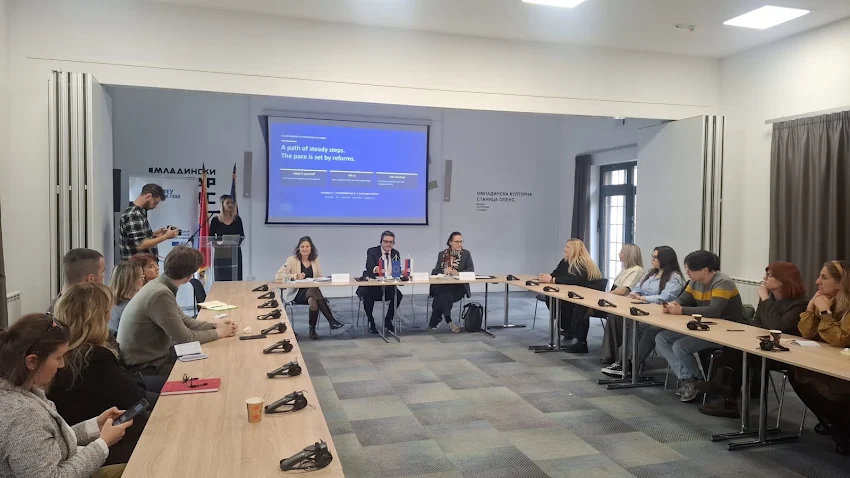
The EU Delegation in Serbia presented the European Commission’s 2026 Annual Report in Novi Sad on Monday to citizens, civil society organisations, students and representatives of the academic community.
Earlier, Vassallo handed over the report to Novi Sad Mayor Žarko Mićin.