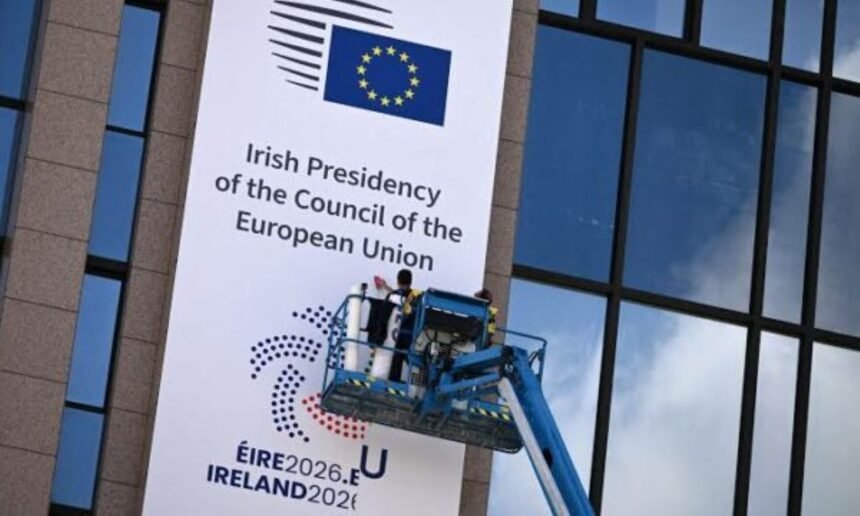
Following the official handover of the rotating Presidency of the Council of the European Union from Cyprus to Ireland on July 1, 2026, Dublin has signaled a conditionally positive approach toward Western Balkan integration. However, the Irish executive maintains that no shortcuts will be granted regarding Kosovo’s stalled membership application.
In an exclusive response to Gazeta Express, the newly minted Irish Presidency reaffirmed its core alignment with EU enlargement as a strategic geopolitical priority, while explicitly tying future advancement to the strict execution of domestic overhauls.
Enlargement as a Geostrategic Investment
Dublin’s six-month policy layout establishes enlargement as a primary tool for stabilizing the European perimeter.
“Ireland strongly supports the expansion of the European Union, which represents one of the main pillars of our EU Presidency,” the official statement to Gazeta Express outlined. “Ireland will support the progression of all candidate and potential candidate countries, including Kosovo, toward European Union membership, only where conditions are met and provided that all necessary reforms are fully implemented.”
                 [IRISH EU PRESIDENCY EXPANSION TRACK]
                                   │
         ┌─────────────────────────┴─────────────────────────┐
         ▼                                                   ▼
   [ACCELERATED ROUTE]                                 [CONDITIONAL ROUTE]
   ───────────────────                                 ───────────────────
   • Montenegro: Concluding final chapters            • Kosovo: Remains "Potential Candidate"
   • Ukraine & Moldova: Rapid advancement              • Stalled since initial Dec 2022 application
   • Albania: Fast-tracked negotiation phases          • Progress conditional on dialogue & reforms
Kosovo remains the only country in the region lacking official candidate status, having filed its application in December 2022 during the Czech Presidency. Since then, the dossier has remained functionally frozen in Brussels through successive rotations of both pro-recognition and non-recognizing member states.
Kosovo Risks Losing €40 Million in EU Growth Plan Funds
The domestic political deadlock in Pristina is already causing severe material setbacks. Parallel to Dublin’s messaging, Kosovo’s Chief EU Negotiator, Jeton Zulfaj, revealed that the country has failed to execute 6 out of 13 critical reform steps ahead of the finalized June 30 grace period extension under the EU’s €6 billion Western Balkans Growth Plan.
“For the steps that failed to finish within the additional period, the funds allocated for their completion are lost,” Zulfaj confirmed at a press conference. “Out of 13 steps… six have not been fully implemented. The financial cost of this failure is estimated to be over €40 million, with the exact figure to be finalized by the European Commission.”
Reports indicate Brussels is prepared to redirect unspent reform funds away from lagging administrations toward regional frontrunners making swift institutional progress, namely Montenegro, Albania, and North Macedonia.
Maliqi Warns of a New “European Border” at Kukës and Rozhaje
The rapid advancement of neighbouring states coupled with Kosovo’s self-inflicted stagnation has triggered deep concern among regional geopoliticians. Political analyst Agon Maliqi issued a stark warning, noting that if Pristina continues its populist trajectory, it risks severe geopolitical isolation.
“If Kosovo does not wake up and escape its decade-long populist intoxication over the Brussels-mediated dialogue, within 3 to 5 years, this could become the political map of the Balkans—with Kukës and Rozhaje serving as Europe’s hard borders with Kosovo,” Maliqi warned.
Maliqi stressed that the unintended consequence of radical “sovereigntist” rhetoric inside Kosovo is ironically driving the country deeper into an isolated orbit, completely reversing the long-standing integration trend with Albania due to the creation of a stringent external EU frontier.