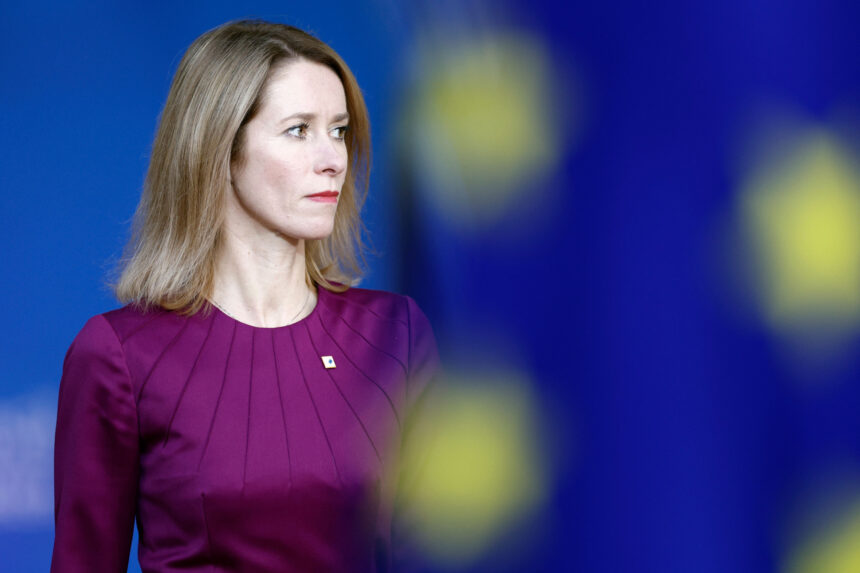
The Government of Israel has officially decided to sever all diplomatic contacts with the European Union’s High Representative for Foreign Affairs and Security Policy, Kaja Kallas. This drastic measure signals a sharp escalation in the already strained relations between Tel Aviv and the political leadership of the European bloc.
According to Israeli media reports, the decision follows continuous and sharp criticisms directed by Kallas toward Israeli policies in the Gaza Strip and the West Bank. It also responds directly to her outspoken support within the EU for punitive measures against Israeli settlements in Palestinian territories.
1. Israel’s Justification: One-Sided Approach and Settlement Pressures
Sources within the Israeli Foreign Ministry have stated that Kallas is pursuing a fundamentally biased and one-sided approach toward Israel, adding that her actions fail to contribute to advancing mutual dialogue or cooperation.
Core Drivers of the Direct Israel–Kallas Clash

 [ BIASED APPROACH ]       ──► CRITICISM OF GAZA & WEST BANK
 • The Israeli government claims Kallas's consistent, unmitigated criticism
   renders her an unfit diplomatic interlocutor.

 [ SANCTIONS ENGAGEMENT ]  ──► TARGETING WEST BANK SETTLEMENTS
 • Israel is reacting heavily against Kallas's active backing of EU-wide
   debates aimed at imposing restrictions on Israeli settlements.

 [ PERSONALIZED EMBARGO ]  ──► INSTITUTIONAL COMMUNICATION MAINTAINED
 • The ministry clarified that this communication freeze targets Kallas exclusively
   in her personal and political capacity, leaving lines open to other EU organs.
2. Kallas’s Platform: Advocating for International Law and Civilian Protection
Since assuming office as the EU’s top diplomat, Kallas has positioned herself as one of the most powerful European voices demanding increased diplomatic pressure on Israel due to the ongoing humanitarian crisis in Gaza.
Pillars of Kallas's European Foreign Policy Stance
┌────────────────────────────────────────────────────────────────────────┐
│                                                                        │
│  [ REVENUE FOR HUMAN RIGHTS ] ─────────────────────────────────────┐   │
│  • Kallas has consistently called for absolute adherence to            │   │
│    international humanitarian law and the protection of civilians.│
│                                                                        │   │
│  [ AID ACCESSIBILITY ] ────────────────────────────────────────────┤   │
│  • The High Representative has continuously pressured Tel Aviv to      │   │
│    facilitate unhindered access for humanitarian aid into war zones.│
│                                                                        │   │
│  [ SETTLER ACCOUNTABILITY ] ───────────────────────────────────────┘   │
│  • Over recent months, debates have intensified within the EU regarding│   │
│    restricting economic cooperation linked to occupied territories.│
└────────────────────────────────────────────────────────────────────────┘
3. The Impact on Long-Term EU–Israel Strategic Relations
While this diplomatic freeze marks a notable low point in formal communication, geopolitical experts assess that the blacklisting of Kallas does not mean an outright rupture in relations between Israel and the European Union.
| Sector of Cooperation | Current Operational Status | Long-Term Strategic Outlook |
| Economic Partnership | The European Union remains one of Israel’s most vital economic and political partners. | Unchanged: High-level bilateral cooperation across vital fields such as international trade, technology transfers, and security intelligence is fully expected to continue. |
| Bilateral Channels | Individual member states and alternative EU bodies remain open to independent diplomacy. | Divided Dynamics: Several EU member states have simultaneously demanded a review of cooperation agreements with Israel to force a sustainable ceasefire. |
| Settlement Debates | Recent EU discussions have focused on targeting extremist settlers accused of violence. | High Friction: Israel continues to strongly oppose these measures, branding them as unfair and entirely politically motivated. |
The decision comes at a time when relations between Tel Aviv and several European capitals have degraded significantly due to the war in Gaza. While everyday trade and defense channels will likely remain intact, this unprecedented move proves that tensions between the Israeli executive branch and European diplomacy have entered a volatile new phase, making a common understanding on the Middle East conflict harder to reach than ever.